
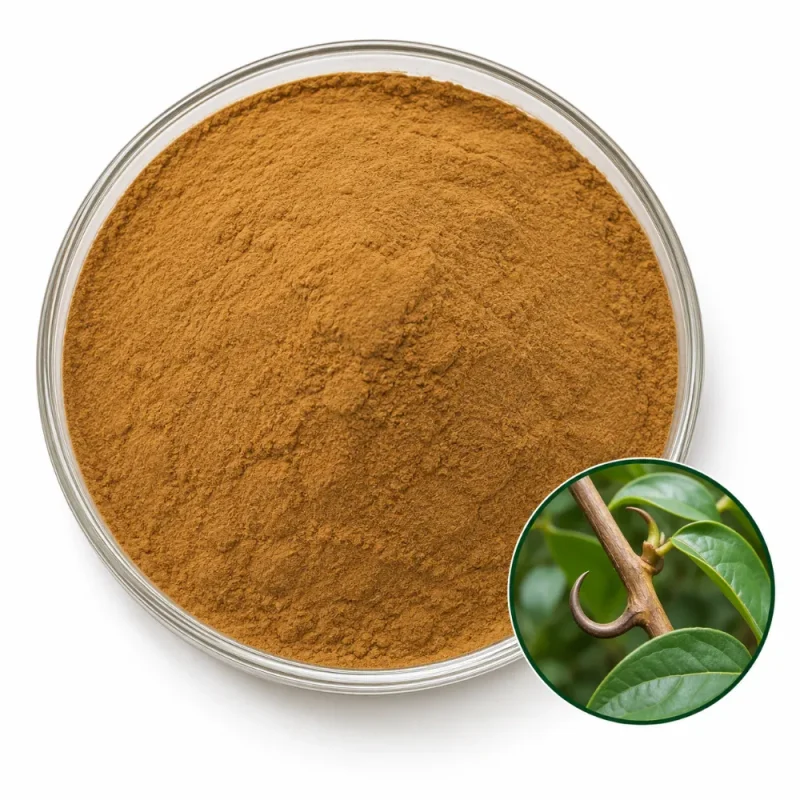
Uncaria Alkaloid Standardization & Grades
The stems and hooks of Uncaria rhynchophylla carry tetracyclic oxindole alkaloids, rhynchophylline and isorhynchophylline, with the indole alkaloids corynoxeine, hirsutine and hirsuteine. Rhynchophylline and isorhynchophylline are stereoisomers that convert into each other in solution until an equilibrium is reached. Uncaria rhynchophylla extract is standardized to total alkaloids because the class covers this interconverting family, and the figure shows how far the stem has been concentrated.
The botanical entity is Uncaria rhynchophylla (Miq.) Miq., and the part is the hook-bearing stem. The curved hooks are modified branches, and the straight stem between them holds less alkaloid. The species is different from Uncaria tomentosa, the cat’s claw of South America, which is used for its bark and carries pentacyclic oxindole alkaloids of another type. The same stem is supplied as a 10:1 ratio extract with no marker figure, the Uncaria Hook Extract Powder.
| Grade | Assay & Method | Where It Fits |
|---|---|---|
| 5% Total Alkaloids | Total alkaloids | Blends, larger inclusion |
| 20% Total Alkaloids | Total alkaloids | Capsules and tablets, small fill |
The 20% grade carries four times the alkaloid load per gram, so a capsule or tablet reaches its target with a small charge. The 5% grade is bulkier and easier to blend. A formulator can scale between the grades by weight alone, since both are expressed on the same basis.
The extract is made from hook-bearing stems that are cut, dried, ground and extracted, then concentrated and purified. Higher strengths come from acid-base partition steps that take the alkaloids into acidic water, remove neutral material and recover the bases at higher pH.


