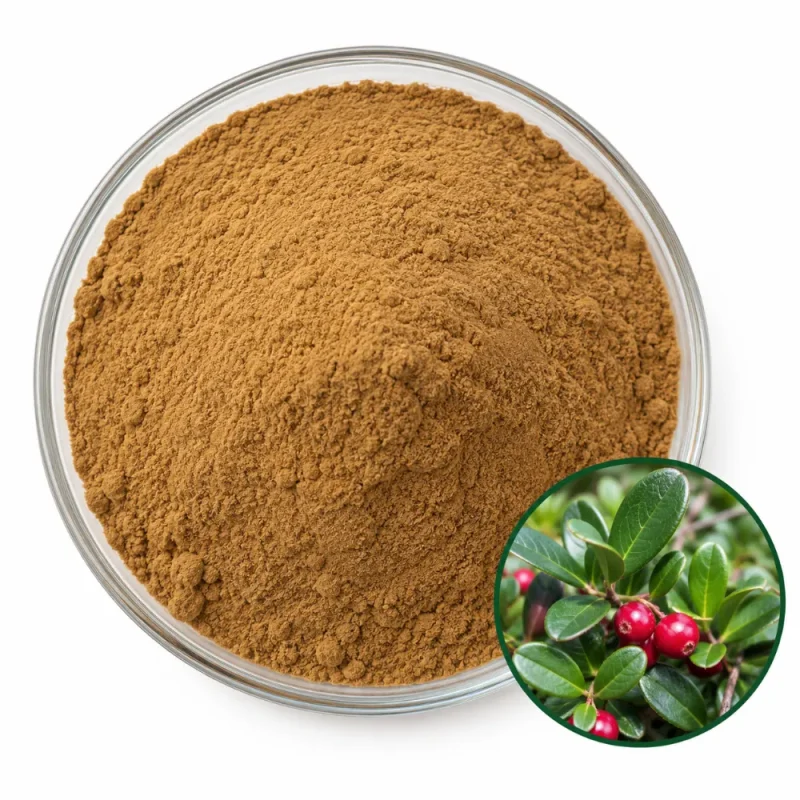
Uva Ursi / Bearberry Extract 20–40% Arbutin

Uva ursi extract, also sold as bearberry extract, is prepared from the leaves of Arctostaphylos uva-ursi (L.) Spreng., a low evergreen shrub of the family Ericaceae that grows across northern temperate regions. Ethanol extraction concentrates the hydroquinone glycoside fraction of the leaf, and the concentrate is dried to a light brown powder that dissolves in water.

Arbutin is measured by HPLC, with a primary grade of 40% and a lower grade of 20%. The powder is 80 mesh. The 40% grade suits capsules and tablets, while the 20% grade suits drink powders and bulk blends.

Arbutin Standardization & Grades

Arbutin is hydroquinone linked to glucose through a beta-glycosidic bond. It is the signature compound of the bearberry leaf, which holds it together with methylarbutin in smaller amounts, gallotannins, flavonoids and phenolic acids. Acid, heat or the plant’s own enzymes can cleave the sugar and free hydroquinone, so the quality of an arbutin extract is judged by the arbutin level and by how little free hydroquinone it carries. Uva ursi extract is standardized to arbutin because the compound is the defining and measurable marker of the leaf.

The botanical entity is Arctostaphylos uva-ursi (L.) Spreng., and the part is the leaf. Lingonberry leaf (Vaccinium vitis-idaea) looks similar and also contains arbutin, but it belongs to a different genus and is not accepted as a source. The same leaf is supplied as a 10:1 ratio extract with no marker figure, Bearberry Leaf Extract Powder, and the single compound is available as Arbutin.

GradeAssay & MethodWhere It Fits
20% ArbutinHPLCDrink powders, bulk blends
40% ArbutinHPLCCapsules and tablets, small fill

The 40% grade carries twice the arbutin of the 20% grade per gram, so a capsule or tablet reaches its target with a smaller charge. The 20% grade is bulkier and carries more of the leaf tannins. Both grades are read on the same HPLC basis, so they scale by weight.

The extract is made from dried leaf that is cleaned of stems and discolored material, extracted, filtered, concentrated and dried at controlled temperature. Higher strengths come from further purification, which removes the gallotannins and chlorophyll and leaves a pale, glycoside-rich powder.

Arbutin Analysis & Purity Risks

An HPLC assay separates arbutin from methylarbutin, hydroquinone, gallic acid and the other leaf phenolics and reads it as a distinct peak against a reference standard. It counts one defined molecule and not a group, and the basis is the dried powder. An arbutin figure cannot be compared with a UV total polyphenol value or with a total hydroquinone derivative figure.

The chromatogram is read for hydroquinone as well. Free hydroquinone is a degradation product of arbutin and is limited in finished products, so its peak is followed as an impurity marker. A lot with a clear hydroquinone peak has been exposed to acid, heat or enzyme action, and it is reviewed before use. Gallotannins can also interfere with a UV-only method, so a diode array and a good column are used to keep the arbutin peak pure.

Purity risks follow from the material class. The leaf of Arctostaphylos uva-ursi is the defined part, and the related Arctostaphylos pungens, a Mexican manzanita, has been reported as a substitute with another phenolic pattern. Lingonberry leaf also contains arbutin. Synthetic arbutin, which is not a plant extract, can be added to raise a figure, so the leaf phenolic pattern is read beside the main peak to confirm a leaf origin.

Harvest and drying also matter. Leaves collected in autumn and dried quickly carry the most arbutin, and a slow, warm drying converts part of it.

Uva ursi leaves are evergreen and leathery, and they are collected in autumn from wild stands in many regions. Heavy harvest of wild stands is limited, so supply varies from year to year. An uva ursi extract is therefore made from blended leaf lots, and the HPLC arbutin figure of each lot guides the blend before extraction.

Typical Specifications

Specification ItemProduct Information
Latin NameArctostaphylos uva-ursi
Plant PartLeaf & Herb
ProcessingEthanol Extraction
Compound ClassPolyphenols
Common NameUva Ursi, Bearberry
Ingredient TypeStandardized Extract
Marker Compound(s)Arbutin
Primary Grade40% Arbutin (HPLC)
Available Grades20% · 40% Arbutin (HPLC)
AppearanceLight Brown powder
Solubility / DispersibilityWater Soluble
Quality Parameters
Moisture (LOD)≤5.0%
Total Ash≤5.0%
Particle Size80 mesh
Heavy MetalsLead ≤2 ppm · Arsenic ≤1 ppm · Cadmium ≤1 ppm · Mercury ≤0.1 ppm
MicrobiologyTPC ≤1,000 cfu/g · Yeast & Mold ≤100 cfu/g · E. coli Negative · Salmonella Negative/25 g
Shelf Life24 months in unopened original packaging, cool and dry storage

Applications by Grade

40% Grade for Capsule Fills

The 40% grade reaches its arbutin target in a small capsule fill. The powder is fine and slightly hygroscopic, so a dry filling room and a flow agent keep the hopper from bridging, and a check weight at the start of each run confirms the fill.

20% Grade in Drink Powders

The 20% grade of uva ursi extract dissolves in cold water to a clear to slightly hazy brown drink with a mild astringent edge. A neutral to slightly acidic pH keeps arbutin intact, and strongly acidic, hot drinks are avoided because they split the glycoside.

40% Grade in Tablet Blends

Tablets of the 40% grade need a dry binder and a lubricant. A film coat limits moisture pickup and hides the brown core, and the tablets are stored dry, because moisture and warmth let enzymes and acid release free hydroquinone.

20% Grade for Herbal Tea Granules

Granules for hot water take the 20% grade with a soluble carrier. The tea is brewed at a moderate temperature and not boiled for long, since extended heat at low pH converts arbutin, and the sachet label tells the user to infuse and not to simmer.

40% Grade for Powder Premixes

Premixes carry the 40% uva ursi grade in a larger dry blend with a bulking carrier. Blend the pale brown particles in two steps with part of the carrier, because a single large addition leaves uneven pockets in the batch.

20% Grade for Stick-Pack Mixes

In stick packs the 20% grade is diluted with a bulking carrier to a higher gram weight. The extract dissolves, but the tannins give a drying mouthfeel, so a sweet fruit base or a mild sweetener keeps the finished drink pleasant.

Technical & Quality Considerations

Uva ursi extract is a light brown powder with a faint tea-like scent and a bitter, astringent taste. It dissolves readily in water, and the solution is clear to slightly hazy brown. Arbutin is stable at neutral and mildly acidic pH at room temperature. It is hydrolyzed by acid with heat and by the plant enzyme beta-glucosidase, releasing hydroquinone, which oxidizes to a brown quinone, so a darkening solution is a sign of breakdown.

Hydroquinone and the leaf phenolics oxidize on contact with air, and iron and copper speed the process. Contact with carbon steel darkens the powder, so stainless surfaces and iron-poor fillers are preferred. Antioxidant carriers and low-oxygen packaging protect liquid formats.

The powder takes up moisture from the air and clumps in humid storage. Desiccant liners and cool storage keep the flow steady. Compare each lot with a retained sample for color, and read the hydroquinone peak on stability samples. A new check weight is needed whenever the line changes grade, since the two powders differ widely in bulk.

Packaging & Commercial Supply

Essencefield supports product evaluation, formulation trials, commercial orders, and ongoing ingredient supply. Packaging, storage, and shipping arrangements are determined by product characteristics, order quantity, stability requirements, and destination-market needs.

Supply ItemGeneral Information
SampleAvailable upon request for formulation, testing, and supplier evaluation
Order Quantities100 g · 1 kg · 5 kg · 25 kg · 100 kg · 500 kg · Bulk
Sample Lead TimeTypically 5–7 days after sample confirmation
Production Lead TimeTypically 15–30 days after order and specification confirmation
PackagingSuitable protective inner packaging with bags, cartons, drums, or other appropriate outer packaging
StorageStore in tightly sealed, suitable protective packaging in a cool, dry environment. Protect from moisture, heat, and direct sunlight. Specific storage conditions follow the approved product specification.
DocumentationCOA · Product Specification · TDS · SDS · Applicable declarations (as applicable)

Final order quantities, lead times, packaging, documentation, and shipping arrangements are confirmed according to the selected product and commercial requirements.

Request Ingredient Specifications & Quote

Share your target specification, application, quantity, and documentation needs. We’ll help confirm suitable options, samples, and commercial supply details.