
Alpha-Amylase Inhibitor Standardization & Grades
The seed of the common bean stores a family of proteins that inhibit the starch-digesting enzyme alpha-amylase. The best-known is phaseolamin, a glycoprotein of about 50 kDa that binds the enzyme and blocks its active site. The extract is standardized by the activity of this protein, because the protein is not a small molecule with a fixed mass fraction, and activity is the property that identifies the material. A mass percentage would not describe it.
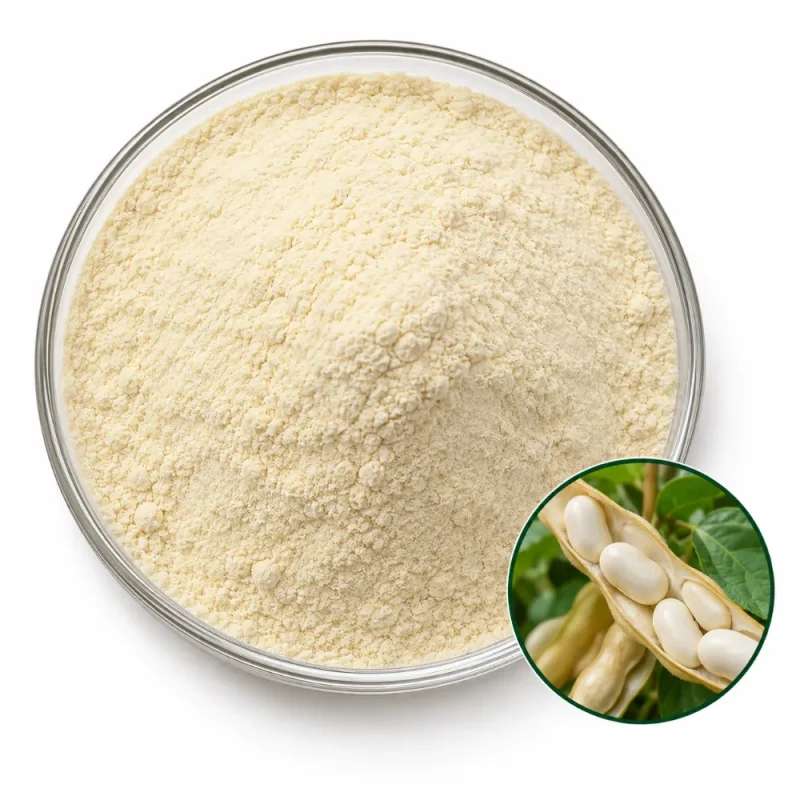
The botanical entity is Phaseolus vulgaris L., and the part is the seed. White, red, kidney and black beans all belong to the same species, and they differ in seed coat. White-seeded types are chosen here because the seed coat holds fewer pigments and the extract is paler. The same species is supplied as a 10:1 ratio extract with no marker figure, White Kidney Bean Extract Powder, and as milled bean, Kidney Bean Powder and Black Bean Powder.
| Grade | Assay & Method | Where It Fits |
|---|---|---|
| 3,000 units/g | Enzymatic (alpha-amylase inhibition) | Dry blends, larger inclusion |
| 20,000 units/g | Enzymatic (alpha-amylase inhibition) | Capsules and tablets, small fill |
The 20,000 units per gram grade carries more than six times the activity of the 3,000 grade, so a capsule or tablet reaches its target with a small charge. The lower grade is bulkier and fits blends where the extract is one component among several. Both grades are read by the same enzymatic method, so scaling is a matter of weight.
The extract is made by soaking and extracting the ground seed with water, separating the protein-rich fraction, and drying it at moderate temperature. Unlike a small molecule, an inhibitor protein loses its activity when it is heated hard, so the drying conditions define the final unit value.


