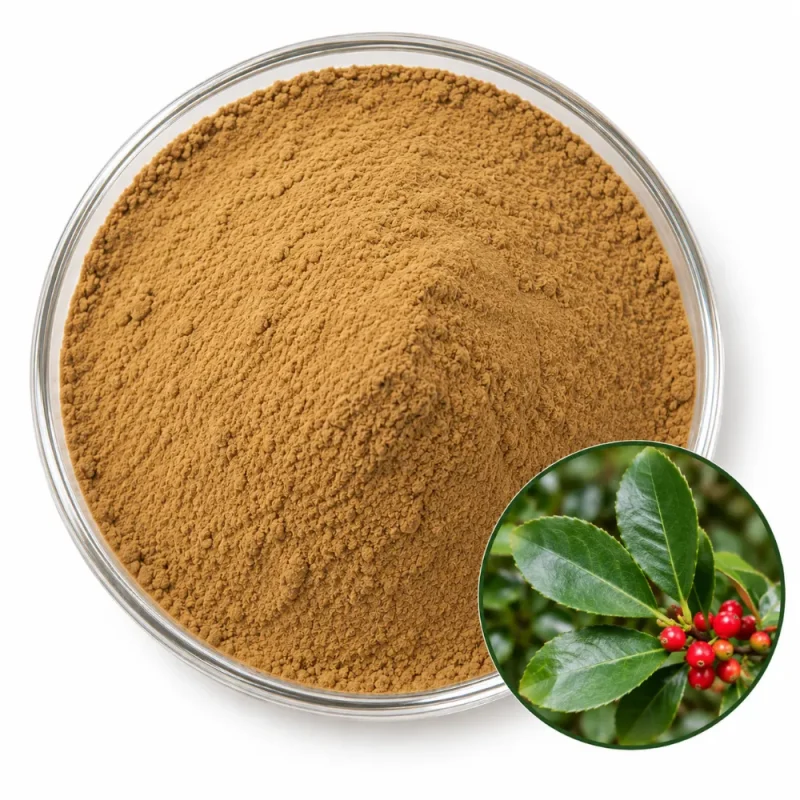
Yerba Mate Extract 8–20% Caffeine

Yerba mate extract is prepared from the leaves of Ilex paraguariensis A.St.-Hil., a holly tree of the family Aquifoliaceae grown in the subtropical forests and plantations of South America. Ethanol extraction concentrates the xanthine alkaloids of the leaf, and the concentrate is dried to a light brown powder that dissolves in water.

Caffeine is measured by HPLC, with a primary grade of 20% and a lower grade of 8%. The powder is 80 mesh. The 20% grade is for capsules and tablets, and the 8% grade is for drink powders and bulk blends.

Caffeine Standardization & Grades

Caffeine is a methylxanthine alkaloid, a purine derivative with three methyl groups. The leaf of yerba mate holds it together with theobromine and traces of theophylline, chlorogenic acids, flavonoids such as rutin, and triterpenoid saponins called matesaponins. Yerba mate extract is standardized to caffeine because the compound is the best-known and most easily measured constituent of the leaf, and the figure expresses how far the leaf has been concentrated.

The botanical entity is Ilex paraguariensis A.St.-Hil., and the part is the leaf, with a small share of thin twig. Other caffeine-containing hollies exist, among them guayusa (Ilex guayusa) and yaupon (Ilex vomitoria), and they are different plants. The same leaf is supplied as a 10:1 ratio extract with no marker figure, Yerba Mate Extract Powder, and as milled leaf, Yerba Mate Leaf Powder. Purified caffeine from plant sources is available separately as Natural Caffeine 99%.

GradeAssay & MethodWhere It Fits
8% CaffeineHPLCDrink powders, bulk blends
20% CaffeineHPLCCapsules and tablets, small fill

The 20% grade carries two and a half times the caffeine of the 8% grade per gram, so a capsule or tablet reaches its target with a smaller charge. The 8% grade is bulkier and carries more of the leaf’s chlorogenic acids and saponins, which gives it a more herbal, slightly smoky character in a dissolved drink.

The extract is made from dried, milled leaf that may be green or lightly roasted before extraction. The concentrate is filtered, purified and dried, and higher strengths come from additional partition or resin steps that take out the chlorogenic acids and saponins.

Caffeine Analysis & Purity Risks

An HPLC assay separates caffeine from theobromine, theophylline and the phenolic acids and reads it as a distinct peak against a reference standard. A single alkaloid is quantified, not a class, and the value is stated on the dry basis. A caffeine figure cannot be compared with a total alkaloid value, and it cannot be combined with a theobromine figure.

Caffeine is a fairly robust analyte. It has strong absorbance near 273 nm, it is stable in solution and it shows little interference, so the method is straightforward. The difficulty lies in identity, because caffeine is common to coffee, tea, guarana, cola and mate, and the figure alone does not identify the plant. The fingerprint of chlorogenic acid isomers, rutin and the theobromine ratio is what ties the extract to yerba mate.

For that reason the theobromine peak is part of the review. Mate carries a higher theobromine share than coffee and a lower one than cocoa, and a lot in which the ratio is outside the expected range is held for review. Added caffeine, which is cheap and soluble, can raise a figure without changing the leaf profile, and the fingerprint reveals it.

Purity risks follow from the material class. The leaf is the defined part, and wood and large stems dilute the caffeine. Smoked, traditionally dried leaf carries polycyclic aromatic compounds from the drying fire, so the starting leaf is checked for that kind of contamination, and the extract is made from leaf dried in a controlled kiln.

Typical Specifications

Specification ItemProduct Information
Latin NameIlex paraguariensis
Plant PartLeaf & Herb
ProcessingEthanol Extraction
Compound ClassAlkaloids
Common NameYerba Mate
Ingredient TypeStandardized Extract
Marker Compound(s)Caffeine
Primary Grade20% Caffeine (HPLC)
Available Grades8% · 20% Caffeine (HPLC)
AppearanceLight Brown powder
Solubility / DispersibilityWater Soluble
Quality Parameters
Moisture (LOD)≤5.0%
Total Ash≤5.0%
Particle Size80 mesh
Heavy MetalsLead ≤2 ppm · Arsenic ≤1 ppm · Cadmium ≤1 ppm · Mercury ≤0.1 ppm
MicrobiologyTPC ≤1,000 cfu/g · Yeast & Mold ≤100 cfu/g · E. coli Negative · Salmonella Negative/25 g
Shelf Life24 months in unopened original packaging, cool and dry storage

Applications by Grade

20% Grade for Capsule Fills

The 20% grade of yerba mate extract reaches its caffeine target in a small capsule fill. Being fine and mildly hygroscopic, the powder needs a dry room and a flow agent to keep the hopper clear, and the fill is confirmed with a check weight.

8% Grade in Drink Powders

The 8% grade of yerba mate extract dissolves in cold water to a clear to slightly hazy brown drink with a grassy, slightly smoky mate flavor. Citrus, mint and ginger flavor bases suit it, and sweetener choice matters because the bitterness of caffeine and the astringency of the leaf combine.

20% Grade in Tablet Blends

Tablets of the 20% yerba mate grade need a dry binder and a lubricant. A film coat masks the bitter taste and limits moisture pickup. Hardness is rechecked after storage because the extract is hygroscopic and the tablet softens in humid air.

8% Grade for Instant Tea-Style Granules

Granules for hot or cold water carry the 8% grade with a soluble carrier. The mate flavor carries well in iced tea formats, and a light haze can develop on cooling as polyphenols and caffeine form complexes, which is why clarity is checked in the cold.

20% Grade for Stick-Pack Mixes

Stick-pack mixes carry the 20% grade in a bulking carrier at a small gram weight. The dose of caffeine per stick is calculated and labeled carefully, and the powder is blended in two steps to avoid hot spots of the strongly bitter alkaloid.

8% Grade for Chewable and Gummy Bases

Chewable and gummy bases take the 8% grade as a flavor-contributing ingredient. Add it after the main cook, because long heating deepens the brown color, and test the finished product for bitterness, which gummies cover less well than drinks.

Technical & Quality Considerations

Yerba mate extract is a light brown powder with a green, slightly smoky scent and a bitter, astringent taste. It is water soluble, and the solution is clear brown. Caffeine is stable to heat and across a wide pH range, so it survives pasteurization and baking. The chlorogenic acids are the less stable fraction, since they isomerize and hydrolyze with heat and alkali, and the color of a hot-held drink deepens.

Chlorogenic acids and flavonoids bind iron, which turns the powder and the solution dark, so carbon-steel surfaces and iron-containing fillers are avoided. Caffeine also forms complexes with polyphenols, and in a cold or concentrated drink a fine cream-like haze appears. Dilution and warmth redissolve it.

The powder takes up moisture and cakes in humid storage. A sealed liner with desiccant and a cool store hold the extract in a pourable condition. Compare each lot with a retained sample for color and aroma, since roasting depth shifts the tone, and take a new check weight whenever the line changes between the two grades, because their bulk differs.

Packaging & Commercial Supply

Essencefield supports product evaluation, formulation trials, commercial orders, and ongoing ingredient supply. Packaging, storage, and shipping arrangements are determined by product characteristics, order quantity, stability requirements, and destination-market needs.

Supply ItemGeneral Information
SampleAvailable upon request for formulation, testing, and supplier evaluation
Order Quantities100 g · 1 kg · 5 kg · 25 kg · 100 kg · 500 kg · Bulk
Sample Lead TimeTypically 5–7 days after sample confirmation
Production Lead TimeTypically 15–30 days after order and specification confirmation
PackagingSuitable protective inner packaging with bags, cartons, drums, or other appropriate outer packaging
StorageStore in tightly sealed, suitable protective packaging in a cool, dry environment. Protect from moisture, heat, and direct sunlight. Specific storage conditions follow the approved product specification.
DocumentationCOA · Product Specification · TDS · SDS · Applicable declarations (as applicable)

Final order quantities, lead times, packaging, documentation, and shipping arrangements are confirmed according to the selected product and commercial requirements.

Request Ingredient Specifications & Quote

Share your target specification, application, quantity, and documentation needs. We’ll help confirm suitable options, samples, and commercial supply details.