Water-soluble botanical extracts contain constituents that dissolve in water under defined conditions; water-dispersible extracts distribute as suspended particles or droplets without fully dissolving. The difference shows up in beverage clarity, sedimentation, mixing behavior and physical stability. Choosing a grade therefore takes more than checking whether a powder mixes with water — one ingredient may disperse quickly but settle in storage, while another dissolves in purified water yet hazes after acidification or heat processing. This guide covers the technical differences, commercial examples, application testing and supplier qualification. For the broader picture of soluble, dispersible and insoluble forms, see Botanical Extract Solubility.
How Botanical Extracts Dissolve or Disperse
Solubility and dispersibility are different physical behaviors. Both matter in beverages, powdered products and liquid supplements, but they are not interchangeable.
Water-Soluble Extracts
A water-soluble extract contains compounds that can dissolve into an aqueous phase at a specified concentration. IUPAC defines solubility in terms of the composition of a saturated solution, which for botanicals means it depends on the constituent, solvent conditions and concentration. Because an extract is a mixture with varied physicochemical properties, some compounds dissolve readily while others stay partly insoluble, so a commercial “water-soluble” grade may have a large dissolved fraction without every constituent in true solution. Appearance is a separate matter: dissolved compounds can add yellow, red or brown color without causing turbidity.
Water-Dispersible Extracts
A water-dispersible extract spreads through water while some constituents remain as particles or droplets, forming a suspension, emulsion or colloidal dispersion depending on composition and processing. A poorly soluble compound may be brought into water with carriers, emulsifiers or particle processing, which improves mixing without necessarily raising its intrinsic molecular solubility. Performance depends on particle or droplet size, surface characteristics, viscosity and interactions with other ingredients. The ISO/TR 13097:2013 technical report gives general guidance on characterizing dispersion stability through changes in physical properties over time; actual acceptance limits must be set for the product and storage conditions.
Key Differences at a Glance
| Property | Water-Soluble Extract | Water-Dispersible Extract |
|---|---|---|
| Behavior in water | Constituents dissolve within applicable solubility limits | Undissolved particles or droplets distribute through water |
| Physical state | Solution for the dissolved fraction | Suspension, emulsion, or colloidal dispersion |
| Appearance | Clear, colored, or sometimes hazy | Cloudy, translucent, or optically clear |
| Sedimentation | Not expected from constituents that remain dissolved | Possible depending on dispersion stability |
| Main concerns | Precipitation, solubility limits, chemical degradation | Aggregation, sedimentation, creaming, separation |
| Key measurements | Dissolved fraction, marker assay, clarity | Turbidity, particle behavior, settling, redispersibility |
| Main selection priority | Maintain acceptable dissolution and compatibility | Maintain uniform distribution and physical stability |
The core distinction is between dissolution, which yields a homogeneous solution, and dispersion, which distributes a separate phase through the liquid. Neither guarantees shelf life, marker retention or finished-product compatibility on its own.
What Influences Solubility and Dispersibility?
Water behavior depends on chemical composition, processing history and the surrounding formulation, so two grades of the same plant can perform differently because of constituent concentration, particle characteristics or carriers.
Botanical Chemistry and Polarity
Hydrophilic constituents such as some organic acids, glycosides and polyphenols may dissolve under suitable conditions, while lipophilic ones such as some terpenoids and curcuminoids are harder to use in water. Chemical class alone does not predict a whole extract, though: structure, ionization, interactions and the botanical matrix all affect dissolution and stability. Buyers need botanical identity, constituent profile, marker assay and the measured behavior of the actual grade.
Extraction, Particle Size, and Carrier Systems
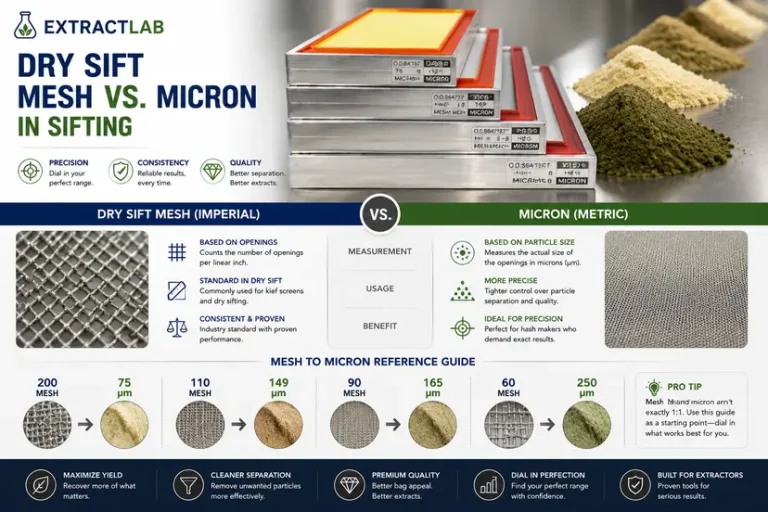
A water-made extract does not necessarily stay fully water-soluble after concentration and drying, and a hydroalcoholic extract can still contain constituents suited to aqueous use — see water vs ethanol extraction. Downstream steps add more differences: size reduction can improve wetting or dissolution rate (see Particle Size & Mesh Size Explained), and spray-drying, agglomeration and instantization improve handling and reconstitution. Formulated grades may contain maltodextrin, gum arabic, modified starch, lecithin or other carriers that affect dispersion, stability and the share of botanical constituents in the product. In Nanoemulsions as Delivery Systems for Lipophilic Nutraceuticals, Seung Jun Choi and David Julian McClements describe how engineered colloids help incorporate hydrophobic compounds. Improved dispersibility, higher equilibrium solubility and increased human bioavailability are separate claims, each needing its own evidence.
pH, Temperature, and Concentration
Higher concentrations can exceed the solubility of some constituents; temperature shifts affect dissolution, precipitation, particle interactions and chemical stability; pH changes ionization, pigment structure and compatibility; and minerals, proteins, acids and flavors add further interactions. That is why an extract that behaves well in purified water can misbehave in an acidic beverage or concentrated formulation, and why screening should use the intended concentration and processing conditions.
Choosing the Right Grade for Beverages and Supplements
Product formats need different combinations of clarity, dispersion stability, sensory performance and processing compatibility, so start by defining what the finished product must achieve and then select a grade that can meet it.
Clear and Cloudy Beverages
In clear ready-to-drink (RTD) beverages, the concern is whether the grade keeps acceptable appearance and marker concentration through formulation, processing and storage. A suitable soluble extract simplifies development, and some engineered dispersions achieve acceptable optical clarity, although visual transparency does not prove molecular dissolution. Cloudy beverages prioritize uniformity, sedimentation and redispersibility over transparency, while concentrated shots add viscosity, flavor intensity and mouthfeel. Polyphenol-rich ingredients need attention to protein compatibility: a green tea extract that performs well in water may haze in a protein-containing beverage. Our Functional Beverages page covers how form, concentration and processing influence grade choice.
Instant Drink Powders and Liquid Supplements
Instant powders must work under real consumer preparation: a material that disperses under lab high-shear mixing may clump when hand-stirred into cold water, so wetting time, floating, reconstitution and visible residue are key screens. Liquid supplements can carry dispersed ingredients if sedimentation and dose uniformity stay acceptable through storage and use. Gummies bring texture, distribution and processing-temperature requirements, and full molecular dissolution is not always needed when suspended material suits the product.
Application Selection Matrix
| Product format | Preferred screening direction | Main evaluation |
|---|---|---|
| Clear RTD beverage | Soluble or optically compatible engineered grade | Clarity, precipitation, marker retention |
| Cloudy functional beverage | Stable soluble or dispersible grade | Sedimentation, uniformity, sensory properties |
| Botanical wellness shot | Grade compatible with concentrated loading | Redispersibility, viscosity, stability |
| Instant drink powder | Fast-wetting soluble or dispersible powder | Reconstitution, clumping, residue |
| Liquid supplement | Stable solution or dispersion | Dose uniformity, separation |
| Gummies | Ingredient compatible with homogeneous processing | Texture, heat exposure, distribution |
These are screening priorities rather than universal specifications.
Processing, Packaging, and Storage Compatibility
Evaluate the grade through the full production sequence, not just initial mixing. Heating, cooling, filling, oxygen exposure and storage can change clarity, sedimentation, color or marker retention — an RTD beverage can look fine before processing and haze after cooling — and instant powders can take up moisture in storage, affecting flow, agglomeration and reconstitution, which makes packaging protection important. Account for these when moving from lab samples to pilot and commercial production.
How Different Botanical Ingredients Behave in Water
The examples below show why analytical concentration, ingredient form and aqueous performance must be judged separately. They are drawn from published Essencefield Botanicals product information and are not results from a single comparative study.
Green Tea Extract: Marker Strength vs Instant Grades
Green tea extract comes from Camellia sinensis leaves and contains characteristic polyphenols, including catechins such as EGCG, with commercial grades differing in polyphenol level, catechin profile, caffeine content and preparation. Our Green Tea Extract Powder lists these published options:
| Grade | Tea polyphenols | Total catechins | EGCG |
|---|---|---|---|
| High-Marker | 98% | 80% | 50% |
| Balanced | 50% | 30% | 15% |
| Instant / Water-Soluble | Grade-dependent | Grade-dependent | Grade-dependent |
The high-marker and balanced grades are different analytical concentrations; instant/water-soluble formats are further options whose marker content and physical performance must be confirmed for the chosen grade. The published primary specification uses UV for total tea polyphenols and HPLC for total catechins and EGCG — different analytical targets that are not interchangeable. For beverages, compare catechin loading, wetting, clarity, astringency, pH compatibility and storage performance; a higher EGCG percentage does not by itself mean better aqueous compatibility.
Echinacea Extract: A Water-Dispersible Standardized Grade
Our Echinacea Extract 4% Polyphenols, from Echinacea purpurea, is supplied as an 80-mesh powder standardized to 4% total polyphenols, and its published specification describes it as dispersible in water. That can suit powdered drinks and other formulations where a controlled dispersion is acceptable, with testing at use level for wetting, haze, suspended solids, sedimentation and flavor. The 4% figure covers a broad compound group rather than an individual marker such as chicoric acid; total-polyphenol assays and single-compound measurements are not interchangeable, so confirm analyte definition, method, reporting basis and acceptance range rather than comparing percentages.
Turmeric Extract: High Curcuminoid Content and Limited Solubility
The principal curcuminoids of Curcuma longa — curcumin, demethoxycurcumin and bisdemethoxycurcumin — have limited intrinsic water solubility. Our Turmeric Extract Powder is specified at ≥95% total curcuminoids by HPLC and described as poorly soluble in water, so it suits applications where concentrated curcuminoids are wanted but is difficult to put directly into clear beverages. Engineered curcumin dispersions use encapsulation, emulsification or carriers to improve water incorporation and should be compared on curcuminoid loading, carrier content, dispersion behavior, appearance and stability. A conventional 95% powder and an engineered water-dispersible ingredient are different materials, to be evaluated separately — particularly where a supplier makes added absorption or bioavailability claims.
Hibiscus: Water-Soluble Pigments in a Native Botanical Powder
Our Hibiscus Flower Powder is an 80–100 mesh native powder of dried Hibiscus sabdariffa calyces rather than a standardized extract. It keeps finely milled plant solids alongside naturally occurring anthocyanins: the water-soluble pigments give red color while insoluble material may stay suspended and cause haze or sediment. Anthocyanin stability also depends on pH, temperature, oxygen and light, as discussed in Anthocyanins: Factors Affecting Their Stability and Degradation. Whole botanical powders and refined extracts should not be assumed to behave the same way in water.
Testing Solubility and Dispersion Stability
Testing should separate immediate reconstitution from longer-term physical, chemical and sensory performance, because a powder that mixes well at first can still fail on appearance, marker retention or stability.
Physical, Chemical, and Sensory Stability
Physical stability covers turbidity, aggregation, sedimentation, creaming and phase separation, assessed by visual observation, turbidity measurement, particle analysis and redispersibility testing. Chemical stability covers oxidation, degradation or conversion of important markers, for which HPLC or another validated stability-indicating method may suit. Sensory stability covers changes in bitterness, astringency, aroma, color perception and mouthfeel. A physically uniform beverage can still degrade chemically, and one with good marker retention can still throw sediment, so evaluate each separately.
How to Compare Water and Finished-Beverage Performance
A controlled comparison helps show whether a problem comes from the botanical, the beverage base or processing. An initial design might be:
| Sample | Purpose |
|---|---|
| Beverage base without extract | Identify instability or haze originating in the base |
| Extract in purified water | Establish baseline ingredient behavior |
| Extract in unprocessed beverage base | Screen for matrix interactions |
| Complete beverage after processing | Evaluate combined formulation and processing effects |
To isolate processing effects, compare matched unprocessed and processed samples of the same complete formulation. The screen narrows possible causes without proving causation; if pH or temperature is suspected, vary that factor while controlling the others, and prepare all samples at defined concentrations with documented mixing.
Marker Recovery vs Chemical Degradation
A lower marker value in a filtered beverage sample does not necessarily mean degradation — some constituent may have gone into sediment, been removed by filtration, or been affected by analytical recovery or matrix interference. Where appropriate, compare validated whole-sample results with the clarified liquid and separated material; a drop in EGCG in filtered green tea beverage, for instance, needs investigation before being blamed on catechin degradation. The distinction matters because fixing precipitation calls for different action than fixing chemical instability.
Test Results and Acceptance Criteria
A practical screening record should capture ingredient identity, exact grade and lot; concentration and matrix; temperature, pH, mixing method and preparation time; initial dissolution or dispersion; clarity, turbidity, sedimentation and redispersibility; marker results and relevant fractions; processing and storage observations; and the predefined acceptance criteria and decision. Criteria should be fixed before approval — a clear RTD may need strict turbidity control, while a naturally cloudy drink may tolerate suspended material if uniformity and acceptability hold — and critical properties should then go into the purchasing specification. For batch qualification, our Quality & Testing page covers identity, markers, physical parameters and batch-specific requirements.
Common Mixing and Stability Problems
Problems often appear after initial mixing; identifying the likely mechanism first helps avoid changing the grade or process unnecessarily.
| Observed problem | Possible cause | Recommended investigation |
|---|---|---|
| Floating powder | Poor wetting or surface characteristics | Addition sequence and mixing conditions |
| Persistent clumps | Agglomeration or incomplete hydration | Premixing, wetting, powder handling |
| Unexpected haze | Suspended particles or matrix interactions | Turbidity, formulation composition, particle behavior |
| Sediment during storage | Insoluble solids or particle aggregation | Settling, particle distribution, redispersibility |
| Precipitation after cooling | Temperature-dependent solubility | Controlled temperature and concentration testing |
| Haze after pH adjustment | Ionization changes or aggregation | pH response and ingredient interactions |
| Color fading | Pigment degradation or oxidation | Oxygen, light, temperature, pH |
| Instability after scale-up | Different mixing, heating, or processing conditions | Laboratory-to-production process comparison |
These are possible causes, not diagnoses. Floating powder may reflect poor wetting rather than low equilibrium solubility; sedimentation is existing particles settling, whereas precipitation is dissolved material forming a new phase; and with polyphenol-rich extracts, haze can come from protein interactions, which testing the ingredient alone, the base alone and the combination can help pin down. Separate physical change from chemical degradation, since a formulation can keep its marker level while becoming visibly unstable, or look uniform while a sensitive compound degrades. Troubleshooting starts with identifying which property changed.
Comparing Ingredient Grades and Supplier Specifications
A technically suitable ingredient also has to meet consistent commercial specifications, so qualification should tie together identity, composition, physical performance, documentation and purchasing requirements.
Native Extract, Carrier Content, and Marker Assay
A plant-to-extract ratio relates starting material to extract yield on a defined basis and does not establish the concentration of every important constituent, and native extract and finished powder differ when carriers or excipients are added. Understanding Plant to Extract Ratios in Botanical Extracts explains why ratios should be read alongside extraction conditions, composition and excipients. Confirm whether a declared ratio or assay refers to the native extract or the finished material, and where relevant have the specification state carrier type and proportion and the analytical basis for the marker — especially when comparing concentrated standardized extracts with instant or formulated dispersible grades.
Marker Loading and Cost-in-Use
The highest marker percentage is not always the most economical. In an illustrative example, a formulation needing 40 mg of a marker per serving would use 200 mg of a 20% grade or 80 mg of a 50% grade; at hypothetical prices of $30/kg and $60/kg, that works out to $0.0060 and $0.0048 per serving. These figures are not Essencefield quotations; they show that price per kilogram may not reflect the cost of delivering a marker. A full assessment also weighs carrier composition, compatibility, manufacturing losses and processing efficiency, and a cheaper marker cost is of little value if the grade causes haze, sediment or flavor problems.
COA, TDS, and Regulatory Suitability
A Technical Data Sheet (TDS) generally describes a grade and its intended characteristics; a Certificate of Analysis (COA) gives results or conformity information for a particular lot. For aqueous formulations, confirm whether solubility or dispersibility claims rest on defined test conditions. The commercial specification may need to cover identity and plant part; ingredient type and grade; marker assay, method and reporting basis; ratio and carrier composition where relevant; particle characteristics and aqueous behavior; physical and chemical quality requirements; representative sampling and batch documents; intended category and market; and quantity, packaging and supply. Regulatory suitability is separate from physical performance — an ingredient that disperses well is not automatically permitted in every beverage or supplement category. For the U.S., the FDA’s guidance on determining the regulatory status of a food ingredient explains why identity, specifications and intended conditions of use matter; verify the actual ingredient, carriers, use and target market before approval.
From Representative Sample to Commercial Supply
A representative sample shows whether a grade meets formulation and analytical requirements, but sample approval is not commercial batch approval: pilot processing can reveal effects of mixing energy, heating, holding time or addition sequence. Once a sample is approved, the purchasing specification should name the critical parameters that must stay consistent — marker assay, carrier composition, water behavior and other agreed characteristics. Our Specification & Grade Matching service compares available grades against formulation requirements, analytical targets and purchasing criteria. Before ordering, confirm the approved grade, test methods, acceptance criteria, sample information and batch documentation.
Choosing by Measured Performance
The choice between water-soluble and water-dispersible extracts depends on the finished formulation rather than on supplier terminology. A clear beverage may need low turbidity and stable dissolution, while a cloudy drink or powdered supplement needs acceptable dispersion and reconstitution. Reliable selection combines chemical composition, grade specifications, controlled formulation testing and batch qualification, with the aim of approving an ingredient that delivers the required marker content and performs consistently through processing, storage and commercial supply — which is a higher bar than mixing easily with water.
Request a Botanical Extract Specification and Sample
If you are developing a clear functional beverage, botanical shot, instant drink powder or liquid supplement, share your target botanical, marker specification, intended concentration and required water behavior. We can review suitable grades from our Botanical Extracts and Standardized Extracts ranges, technical documentation and sample options through our Sample & Bulk Supply service. Contact Essencefield Botanicals to request an ingredient specification and sample.
Technical note: Commercial ingredient specifications are based on published Essencefield Botanicals product information. Application recommendations, screening methods and hypothetical cost calculations are provided for formulation and purchasing guidance rather than as measured results from a particular production batch.