
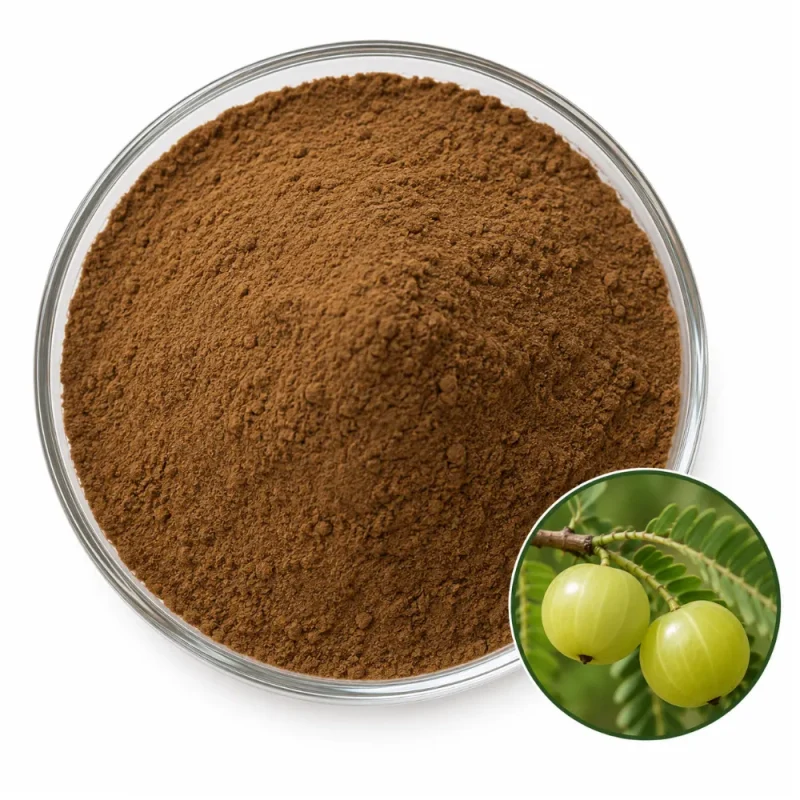
Tannin Standardization & Grades
Tannins are polyphenols that bind proteins and give plant tissue its astringency. Amla fruit holds mainly hydrolyzable tannins, esters of gallic acid and ellagic acid with a sugar core, and the compounds named emblicanin A and B and punigluconin belong to this group. Free gallic acid and ellagic acid are also present in smaller amounts. The grade reports the total tannin content of the extract and does not name a single compound. The botanical entity is Phyllanthus emblica L., a tree of the family Phyllanthaceae, and the part used is the fruit.
The grade is a single level at 40%, so the choice is between amla materials and not between tiers. Amla fruit is also supplied as a 10:1 ratio extract, the Amla Extract Powder, as a spray-dried fruit powder, the Amla Powder, and as a freeze-dried powder, the Freeze-Dried Amla Powder. Those forms hold the fruit matrix with its fiber, sugars and acids and carry no tannin figure. The 40% grade is a tannin concentrate that supplies a defined polyphenol load from a small fill and is more astringent than the whole fruit. Amla extract is therefore a different tool from amla powder, and amla extract at 40% should be dosed by its tannin figure, not by fruit weight.


