
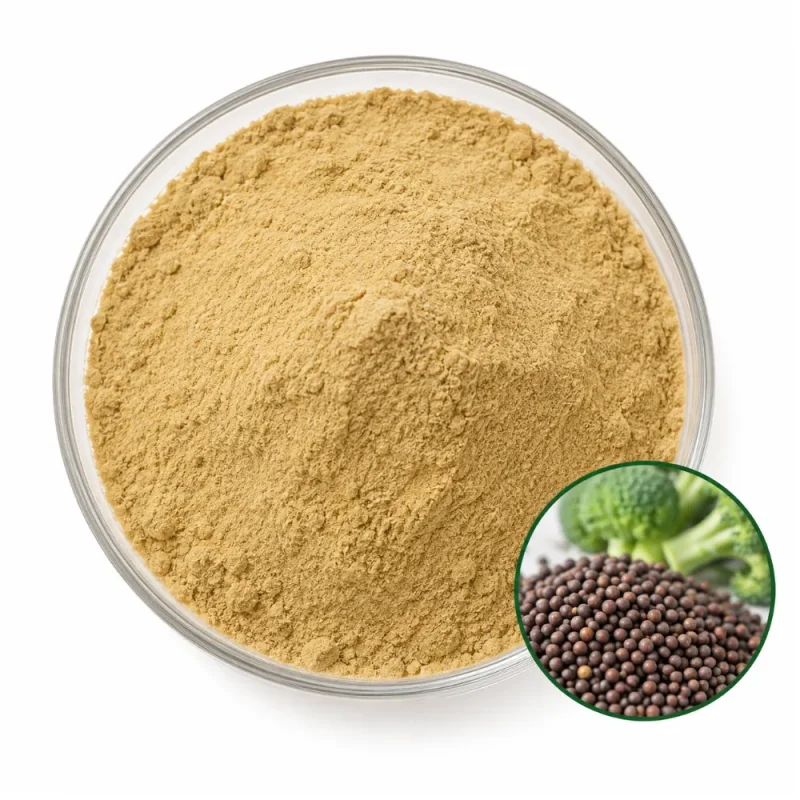
Glucoraphanin Standardization & Grades
Glucoraphanin is a glucosinolate, a sulfur-containing glycoside that is stable while the plant tissue is intact. When the seed or the leaf is crushed and wetted, the plant enzyme myrosinase converts glucoraphanin to the isothiocyanate sulforaphane. The extract is standardized to the precursor because it is the stable form that can be measured as a single compound, and because seeds hold far more of it than the florets. The botanical entity is Brassica oleracea var. italica Plenck, and the part used is the seed.
| Grade | Assay & Method | Where It Fits |
|---|---|---|
| 5% Glucoraphanin | HPLC | Drink powders and blended premixes |
| 30% Glucoraphanin | HPLC | Capsules and tablets with small fill |
The two grades differ by a factor of six. The 30% grade is a precursor concentrate that supplies a defined load from a small fill. The 5% grade holds more of the seed matrix, the sugars, the proteins and the sinapic acid esters, so broccoli seed extract at this level is bulkier and suits drink powders and blended premixes. The seed is also supplied as a 10:1 ratio extract, the Broccoli Seed Extract Powder, the whole plant as the Broccoli Extract Powder, and the converted isothiocyanate as the purified compound Sulforaphane 98%. A glucoraphanin extract is not a sulforaphane product, and the two should not be read as interchangeable. Broccoli seed is the richest broccoli material for glucoraphanin, while the broccoli floret that is eaten as a vegetable holds much less, so a broccoli extract made from the seed is a very different ingredient from one made from the whole plant. Broccoli seed extract at 30% is the more concentrated of the two grades.


