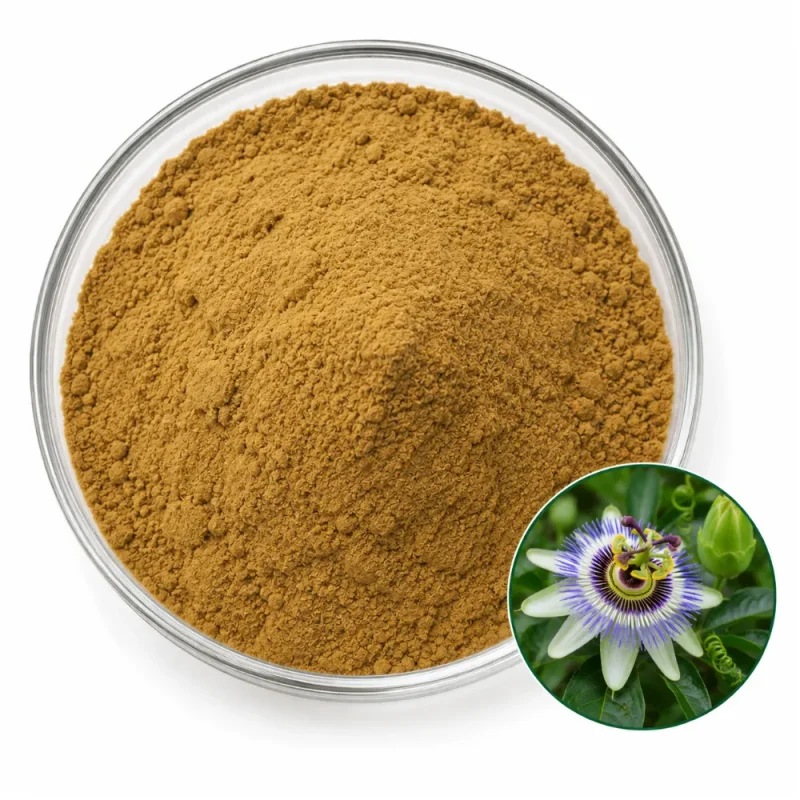
Passionflower Extract 4% Total Flavonoids as Vitexin

Passionflower extract is prepared from the aerial parts of Passiflora incarnata, the purple passionflower of the southeastern United States, and not from the fruit-bearing Passiflora edulis or from the root. Ethanol extraction takes up the flavonoids of the leaf and stem, and the liquor is dried to a light brown powder.

The grade is 4% total flavonoids expressed as vitexin by UV, a colorimetric total. The powder is 80 mesh and slightly soluble in water. A single grade is supplied, which suits capsules, tablets and dry herbal blends that need a defined flavonoid load from a common herbal ingredient.

Flavonoid Standardization & Grades

Flavonoids are plant phenols built on a three-ring skeleton. In Passiflora incarnata the main members are C-glycosyl flavones, in which a sugar is joined to the flavone skeleton through a carbon bond that resists hydrolysis. The best known are vitexin, isovitexin, orientin and isoorientin. The grade expresses the total flavonoid response on vitexin as the reference, which fixes the basis of the percentage. The botanical entity is Passiflora incarnata L., a climbing vine of the Passifloraceae, and the part used is the aerial herb.

For passionflower, the grade is a single level at 4%, so there is no tier to choose between. The choice is between passionflower materials. The herb is also supplied as a 10:1 ratio extract, the Passionflower Extract Powder, which carries no marker figure, as a milled herb, the Passionflower Herb Powder, and as the purified flavone Isoorientin 98%. Passionflower extract at this level is a flavonoid concentrate of the herb, and passionflower extract is a simple name for several differently standardized products. Industry extracts of this plant are commonly standardized either to isovitexin by HPLC or to vitexin by UV, and a figure expressed on one basis is not comparable with one expressed on the other.

Flavonoid Analysis & Purity Risks

The flavonoid figure is measured by UV. This is a colorimetric method: the sample forms a colored complex with a metal salt reagent, and the absorbance is read against vitexin. The result is expressed as vitexin equivalents and counts every flavonoid that gives the reaction. It is not an HPLC result, and it cannot be converted into a figure for isovitexin or for any other single member.

The expression on vitexin matters. A different reference flavonoid would give a different percentage for the same extract, because each flavone responds differently in the assay. Sample preparation affects the reading too.

HPLC is used beside the UV total to show the pattern of C-glycosyl flavones. A passionflower chromatogram has a recognizable cluster of vitexin, isovitexin, orientin and isoorientin, and the relative sizes of these peaks identify the species. The UV total counts all of them, but it does not distinguish them, so the pattern gives the identity check that the total cannot.

Purity risks follow from the genus. Passiflora is a large genus, and Passiflora edulis, the fruit-bearing passion fruit, and Passiflora caerulea, the blue passionflower, are different species with different leaf chemistry. A stated species, the aerial parts as the plant part and the flavone pattern are the first identity checks. Other flavonoid-rich leaves can raise a colorimetric reading without adding the characteristic C-glycosides. Passionflower is a vine whose leaves and stems are cut while the plant is in flower, and the aerial herb is the standard material for this extract.

Typical Specifications

Specification ItemProduct Information
Latin NamePassiflora incarnata
Plant PartLeaf & Herb
ProcessingEthanol Extraction
Compound ClassFlavonoids, Polyphenols
Common NamePassionflower, Maypop, Purple Passionflower
Ingredient TypeStandardized Extract
Marker Compound(s)Total flavonoids expressed as vitexin (C-glycosyl flavones)
Primary Grade4% Total Flavonoids as Vitexin (UV)
AppearanceLight Brown powder
Solubility / DispersibilitySlightly Soluble in Water
Quality Parameters
Moisture (LOD)≤5.0%
Total Ash≤5.0%
Particle Size80 mesh
Heavy MetalsLead ≤2 ppm · Arsenic ≤1 ppm · Cadmium ≤1 ppm · Mercury ≤0.1 ppm
MicrobiologyTPC ≤1,000 cfu/g · Yeast & Mold ≤100 cfu/g · E. coli Negative · Salmonella Negative/25 g
Shelf Life24 months in unopened original packaging, cool and dry storage

Applications by Grade

Single Grade for Compact Capsules

For passionflower, for passionflower, the single grade fills capsules and tablets with a defined flavonoid load. For passionflower, the light brown powder is slightly soluble in water and hygroscopic, so fill in a dry room and keep a desiccant in the closure of the bottle.

Herb Extract in Tablet Blends

Tablets need a dry binder and a moisture-tolerant filler, because flavonoid powders take up water and soften compacts. A film coat covers the bitter, grassy taste of the herb, and a sealed blister limits humidity during storage.

Herb Extract in Dry Herbal Blends

Dry blends combine the powder with hops, lemon balm, chamomile or valerian extracts. Pre-blend it with a portion of the carrier to avoid streaks, since the light brown powder is easy to confuse with its neighbors in a visual check.

Herb Extract in Tea-Style Mixes

Tea-style mixes use the powder with mint, citrus peel or chamomile. The powder is only slightly soluble and gives a hazy, yellow-brown infusion, so a filter bag or a note to stir keeps the cup uniform.

Herb Extract in Drink Powders

Drink powders carry the extract with fruit and herbal flavors and a sweetener. The slightly soluble solid forms a haze, so a thickener holds the particles in suspension, and a taste trial shows how much of the grassy note the base can cover.

Herb Extract in Softgel Fills

For passionflower, for passionflower, softgel fills can carry the powder as a milled suspension in oil. For passionflower, the slightly soluble solid does not dissolve in oil, so particle size and a suspending agent decide whether the fill stays uniform through storage.

Technical & Quality Considerations

The extract is a light brown powder with a faint, grassy odor and a mildly bitter, astringent taste. The C-glycosyl flavones resist hydrolysis better than the usual O-glycosides, so passionflower extract tolerates acid and heat well, but the flavonoids still darken on contact with iron and copper and fade slowly in light.

Sieve before blending to break up soft agglomerates and fold the extract into a portion of the carrier. A fine flow aid helps the powder through hoppers and feeders, and dedicated scoops avoid cross-contact with pale products.

Compare each lot with a retained sample for color, odor and the flavone pattern. Stainless steel and glass are the right contact materials, and a cool, dry store in a sealed liner keeps the powder free-flowing through shelf life. A retained sample from each lot, tested again near the end of shelf life, shows whether the packaging holds the flavonoid figure and the color together. Taste trials with the final flavor system should use the intended dose, because the grassy note of passionflower builds at higher fills.

Passionflower extract is the easier of the herbal extracts to blend, because its taste is mild, but the fine powder can dust at transfer points, so closed transfers and a dust mask for open handling keep the area clean.

Packaging & Commercial Supply

Essencefield supports product evaluation, formulation trials, commercial orders, and ongoing ingredient supply. Packaging, storage, and shipping arrangements are determined by product characteristics, order quantity, stability requirements, and destination-market needs.

Supply ItemGeneral Information
SampleAvailable upon request for formulation, testing, and supplier evaluation
Order Quantities100 g · 1 kg · 5 kg · 25 kg · 100 kg · 500 kg · Bulk
Sample Lead TimeTypically 5–7 days after sample confirmation
Production Lead TimeTypically 15–30 days after order and specification confirmation
PackagingSuitable protective inner packaging with bags, cartons, drums, or other appropriate outer packaging
StorageStore in tightly sealed, suitable protective packaging in a cool, dry environment. Protect from moisture, heat, and direct sunlight. Specific storage conditions follow the approved product specification.
DocumentationCOA · Product Specification · TDS · SDS · Applicable declarations (as applicable)

Final order quantities, lead times, packaging, documentation, and shipping arrangements are confirmed according to the selected product and commercial requirements.

Request Ingredient Specifications & Quote

Share your target specification, application, quantity, and documentation needs. We’ll help confirm suitable options, samples, and commercial supply details.