
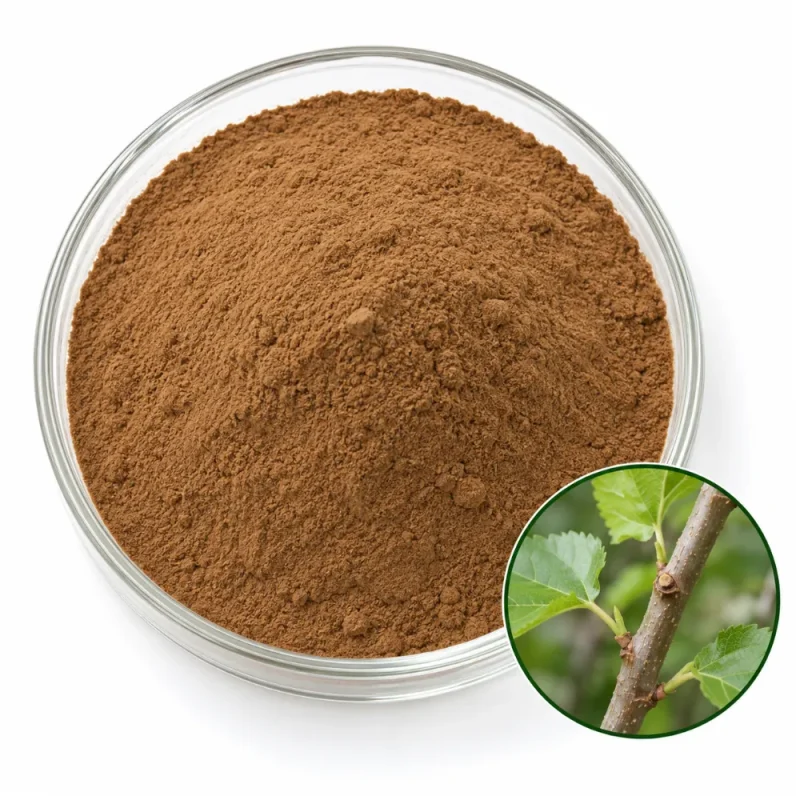
Mulberry Twig Identity & Plant Part
The species is Morus alba L., the white mulberry, family Moraceae. The part used is the twig, called sang zhi in Chinese herbal practice and Ramulus Mori in pharmacopeial trade. It is the thin, current-year branch of the tree, cut into slices and dried before extraction. The root bark, the leaf, the fruit and the thick older branches are not included in this mulberry twig extract. Mulberry twig is a lignified material, so its extract is drier and woodier in character than a leaf or berry extract.
Twig chemistry differs from that of the other parts. Literature on the genus describes stilbenes such as oxyresveratrol and its glucoside mulberroside A in the wood and branches, along with flavonoids, while the fruit carries anthocyanins and the leaf carries iminosugars. The product name and the part therefore matter: a berry extract is purple and sweet-tart, whereas a twig extract is woody and bitter. The names black mulberry, Morus nigra, and red mulberry, Morus rubra, belong to other species and are not interchangeable with the white mulberry.


