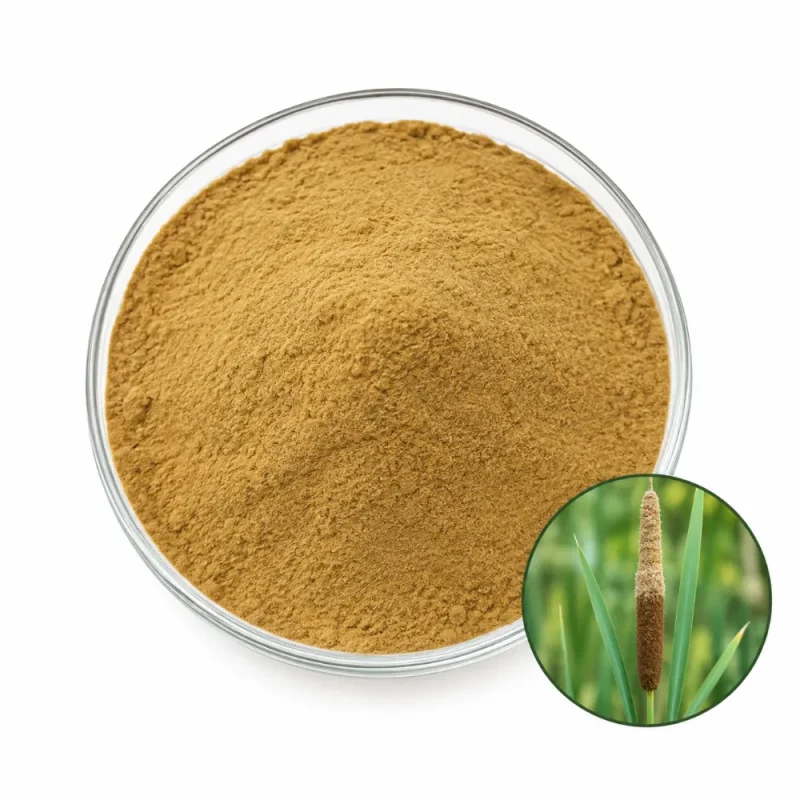
Cattail (Typha) Pollen Extract Powder

Cattail pollen, the golden dust of the narrow-leaved cattail Typha angustifolia known as puhuang in Chinese herbal practice, is the only plant material behind this extract. The pollen is extracted in water, concentrated and dried to a yellow powder. Leaves, stems and the brown seed spikes are not used.

This cattail pollen extract is a 10:1 ratio extract with no marker assay and no flavonoid figure. The powder is milled to 80 mesh and disperses in water. No constituent percentage is stated, so the product is defined by species, part and ratio.

Typha angustifolia Pollen Source & Identity

The botanical entity is Typha angustifolia L., a tall marsh plant of the cattail family, Typhaceae, common in wetlands of the northern hemisphere. The part used is the pollen, a fine yellow dust shed from the male flower spike that sits above the brown female spike. Leaves, rhizomes and the spike itself are not part of this cattail pollen extract.

Pollen from other sources is a different material. Bee pollen is collected by honeybees from many flowers, pine pollen comes from Pinus, and the broad-leaved cattail, Typha latifolia, is a related species. Chinese pharmacopoeial texts accept pollen from T. angustifolia, T. orientalis and other plants of the same genus as puhuang.

Flavonoids, including isorhamnetin and typhaneoside, together with polysaccharides and sterols, are the constituent families of the pollen.

What 10:1 Means for Typha angustifolia

The 10:1 ratio measures pollen going into the extract. It is not a flavonoid assay. Pollen grains have a tough outer wall that resists water, so a water extract draws out the soluble fraction rather than the whole grain, and the ratio describes how much pollen is concentrated into the powder.

Naming the pollen source is the main identity step for buyers. A cattail pollen extract, a bee pollen extract and a pine pollen extract are three unrelated ingredients, and the species and part, Typha angustifolia pollen, settle the question for this product.

Typical Specifications

Specification ItemProduct Information
Latin NameTypha angustifolia
Plant PartFlower
ProcessingWater Extraction
Common NameNarrow-Leaved Cattail, Bulrush Pollen
Ingredient TypeRatio Extract
Extract Ratio10:1
AppearanceYellow powder
Solubility / DispersibilityWater Dispersible
Quality Parameters
Moisture (LOD)≤5.0%
Total Ash≤5.0%
Particle Size80 mesh
Heavy MetalsLead ≤2 ppm · Arsenic ≤1 ppm · Cadmium ≤1 ppm · Mercury ≤0.1 ppm
MicrobiologyTPC ≤1,000 cfu/g · Yeast & Mold ≤100 cfu/g · E. coli Negative · Salmonella Negative/25 g
Shelf Life24 months in unopened original packaging, cool and dry storage

Application Areas

Capsules for a Fine Pollen Extract

Cattail pollen extract fills hard capsules after a flow check at 80 mesh. Pollen-derived powders are fine and can be static, so check flow and dust at the filling station and keep the hopper covered. If the cattail pollen powder bridges in the hopper, add a glidant and keep the hopper covered between runs.

Tablets with Neutral Fillers

For cattail pollen, choose a dry binder for the compression blend and hold the lubricant back until the end of mixing. Flavonoid-bearing extracts can change tone with alkaline excipients, so choose neutral fillers and compare tablet colour and hardness at pressing and after a week of storage. A film coat covers the yellow core.

Golden Drink Sticks

The yellow tone of cattail pollen extract suits drink sticks for warm or cold drinks. The powder disperses in water to a golden, lightly hazy liquid, and honey, citrus or ginger flavours match the colour. Test colour and sediment at the planned dose before choosing the stick fill weight.

Sachets in Sugar Carriers

Stick-pack blends place the cattail pollen extract in a bulking carrier for accurate filling. Sieve it into the carrier before filling to spread the yellow tone evenly, and run a dose-uniformity check at the start, middle and end of the filling run, because fine powders can segregate.

Bar and Gummy Premixes

In a bar, add the cattail pollen powder to the dry ingredients first and bring in the syrup afterwards. The yellow colour shows in pale bases, so honey, lemon or turmeric-style products hide it best, and a colour check after a week of storage shows whether the tone fades.

Formulation Notes

Cattail pollen extract is a yellow powder with a faint, pollen-like smell and a mild taste. In water it forms a golden dispersion with light haze, and a small amount of fine particle may settle on standing. Flavonoid colour can fade in strong light, so opaque or amber packaging protects finished beverages.

Sprinkle the cattail pollen powder into stirred water, or paste it with a little liquid first, so that no dry lumps form. For cattail pollen, sieve once with the carrier, then blend; this avoids concentrated specks in the dry mix. For cattail pollen, return the opened drum to a dry store with the liner pressed flat and sealed.

Packaging & Commercial Supply

Essencefield supports product evaluation, formulation trials, commercial orders, and ongoing ingredient supply. Packaging, storage, and shipping arrangements are determined by product characteristics, order quantity, stability requirements, and destination-market needs.

Supply ItemGeneral Information
SampleAvailable upon request for formulation, testing, and supplier evaluation
Order Quantities100 g · 1 kg · 5 kg · 25 kg · 100 kg · 500 kg · Bulk
Sample Lead TimeTypically 5–7 days after sample confirmation
Production Lead TimeTypically 15–30 days after order and specification confirmation
PackagingSuitable protective inner packaging with bags, cartons, drums, or other appropriate outer packaging
StorageStore in tightly sealed, suitable protective packaging in a cool, dry environment. Protect from moisture, heat, and direct sunlight. Specific storage conditions follow the approved product specification.
DocumentationCOA · Product Specification · TDS · SDS · Applicable declarations (as applicable)

Final order quantities, lead times, packaging, documentation, and shipping arrangements are confirmed according to the selected product and commercial requirements.

Request Ingredient Specifications & Quote

Share your target specification, application, quantity, and documentation needs. We’ll help confirm suitable options, samples, and commercial supply details.