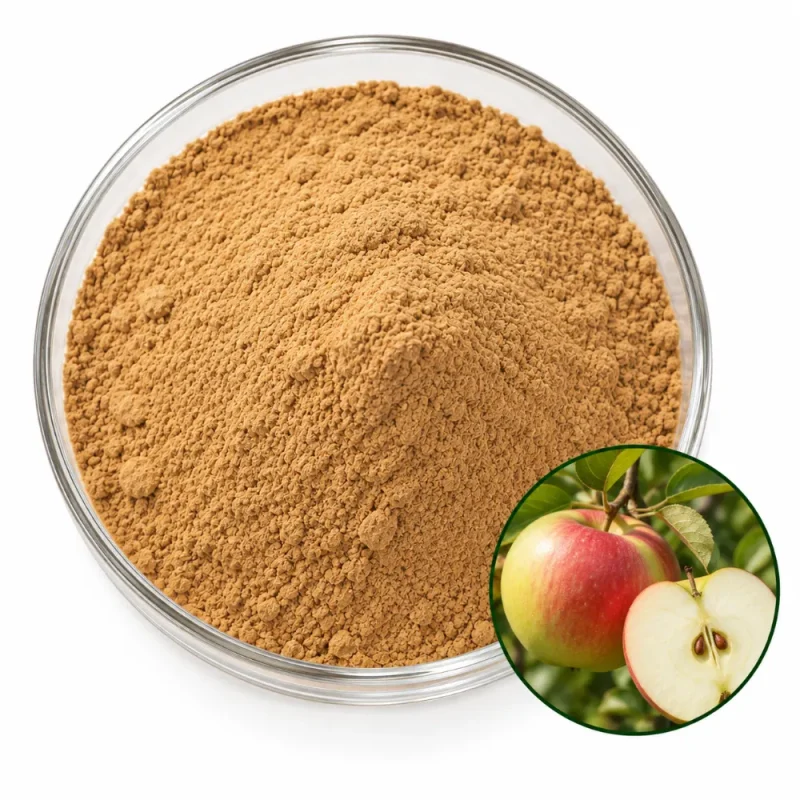
Apple Polyphenols Extract 40–80% Total Polyphenols

Apple polyphenols extract is prepared from the fruit of Malus domestica, the cultivated apple, and not from apple pomace sold as dietary fiber or from apple cider vinegar, which are separate ingredients. Ethanol extraction concentrates the procyanidins, dihydrochalcones and phenolic acids of the fruit, and the liquor is dried to a light yellow, water-soluble powder.

The primary grade is 80% total polyphenols by UV using the Folin-Ciocalteu reagent, with 40% as the lower end of the range. The powder is 80 mesh. The 80% grade serves capsules, tablets and drink sticks with a small fill, while the 40% grade suits beverage bases and gummy premixes.

Polyphenol Standardization & Grades

Total polyphenols in apple fruit are a mixed class. Procyanidins, built from catechin and epicatechin units, usually make up the largest share, and they sit beside chlorogenic acid, the dihydrochalcone phloridzin and flavonol glycosides of quercetin. The grade sums this class without naming one compound, because the apple has no single dominant marker comparable with a tea catechin. The botanical entity is Malus domestica (Suckow) Borkh., and the part used is the fruit.

GradeAssay & MethodWhere It Fits
40% Total PolyphenolsUV (Folin-Ciocalteu)Beverage bases and gummy premixes
80% Total PolyphenolsUV (Folin-Ciocalteu)Capsules, tablets and drink sticks

Grade choice follows dose, fill weight and taste. The 80% grade holds twice the polyphenol load per gram of the 40% grade, so a capsule reaches its target in a smaller fill, but its astringency is stronger. The 40% grade retains more of the fruit sugars and organic acids and gives a rounder, apple-like character. Other apple ingredients are the unstandardized Apple Extract Powder and the dried fruit Apple Powder, which carries no polyphenol figure. The fermented Apple Cider Vinegar Powder is a separate vinegar product and not a substitute for either.

A Folin-Ciocalteu result measures reducing capacity and is usually expressed as an equivalent of one reference phenol such as gallic acid. Buyers who compare apple polyphenols extract quotes should therefore ask which reference compound sits behind the number, because a figure calibrated against catechin and another calibrated against gallic acid describe the same powder with different values.

Since immature apples are richer in polyphenols than ripe ones, raw material maturity influences the starting point of the extraction. The finished grade is fixed by the specification, not by the fruit, but it explains why the polyphenol profile of an apple extract can differ between lots at the same percentage.

Polyphenol Analysis & Purity Risks

Both grades are measured by UV with the Folin-Ciocalteu reagent, a colorimetric method in which phenolic hydroxyl groups reduce the reagent to a blue complex. The reading is therefore a measure of reducing capacity. An HPLC result for procyanidin B2 or chlorogenic acid counts individual peaks and is a different measurement, so the two cannot be converted into each other.

Because the reagent also reacts with other reducing substances, the test is not specific. Ascorbic acid, some amino acids and certain sugars-derived compounds add to the color, and a powder that contains such substances reads higher than its true phenolic content. A clean extract with a low sugar content gives a more reliable figure, which is one reason the 80% grade is easier to measure than the 40% grade.

The chromatographic fingerprint of apple polyphenols has phloridzin and chlorogenic acid as clear peaks, with a procyanidin hump and a group of quercetin glycosides later in the run. Phloridzin is especially characteristic of apple, so its presence helps confirm the source. The low solubility of phloridzin in cold water also affects how clear the final drink looks.

Purity risks follow from the raw material. Grape seed and pine bark extracts also carry high procyanidin levels, so a UV figure alone cannot show that the source is apple. A named species, the fruit as the stated part and a fingerprint with phloridzin protect identity better than a percentage.

Typical Specifications

Specification ItemProduct Information
Latin NameMalus domestica
Plant PartFruit & Berry
ProcessingEthanol Extraction
Compound ClassPolyphenols
Common NameApple, Apple Fruit
Ingredient TypeStandardized Extract
Marker Compound(s)Total polyphenols (procyanidins, dihydrochalcones and phenolic acids of Malus domestica fruit)
Primary Grade80% Total Polyphenols (UV, Folin-Ciocalteu)
Available Grades40% · 80% Total Polyphenols (UV, Folin-Ciocalteu)
AppearanceLight Yellow powder
Solubility / DispersibilityWater Soluble
Quality Parameters
Moisture (LOD)≤5.0%
Total Ash≤5.0%
Particle Size80 mesh
Heavy MetalsLead ≤2 ppm · Arsenic ≤1 ppm · Cadmium ≤1 ppm · Mercury ≤0.1 ppm
MicrobiologyTPC ≤1,000 cfu/g · Yeast & Mold ≤100 cfu/g · E. coli Negative · Salmonella Negative/25 g
Shelf Life24 months in unopened original packaging, cool and dry storage

Applications by Grade

80% Grade for Compact Capsules

The 80% grade delivers a polyphenol target in a small capsule fill. The light yellow powder is fine and hygroscopic, so a dry filling room and a flow agent help the hopper feed evenly, and fill weights should be checked at the start of each run.

80% Grade in Drink Sticks

Because the powder is water soluble, the high grade dissolves in one stir into a clear yellow solution with a pronounced astringent bite. Balance it with a sweetener and malic or citric acid, which round the astringency and keep the polyphenols stable.

40% Grade for Beverage Bases

Beverage bases take the lower grade because its taste is closer to apple juice and its color is paler. Add it to the acidified base before pasteurization, and hold the pH low, since polyphenols oxidize and brown faster in neutral conditions.

40% Grade for Gummy Premixes

Gummies can carry the lower grade added after the cook, which protects the polyphenols from long heat. The astringent edge is softened by pectin and fruit flavors, and a pale yellow tone suits clear or light fruit bases.

80% Grade in Tablet Blends

Tablets of the high grade need a dry binder and a moisture-protective film coat, since the polyphenol powder takes up water and softens compacts. Run a compression trial on the full blend, and test hardness after tablets have stood open in the room.

Technical & Quality Considerations

The extract is a light yellow powder with a faint fruity odor and an astringent, slightly bitter taste. It is water soluble, so it dissolves into a clear to slightly hazy yellow solution that darkens with time. Procyanidins react with proteins and can form haze with milk, gelatin or pea protein, so protein-containing drinks should be tested for sediment before launch.

Polyphenols oxidize to brown pigments in air, in neutral to alkaline solutions and in contact with iron or copper. Acidify the base, add the apple polyphenols extract late and use stainless steel equipment to limit color loss. At production scale, screen the powder before dosing, pre-mix it with a portion of the carrier and keep the drum closed, since the hygroscopic powder cakes at high humidity.

Compare each lot with a retained sample for color, odor and flow. If a lot has darkened beyond the retained sample, check how long the drum stood open and under what conditions. Short exposures and prompt resealing keep the light yellow tone and the free-flowing behavior that make the powder easy to handle.

An apple polyphenols extract should be checked for clarity, color and astringency when dissolved in water. A hazy or brown solution suggests oxidation, and a sweet, sticky powder suggests a high sugar load that also inflates the reducing reading. Keep a retained sample of every apple polyphenols extract lot and confirm the phloridzin and chlorogenic acid peaks, which separate apple from other procyanidin sources.

Packaging & Commercial Supply

Essencefield supports product evaluation, formulation trials, commercial orders, and ongoing ingredient supply. Packaging, storage, and shipping arrangements are determined by product characteristics, order quantity, stability requirements, and destination-market needs.

Supply ItemGeneral Information
SampleAvailable upon request for formulation, testing, and supplier evaluation
Order Quantities100 g · 1 kg · 5 kg · 25 kg · 100 kg · 500 kg · Bulk
Sample Lead TimeTypically 5–7 days after sample confirmation
Production Lead TimeTypically 15–30 days after order and specification confirmation
PackagingSuitable protective inner packaging with bags, cartons, drums, or other appropriate outer packaging
StorageStore in tightly sealed, suitable protective packaging in a cool, dry environment. Protect from moisture, heat, and direct sunlight. Specific storage conditions follow the approved product specification.
DocumentationCOA · Product Specification · TDS · SDS · Applicable declarations (as applicable)

Final order quantities, lead times, packaging, documentation, and shipping arrangements are confirmed according to the selected product and commercial requirements.

Request Ingredient Specifications & Quote

Share your target specification, application, quantity, and documentation needs. We’ll help confirm suitable options, samples, and commercial supply details.