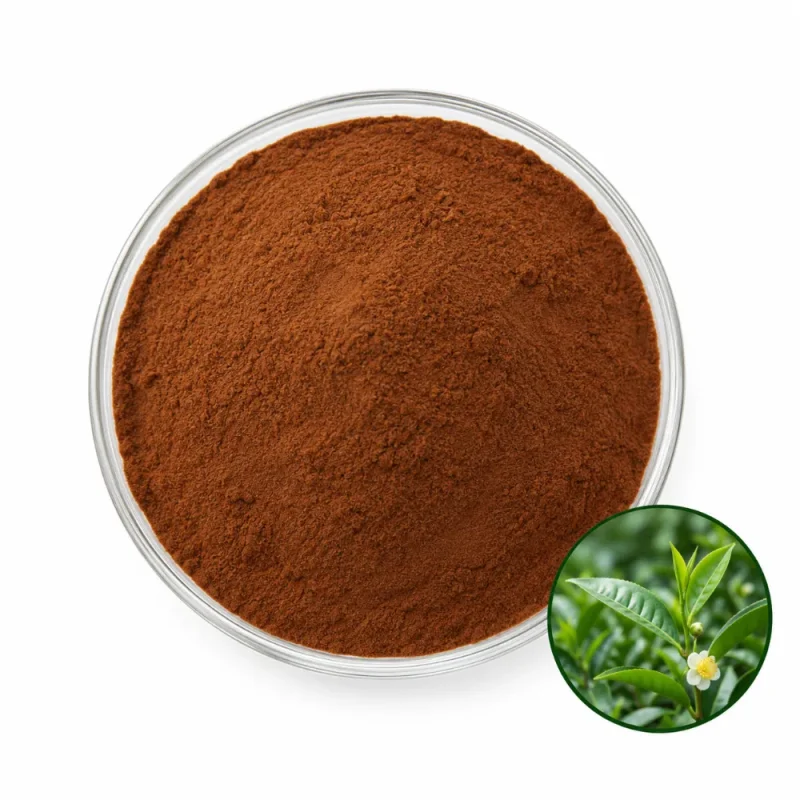
Black Tea Extract 10–40% Theaflavins

Theaflavins define this black tea extract: the orange-red pigments formed when the catechins of Camellia sinensis leaf are oxidized, as in the production of black tea. The leaf of the tea plant is the source, not green tea leaf, matcha or aged tea, and ethanol extraction concentrates the pigments into a brown powder.

The primary grade is 40% theaflavins by HPLC, with 10% as the lower end of the range. The powder is 80 mesh and slightly soluble in water. The 40% grade serves capsules and tablets with a small fill weight, while the 10% grade suits tea-style drink mixes and blends in which the dark color and body of black tea are wanted.

Theaflavin Standardization & Grades

Theaflavins are a family of four main pigments: theaflavin, theaflavin-3-gallate, theaflavin-3′-gallate and theaflavin-3,3′-digallate. They form when two catechins are oxidized and joined into a ring structure with a benzotropolone core, which gives the orange-red color. They are the standardization target because they are specific to oxidized tea and are not present in green tea. The botanical entity is Camellia sinensis (L.) Kuntze, and the part used is the leaf.

GradeAssay & MethodWhere It Fits
10% TheaflavinsHPLCTea-style drink mixes and blends
40% TheaflavinsHPLCCapsules and tablets with small fill

The choice between grades depends on the color strength needed, the dose per serving and the fill weight. The 40% grade carries four times the theaflavin load per gram of the 10% grade, so a capsule reaches its target in a small fill. The 10% grade keeps more of the thearubigins, the brown polymeric pigments that dominate black tea, together with caffeine and the remaining catechins, so it tastes and looks more like black tea. Siblings from the same species are the green-tea Green Tea Extract 40–98% Polyphenols, the unstandardized Green Tea Extract Powder and the ratio-based Black Tea Extract Powder.

The theaflavin figure is not a polyphenol figure. A black tea extract can be high in total polyphenols and low in theaflavins, because most black tea polyphenol is present as thearubigins and other oxidation products. Buyers who compare quotes should ask which pigment group the percentage counts and which method produced it.

Theaflavin Analysis & Purity Risks

Both grades are measured by HPLC, which separates the four theaflavins on a reversed-phase column, identifies each peak by retention time and UV or visible spectrum, and adds the four peaks for the total. A UV total polyphenol reading counts every phenolic compound and cannot distinguish theaflavins from the larger pool of oxidation products, so it is not comparable with the HPLC result.

The fingerprint of black tea extract shows the four theaflavin peaks in the mid-range of the run, a residual catechin group earlier, caffeine as a sharp peak and a broad hump of thearubigins that does not resolve into peaks. The size of that hump explains much of the brown color and astringency, and a high-grade powder has a lower hump and a clearer orange tone.

Sample preparation uses a mixture of water and organic solvent, followed by filtration. Theaflavins are sensitive to light and to alkaline pH, so samples are prepared fresh and read promptly. A solution left in the autosampler loses pigment and gives a falsely low result, which is why the time between preparation and injection should be fixed.

Purity risks follow from the botany and processing. Green tea and black tea come from the same species and differ only in processing, so the species name does not tell the two apart. A theaflavin figure confirms oxidation, and the absence of the figure on a leaf extract marks it as a different ingredient. A fixed part, a method and a fingerprint protect identity more than a percentage alone.

Typical Specifications

Specification ItemProduct Information
Latin NameCamellia sinensis
Plant PartLeaf & Herb
ProcessingEthanol Extraction
Compound ClassCatechins, Flavonoids, Polyphenols
Common NameBlack Tea, Black Tea Leaf
Ingredient TypeStandardized Extract
Marker Compound(s)Theaflavins (oxidation-derived pigments of Camellia sinensis leaf)
Primary Grade40% Theaflavins (HPLC)
Available Grades10% · 40% Theaflavins (HPLC)
AppearanceBrown powder
Solubility / DispersibilitySlightly Soluble in Water
Quality Parameters
Moisture (LOD)≤5.0%
Total Ash≤5.0%
Particle Size80 mesh
Heavy MetalsLead ≤2 ppm · Arsenic ≤1 ppm · Cadmium ≤1 ppm · Mercury ≤0.1 ppm
MicrobiologyTPC ≤1,000 cfu/g · Yeast & Mold ≤100 cfu/g · E. coli Negative · Salmonella Negative/25 g
Shelf Life24 months in unopened original packaging, cool and dry storage

Applications by Grade

40% Grade for Compact Capsules

The 40% grade delivers a theaflavin target in a small capsule fill. The brown powder is fine and a little sticky, so a flow agent keeps the hopper feeding evenly, and fill weight should be checked at the start of each run and after each pause in production.

40% Grade in Tablet Blends

Tablets of the high grade need a dry binder and an absorbent, because the astringent, hygroscopic powder softens compacts in humid rooms. Run a compression trial on the full blend, check hardness after storage and use a film coat that protects against moisture and staining.

10% Grade for Instant Tea Mixes

At 10% the extract is dosed by weight in instant tea and iced-tea mixes, where it supplies the amber color and body of black tea. Pair it with lemon and sweetener, and expect a faint haze on cooling, caused by caffeine and polyphenol complexes.

10% Grade for Drink Sticks

Sticks carry the lower grade with a flavor system built around citrus, peach or spice. The slightly soluble powder dissolves with stirring into a clear amber liquid when hot and a hazy liquid when cold, so recommend hot water for the clearest cup.

10% Grade for Dry Herbal Blends

Dry blends use the lower grade beside other tea leaves and botanical powders. Pre-mix it with a bulking agent so the fine brown powder spreads evenly, and note that its caffeine content should be counted together with other tea ingredients in the same blend.

Technical & Quality Considerations

The extract is a brown powder with a malty, tea-like odor and an astringent taste. It is slightly soluble in water, so it forms an amber solution in hot water that turns hazy when cooled, because caffeine and polyphenols associate into a loose complex known as tea cream. Adding a little acid or reducing the concentration delays the haze, and warm filling keeps the drink clear.

Theaflavins are sensitive to alkaline pH, which shifts them to dark brown thearubigin-like pigments, and to light and long heating. Iron gives dark complexes with the polyphenols, so avoid iron vessels. At production scale, screen the black tea extract before dosing and pre-mix it with a portion of the carrier. Keep the drum closed, cool and dry, and compare each lot with a retained sample for color and flow.

Because black tea extract carries caffeine, labeling and dose planning should include it, especially when the powder is combined with other tea or coffee ingredients. Clean mixers between black tea and pale products, since the brown, astringent powder is easily carried over, and record the date the drum was opened.

A black tea extract is checked by the color of its solution. An amber to orange-red tone in hot water points to theaflavins, while a muddy dark brown suggests that most of the pigment is polymeric. Keep a retained sample of every black tea extract lot, and compare the four theaflavin peaks and the size of the thearubigin hump, since both change when oxidation is pushed too far.

Packaging & Commercial Supply

Essencefield supports product evaluation, formulation trials, commercial orders, and ongoing ingredient supply. Packaging, storage, and shipping arrangements are determined by product characteristics, order quantity, stability requirements, and destination-market needs.

Supply ItemGeneral Information
SampleAvailable upon request for formulation, testing, and supplier evaluation
Order Quantities100 g · 1 kg · 5 kg · 25 kg · 100 kg · 500 kg · Bulk
Sample Lead TimeTypically 5–7 days after sample confirmation
Production Lead TimeTypically 15–30 days after order and specification confirmation
PackagingSuitable protective inner packaging with bags, cartons, drums, or other appropriate outer packaging
StorageStore in tightly sealed, suitable protective packaging in a cool, dry environment. Protect from moisture, heat, and direct sunlight. Specific storage conditions follow the approved product specification.
DocumentationCOA · Product Specification · TDS · SDS · Applicable declarations (as applicable)

Final order quantities, lead times, packaging, documentation, and shipping arrangements are confirmed according to the selected product and commercial requirements.

Request Ingredient Specifications & Quote

Share your target specification, application, quantity, and documentation needs. We’ll help confirm suitable options, samples, and commercial supply details.