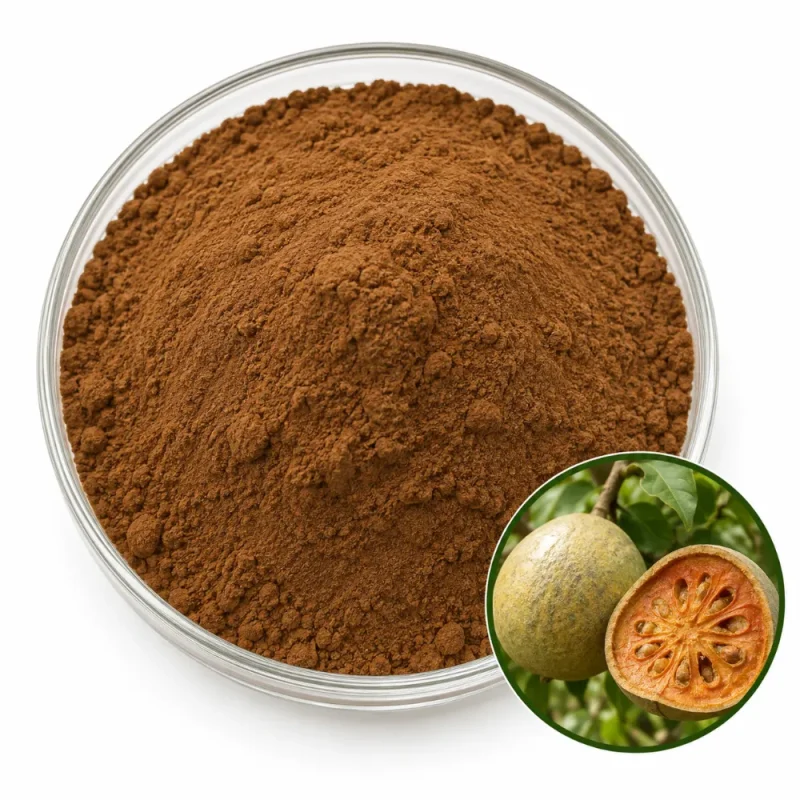
Bael Extract 5% Tannins

Bael extract is prepared from the fruit of Aegle marmelos, the bael tree of South Asia sometimes called Bengal quince, and not from the leaves, the roots or the wood apple (Limonia acidissima), a different fruit with a similar hard shell. Ethanol extraction concentrates the tannins of the fruit, and the liquor is dried to a light brown, water-soluble powder.

The grade is 5% tannins by UV. The powder is 80 mesh. It is meant for capsules, tablets, drink sticks and dry blends in which the astringent, pectin-rich character of bael is wanted at a defined tannin level.

Tannin Standardization & Grades

Tannins in bael fruit are phenolic compounds that bind proteins and give the characteristic dry, puckering taste of the unripe fruit. They sit beside a large fraction of pectin and mucilage, together with coumarins such as marmelosin and imperatorin, and small amounts of alkaloids. The grade expresses the tannin class as a whole, because the fruit has no single dominant tannin marker. The botanical entity is Aegle marmelos (L.) Corrêa, and the part used is the fruit.

A 5% tannin level is moderate for a fruit extract, and the powder is best viewed as a whole-fruit extract with a defined astringent floor, not a tannin concentrate. The remaining weight consists of pectin, soluble sugars, organic acids and minerals. The page carries one grade, so there is no ladder of tiers, and the decision concerns dose, texture and taste.

Siblings from the same fruit are the ratio-based Bael Fruit Extract Powder, made from the same material with no tannin figure, and the dried and milled Bael Fruit Powder, which carries the whole pulp with its fiber. A formulator who wants a defined astringent content in a soluble powder will choose the graded extract, while one who wants a fruit powder with fiber will choose the milled product.

Buyers who compare bael extract quotes should check the part and the ripeness. Unripe fruit is richer in tannins and is the form used in traditional dried slices, while ripe fruit is sweeter and has a more aromatic pulp. A named species and the fruit as the stated part keep the identity clear, and the tannin figure should be read with the method in mind.

Tannin Analysis & Purity Risks

The grade is measured by UV, a spectrophotometric method in which phenolic compounds reduce a reagent to a colored complex read at a fixed wavelength. Tannin methods are normally calibrated with a reference phenol, tannic acid or gallic acid, and the choice of reference moves the number. An HPLC result for a single phenolic compound is a different measurement and cannot be converted into the UV value.

Bael pulp contains a high proportion of pectin and sugars, and these do not react with phenol reagents, but they affect sample preparation. A viscous, gel-forming sample is difficult to filter, so a well-run method breaks the gel with enzyme or dilution before measurement, and an incompletely prepared sample gives a low and variable reading.

The fingerprint of the fruit extract shows a group of phenolic acids and coumarins, with marmelosin and imperatorin among the lipophilic peaks. Coumarins are photoactive, and their presence helps distinguish bael from other tannin-bearing fruits. A profile without any coumarin peaks points to a different source.

Purity risks follow from the botany. The wood apple, Limonia acidissima, is also sold as a hard-shelled fruit and is often confused with bael, and the dried slices of unripe bael are sometimes mixed with those of other fruit. A named species, the fruit as the stated part and a fingerprint with coumarins protect identity better than a percentage.

Typical Specifications

Specification ItemProduct Information
Latin NameAegle marmelos
Plant PartFruit & Berry
ProcessingEthanol Extraction
Compound ClassPolyphenols
Common NameBael, Bengal Quince, Stone Apple
Ingredient TypeStandardized Extract
Marker Compound(s)Tannins (phenolic tannin fraction of Aegle marmelos fruit)
Primary Grade5% Tannins (UV)
AppearanceLight Brown powder
Solubility / DispersibilityWater Soluble
Quality Parameters
Moisture (LOD)≤5.0%
Total Ash≤5.0%
Particle Size80 mesh
Heavy MetalsLead ≤2 ppm · Arsenic ≤1 ppm · Cadmium ≤1 ppm · Mercury ≤0.1 ppm
MicrobiologyTPC ≤1,000 cfu/g · Yeast & Mold ≤100 cfu/g · E. coli Negative · Salmonella Negative/25 g
Shelf Life24 months in unopened original packaging, cool and dry storage

Applications by Grade

5% Grade for Capsule Fills

Capsules take the single 5% grade by weight, and reaching a tannin target usually calls for a generous fill. Because the light brown powder is fine and hygroscopic, a flow agent and a dry filling room keep the hopper feeding evenly.

Drink Sticks With Fruit Flavors

Because the powder is water soluble, it dissolves in one stir into a tan, slightly viscous solution because of the pectin. Citrus, pomegranate or ginger flavors suit the astringent, tart fruit note, and a sweetener softens the dry finish.

Tablet Blends With Fruit Extracts

Tablets combine the grade with other fruit extracts at moderate inclusion. The pectin and sugar content make the powder hygroscopic and sticky, so a dry binder, an absorbent and a moisture-protective film coat help, followed by a hardness check after storage.

Dry Herbal Compounds

Dry compounds combine the extract with other fruit and bark powders in measured ratios. Pre-mix it with a bulking agent and screen the blend before filling, because the pectin-rich powder takes up moisture and forms lumps that are difficult to break.

Gummy and Jelly Premixes

Pectin-based gummies are a natural partner for bael, since the extract brings its own pectin and a tart, caramel-like fruit note. Add it after the cook, check the set of the gel, and adjust the acid level, because tannins can weaken some gels.

Technical & Quality Considerations

The extract is a light brown powder with a sweet, resinous fruit odor and an astringent, slightly bitter taste. It is water soluble, so it dissolves into a tan, slightly viscous solution that darkens with concentration. The viscosity comes from the pectin of the fruit, which thickens drinks and can slow filtration and filling.

Tannins bind proteins, so milk-based or plant-protein drinks may turn cloudy when the powder is added, and they form dark complexes with iron, so use stainless steel equipment. The sugar and pectin content makes the powder strongly hygroscopic, which causes caking and loss of flow. When producing at scale, screen the Bael extract before it is dosed, and mix it first with a portion of the carrier.

Keep the drum closed, cool and dry, open it only briefly and re-seal it with the liner in place. Compare each lot with a retained sample for color, odor, viscosity behavior and flow, and record the date the drum was opened. Clean equipment between this powder and pale products, because the tannic tint and the resinous odor carry over.

A bael extract is checked by dissolving a sample in water and noting viscosity, color and astringency. A slightly viscous tan solution is typical of the pectin-bearing fruit, while a thin, watery solution suggests a low pulp share. Keep a retained sample of every bael extract lot, and compare its viscosity and its coumarin peaks with later lots to confirm that the fruit and not another tannin source was used.

Packaging & Commercial Supply

Essencefield supports product evaluation, formulation trials, commercial orders, and ongoing ingredient supply. Packaging, storage, and shipping arrangements are determined by product characteristics, order quantity, stability requirements, and destination-market needs.

Supply ItemGeneral Information
SampleAvailable upon request for formulation, testing, and supplier evaluation
Order Quantities100 g · 1 kg · 5 kg · 25 kg · 100 kg · 500 kg · Bulk
Sample Lead TimeTypically 5–7 days after sample confirmation
Production Lead TimeTypically 15–30 days after order and specification confirmation
PackagingSuitable protective inner packaging with bags, cartons, drums, or other appropriate outer packaging
StorageStore in tightly sealed, suitable protective packaging in a cool, dry environment. Protect from moisture, heat, and direct sunlight. Specific storage conditions follow the approved product specification.
DocumentationCOA · Product Specification · TDS · SDS · Applicable declarations (as applicable)

Final order quantities, lead times, packaging, documentation, and shipping arrangements are confirmed according to the selected product and commercial requirements.

Request Ingredient Specifications & Quote

Share your target specification, application, quantity, and documentation needs. We’ll help confirm suitable options, samples, and commercial supply details.