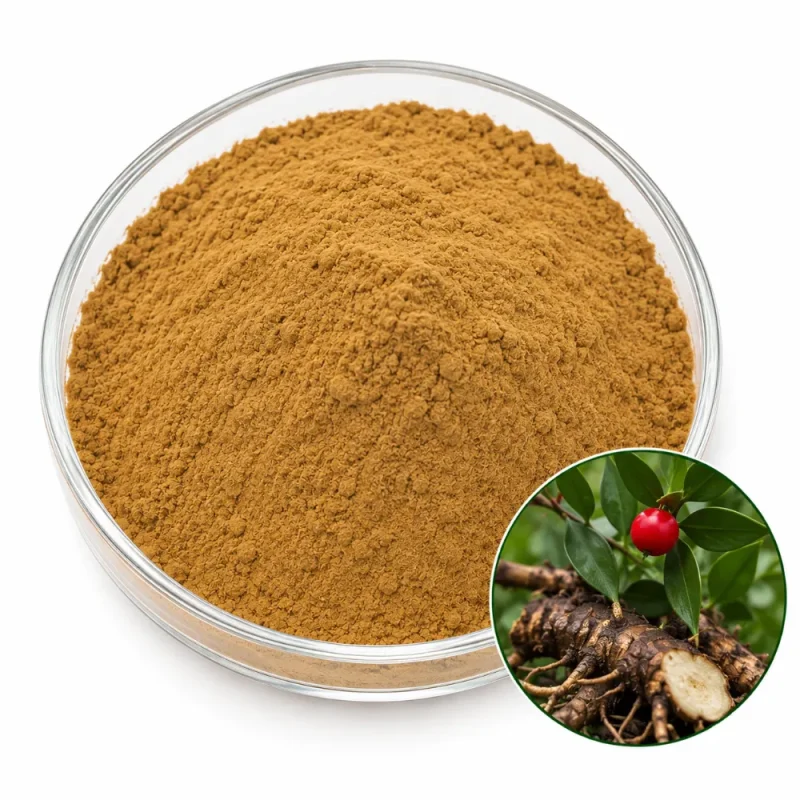
Butcher’s Broom Extract 9% Ruscogenins

Butcher’s broom extract is prepared from the rhizome of Ruscus aculeatus, the spiny evergreen shrub of Mediterranean woodland, and not from the cladodes, the leaf-like flattened stems that carry the spines, or from the related Danae and other Ruscus species. Ethanol extraction concentrates the steroidal saponins and sapogenins of the rhizome, and the liquor is dried to a light brown powder.

The grade is 9% ruscogenins by HPLC. The powder is 80 mesh and insoluble in water. It is meant for capsules, tablets and softgels in which the spirostanol sapogenin ruscogenin has to be quantified as a named compound within the character of a whole-rhizome extract.

Ruscogenin Standardization & Grades

Ruscogenin and neoruscogenin are spirostanol sapogenins, the steroid aglycones of the saponins of butcher’s broom rhizome. In the plant they occur largely as glycosides, among them ruscin and ruscoside, and the grade states the content of the two aglycones, which is the form that an HPLC method can quantify consistently. The botanical entity is Ruscus aculeatus L., and the part used is the rhizome, which the master data groups with roots and rhizomes.

The specification has a single grade, so there is no ladder of tiers, and the decision concerns format and dose planning. At 9% ruscogenins, the powder is a whole-rhizome extract in which the sapogenin pair is a major lipophilic component, and the remainder consists of intact saponins, sugars, flavonoids and the pigments of the rhizome. A capsule needs a moderate fill to reach a target, and the powder behaves as a waxy, only partly wettable solid.

The sibling product from the same plant is the Butcher’s Broom Extract Powder, a ratio-based extract made from the same rhizome with no sapogenin figure. A formulator who needs a defined ruscogenin content will choose the graded extract, while one who wants a plain rhizome extract will find the sibling sufficient.

Buyers who compare butcher’s broom extract quotes should check what the figure counts. Ruscogenins can be reported as the free aglycones present in the powder or as the total after hydrolysis of all glycosides, and the second is always larger. The basis, the species and the rhizome as the stated part are the three items that make a ruscogenin percentage comparable between suppliers.

Ruscogenin Analysis & Purity Risks

The marker is measured by HPLC, which separates ruscogenin from neoruscogenin and the other sapogenins on a reversed-phase column, identifies each peak by retention time and UV spectrum at a short wavelength, and quantifies against reference standards. Spirostanol sapogenins have no strong chromophore, so detection is sensitive to solvent quality and baseline drift. A gravimetric total saponin value is not comparable with the HPLC figure.

Because the glycosides of the rhizome are much more abundant than the free aglycones, the preparation matters. A method that includes an acid hydrolysis step converts the saponins to sapogenins and reports the total, while a method without it reports only the free fraction. Acid can also rearrange part of the sapogenins into artifacts, so a controlled hydrolysis time is part of a sound method, and the chosen basis should be the same for every lot.

The fingerprint of the rhizome shows ruscogenin and neoruscogenin as the two main sapogenin peaks, with smaller peaks of related spirostanols. Their ratio is characteristic of the species and helps distinguish it from other Ruscus relatives. A pattern dominated by a single sapogenin points to another source, such as a plant rich in diosgenin.

Purity risks follow from the botany. Ruscus hypoglossum and Danae racemosa are related shrubs that are sometimes sold as butcher’s broom, and their saponin patterns differ. The cladodes of the plant are a separate material with a different composition. A species statement, the rhizome as the stated part and the paired sapogenin fingerprint protect identity better than a percentage.

Typical Specifications

Specification ItemProduct Information
Latin NameRuscus aculeatus
Plant PartRoot & Rhizome
ProcessingEthanol Extraction
Compound ClassSaponins
Common NameButcher’s Broom, Box Holly, Knee Holly
Ingredient TypeStandardized Extract
Marker Compound(s)Ruscogenins (spirostanol sapogenins of Ruscus aculeatus rhizome)
Primary Grade9% Ruscogenins (HPLC)
AppearanceLight Brown powder
Solubility / DispersibilityInsoluble in Water
Quality Parameters
Moisture (LOD)≤5.0%
Total Ash≤5.0%
Particle Size80 mesh
Heavy MetalsLead ≤2 ppm · Arsenic ≤1 ppm · Cadmium ≤1 ppm · Mercury ≤0.1 ppm
MicrobiologyTPC ≤1,000 cfu/g · Yeast & Mold ≤100 cfu/g · E. coli Negative · Salmonella Negative/25 g
Shelf Life24 months in unopened original packaging, cool and dry storage

Applications by Grade

9% Grade for Capsule Fills

The single 9% grade is dosed by weight in capsules, and a typical formula needs a moderate fill to reach a ruscogenin target. The light brown powder is waxy and cohesive, so a flow agent helps the hopper feed evenly, and capsule weights should be checked at the start of each run.

Tablet Blends With Rhizome Extracts

Tablets suit the grade when it is blended with other extracts at moderate inclusion. The waxy sapogenin fraction sticks to punches and softens compacts, so a dry binder, an absorbent and a modest lubricant level help, followed by a hardness check after storage.

Oil-Based Softgel Fills

Sapogenins dissolve better in oil than in water, so softgel fills disperse the 9% grade in a carrier oil. A fine mill and stirring during encapsulation matter because insoluble particles settle in the feed line and shift the content from capsule to capsule.

Dry Mix Premixes

Dry mixes combine the extract with other botanicals and a bulking agent. Pre-mix the waxy powder with a portion of the carrier, because it lumps against dry fillers, and screen the blend before filling to remove small agglomerates that would affect uniformity.

Combination Capsule Formulas

Multi-ingredient capsules often pair the extract with flavonoids and vitamins in measured ratios. Because the powder is hydrophobic, it does not mix evenly with very polar ingredients, so a staged blend with an intermediate carrier gives a more uniform final fill.

Technical & Quality Considerations

The extract is a light brown powder with a faint earthy odor and a bitter, slightly acrid taste. Ruscogenins stay out of aqueous solution, so the powder settles in drink bases and needs stirring to redisperse. Ruscogenins dissolve in ethanol, in oils and in some surfactant systems, and the choice of carrier decides how the compound behaves in the finished product.

Spirostanol sapogenins are stable in dry form, though strong acid can rearrange the spiroketal ring and change the chromatographic pattern. Avoid long acidic holds in wet processes, and keep the pH near neutral if the aglycone content matters. At production scale, screen the butcher’s broom extract before dosing and pre-mix it with a portion of the carrier before it enters the main blender.

Waxy residues cling to equipment, which is why warm detergent or an ethanol cleaner is used for washing and scoops are dedicated where possible. Compare each lot with a retained sample for color, odor and flow, record the date the drum was opened and keep the drum closed, cool and dry. A powder stored warm becomes tacky and cakes, which is a reason to keep it away from heat sources.

A butcher’s broom extract is checked by color, odor and the paired sapogenin peaks. A light brown powder with a faint earthy smell is typical, and the ruscogenin and neoruscogenin peaks should keep a steady ratio from lot to lot. Keep a retained sample of each butcher’s broom extract lot, and compare its chromatogram with later lots, watching for new peaks that signal acid rearrangement.

Packaging & Commercial Supply

Essencefield supports product evaluation, formulation trials, commercial orders, and ongoing ingredient supply. Packaging, storage, and shipping arrangements are determined by product characteristics, order quantity, stability requirements, and destination-market needs.

Supply ItemGeneral Information
SampleAvailable upon request for formulation, testing, and supplier evaluation
Order Quantities100 g · 1 kg · 5 kg · 25 kg · 100 kg · 500 kg · Bulk
Sample Lead TimeTypically 5–7 days after sample confirmation
Production Lead TimeTypically 15–30 days after order and specification confirmation
PackagingSuitable protective inner packaging with bags, cartons, drums, or other appropriate outer packaging
StorageStore in tightly sealed, suitable protective packaging in a cool, dry environment. Protect from moisture, heat, and direct sunlight. Specific storage conditions follow the approved product specification.
DocumentationCOA · Product Specification · TDS · SDS · Applicable declarations (as applicable)

Final order quantities, lead times, packaging, documentation, and shipping arrangements are confirmed according to the selected product and commercial requirements.

Request Ingredient Specifications & Quote

Share your target specification, application, quantity, and documentation needs. We’ll help confirm suitable options, samples, and commercial supply details.