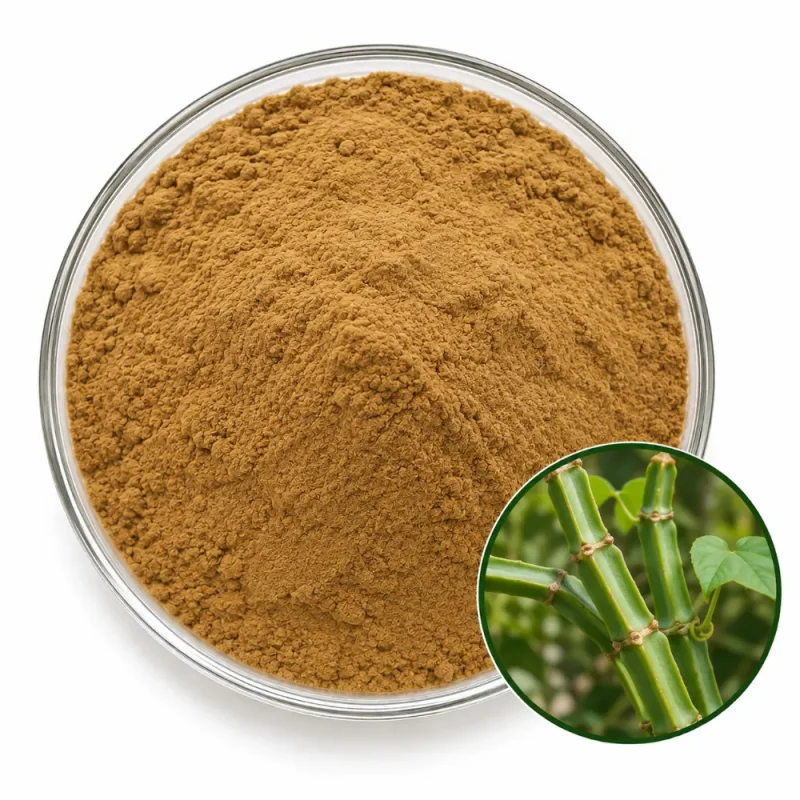
Cissus quadrangularis Extract 10–40% Ketosterones

The succulent stem of Cissus quadrangularis, the veldt grape or devil’s backbone, is the only part used in this extract, and the leaf, root and tendril are excluded. Ethanol extraction takes up the lipophilic sterol and triterpenoid fraction of the stem, and the concentrate is dried to a light brown powder.

The marker is measured by HPLC, with a primary grade of 40% and a lower grade of 10%. The powder is 80 mesh and insoluble in water. The 40% grade fits capsules and tablets that need a small fill, while the 10% grade suits blends in which the stem matrix is the main body.

Ketosterone Standardization & Grades

Ketosterones is a trade term for the keto-sterol and keto-triterpenoid fraction of the Cissus stem, a group of lipophilic compounds that is quantified as one class figure by HPLC against a reference. The term is not a pharmacopoeial name, and its exact composition depends on the method used, which is why the data table notes that the figure varies with the method. The botanical entity is Cissus quadrangularis L., and the extract is standardized to this fraction because it is the signature lipophilic class of the stem.

GradeAssay & MethodWhere It Fits
10% KetosteronesHPLCDry blends, higher inclusion rates
40% KetosteronesHPLCCapsules and tablets, small fill weight

Grade choice follows dose and fill weight. The 40% grade carries four times the marker load of the 10% grade per gram, so a capsule reaches its target with less powder, while the 10% grade is bulkier and behaves more like a milled stem. Cissus is also supplied as a 10:1 ratio extract with no marker figure, the Cissus Quadrangularis Extract Powder. Use the standardized extract when a ketosterone figure has to appear in the specification of a Cissus quadrangularis extract.

Ketosterone Analysis & Purity Risks

HPLC separates the keto-steroidal and triterpenoid peaks of the stem and sums the group against a reference. Because the term has no fixed list of compounds, a result depends on which peaks are integrated and which reference is used. Two laboratories can report different totals for the same powder, so a figure is comparable only with another figure from the same method. It cannot be converted into a UV or gravimetric sterol value.

For identity, the HPLC fingerprint of the stem is read beside the class figure. Phytosterols such as beta-sitosterol, triterpenoids such as friedelin, and stilbenes such as resveratrol and piceatannol derivatives are reported in the plant, and the pattern helps to separate Cissus stem from other Vitaceae material. Because the marker is lipophilic, the chromatogram also depends on the polarity of the extraction solvent.

Purity risks follow from the botanical group. Several Vitaceae vines are traded under similar names, and the leaf and root of Cissus carry different chemistry from the four-angled stem, so the stated species and the stem part are part of the identity. A high class figure can also include co-extracted waxes and fatty material that read in the same region of the chromatogram, which is why the fingerprint matters as much as the percentage.

Sample preparation uses a non-polar or mid-polar solvent that dissolves the lipophilic fraction, followed by filtration, and the sample is injected promptly. The stem is a fibrous, mucilaginous tissue, so gel-like material can foul the filter if it is not removed before injection.

The stem itself adds a laboratory consideration. Cissus stems are cut into pieces and dried, and they are known to hold mineral matter, chiefly calcium salts, so ash can be a limiting quality factor for the extract even when the marker figure is on target. Extraction with a solvent leaves much of this mineral fraction behind, but inadequate separation of fibrous stem tissue before extraction can carry some of it forward, which is why total ash is controlled in the specification of Cissus quadrangularis extract.

Typical Specifications

Specification ItemProduct Information
Latin NameCissus quadrangularis
Plant PartBark & Stem
ProcessingEthanol Extraction
Common NameCissus, Veldt Grape, Devil’s Backbone
Ingredient TypeStandardized Extract
Marker Compound(s)Ketosterones (keto-sterol and keto-triterpenoid fraction of the stem)
Primary Grade40% Ketosterones (HPLC)
Available Grades10% · 40% Ketosterones (HPLC)
AppearanceLight Brown powder
Solubility / DispersibilityInsoluble in Water
Quality Parameters
Moisture (LOD)≤5.0%
Total Ash≤5.0%
Particle Size80 mesh
Heavy MetalsLead ≤2 ppm · Arsenic ≤1 ppm · Cadmium ≤1 ppm · Mercury ≤0.1 ppm
MicrobiologyTPC ≤1,000 cfu/g · Yeast & Mold ≤100 cfu/g · E. coli Negative · Salmonella Negative/25 g
Shelf Life24 months in unopened original packaging, cool and dry storage

Applications by Grade

40% Grade for Compact Capsules

The 40% grade of Cissus quadrangularis extract reaches a ketosterone target in a small fill, which suits compact capsules. The lipophilic powder is waxy and tends to cling to hopper walls, so a flow agent and a dry room help keep fill weights steady.

10% Grade in Sports-Nutrition Powders

The 10% grade is bulky enough to carry in powder blends at a practical gram weight. It is insoluble in water, so the label should advise shaking, and a fine grind avoids visible gritty particles in the cup.

40% Grade in Tablet Blends

Tablets of the 40% grade need a dry binder and a glidant, because the waxy extract can stick to punches in humid rooms. A film coat limits dust and covers the faint earthy taste of the stem.

10% Grade in Sachet Blends

Sachets of the 10% grade are built on a bulking carrier, which lets the filler weigh an accurate dose of the waxy stem extract. The lipophilic particles float, so stir-in instructions reduce the layer that forms on top of water.

10% Grade in Bar Blends

Bars take the 10% grade into the dry fraction before the syrup is added. The earthy flavor sits under cocoa and nut notes, and the fibrous particles blend well into dense bar bases, where they add slight chew without a gritty feel.

40% Grade in Softgel-Style Fill Carriers

Where a liquid or semi-solid capsule is wanted, the 40% grade is dispersed in an oil carrier. Mill it fine first, because a coarse lipophilic powder settles in the fill and leads to uneven dosing, and keep the fill under gentle agitation during dispensing.

Technical & Quality Considerations

The extract is a light brown, waxy-feeling powder with a mild earthy odor. It is insoluble in water, so any liquid format needs a suspension system or an oil carrier. The lipophilic marker dissolves in oils and in alcoholic phases, which is why an oil dispersion gives better uniformity than an aqueous mix.

The class is moderately stable to heat but sensitive to oxidation in humid air, and the fibrous matrix absorbs water slowly. Resveratrol-type stilbenes in the stem darken on exposure to light, so protect finished goods from direct light. A fine grind and a premix with a flow agent are the usual route to a consistent fill, since the particles are electrostatic and cohesive.

Scale-up starts with sieving the powder through a fine screen and premixing it with part of the carrier. Run encapsulation in a controlled-humidity room, wipe surfaces after each weighing, and keep drums sealed with a desiccant. Cool storage preserves the powder, and an accelerated trial shows early whether a tablet coat is needed.

Mixing behavior deserves a separate note. Because Cissus quadrangularis extract is waxy and cohesive, it tends to form lumps when it meets moisture, and these lumps then segregate in a blender. Pre-blending with a small share of a dry, free-flowing diluent such as microcrystalline cellulose or rice concentrate breaks the lumps and gives a uniform blend. Dust collection also matters, since the fine waxy particles coat filters and surfaces, and cleaning intervals should be set accordingly.

Packaging & Commercial Supply

Essencefield supports product evaluation, formulation trials, commercial orders, and ongoing ingredient supply. Packaging, storage, and shipping arrangements are determined by product characteristics, order quantity, stability requirements, and destination-market needs.

Supply ItemGeneral Information
SampleAvailable upon request for formulation, testing, and supplier evaluation
Order Quantities100 g · 1 kg · 5 kg · 25 kg · 100 kg · 500 kg · Bulk
Sample Lead TimeTypically 5–7 days after sample confirmation
Production Lead TimeTypically 15–30 days after order and specification confirmation
PackagingSuitable protective inner packaging with bags, cartons, drums, or other appropriate outer packaging
StorageStore in tightly sealed, suitable protective packaging in a cool, dry environment. Protect from moisture, heat, and direct sunlight. Specific storage conditions follow the approved product specification.
DocumentationCOA · Product Specification · TDS · SDS · Applicable declarations (as applicable)

Final order quantities, lead times, packaging, documentation, and shipping arrangements are confirmed according to the selected product and commercial requirements.

Request Ingredient Specifications & Quote

Share your target specification, application, quantity, and documentation needs. We’ll help confirm suitable options, samples, and commercial supply details.