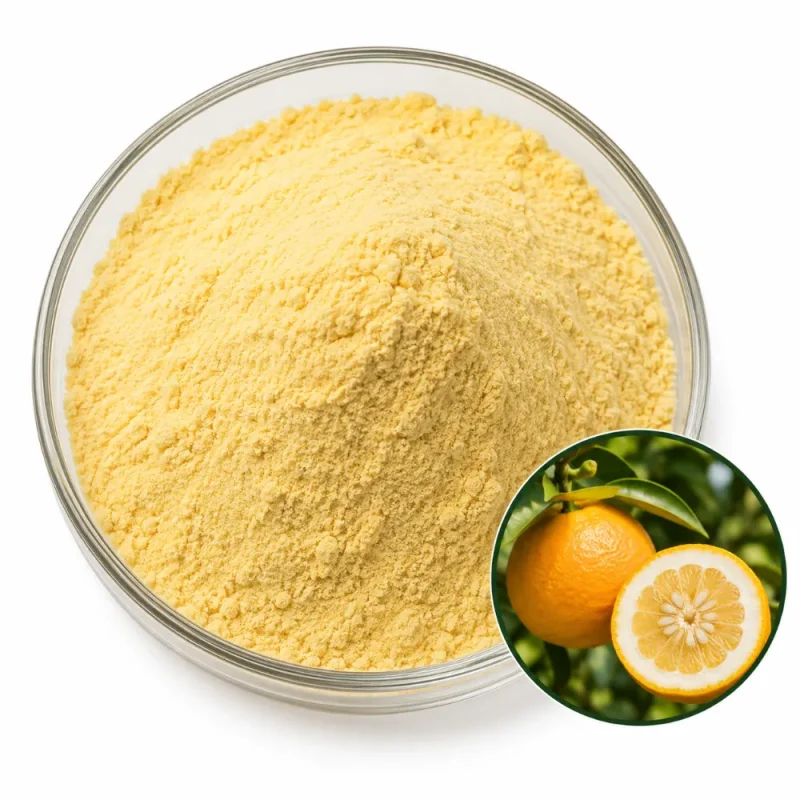
Citrus Bioflavonoids Extract 40–90% Total Bioflavonoids

Citrus bioflavonoids extract is prepared from the peel of Citrus sinensis, the sweet orange, and the juice, pulp and seed are not the starting material. Ethanol extraction takes up the flavanone glycosides of the peel, and the concentrate is dried to a light yellow powder.

Total bioflavonoids are measured by UV, with a primary grade of 90% and a lower grade of 40%. The powder is 80 mesh and slightly soluble in water. The 90% grade fits capsules and tablets that need a very small fill, while the 40% grade fits blends and premixes in which a bulkier peel matrix is wanted.

Total Bioflavonoid Standardization & Grades

Bioflavonoids is the trade name for the flavonoid fraction of citrus fruit. In sweet orange peel it is dominated by hesperidin, a flavanone rutinoside, with narirutin as the second main component and smaller amounts of didymin and polymethoxylated flavones. A UV assay adds these into one number. The botanical entity is Citrus sinensis (Mill.) Pers., and the extract is standardized to the class because it is the defining phenolic fraction of the peel.

GradeAssay & MethodWhere It Fits
40% Total BioflavonoidsUVBlends and drink premixes
90% Total BioflavonoidsUVCapsules and tablets, very small fill

Grade choice for citrus bioflavonoids extract follows dose and fill weight. The 90% grade carries more than twice the bioflavonoid load of the 40% grade per gram, and a capsule reaches its target in a very small fill, while the 40% grade is bulkier, lighter in color and easier to disperse in a blend. Citrus is also supplied as 10:1 ratio extracts with no marker figure: the Citrus Bioflavonoid Extract Powder, the Orange Peel Extract Powder and the Bitter Orange Peel Extract Powder. The standardized extract is the row to use when a bioflavonoid figure has to appear in the specification.

Total Bioflavonoid Analysis & Purity Risks

A UV assay reads the absorbance of a flavonoid complex and calculates the total against a reference compound. For citrus flavanones the reference is typically hesperidin or naringin, so the result is expressed as an equivalent. The choice of reference moves the number, and a UV total cannot be converted into an HPLC result for hesperidin alone, since the two methods measure different things.

For identity, an HPLC fingerprint of the peel is read beside the total. A dominant hesperidin peak with narirutin as a second peak points to sweet orange or mandarin, while a pattern led by naringin and neohesperidin points to bitter orange or grapefruit. The pattern, rather than the percentage, shows which citrus fruit supplied the material.

Purity risks follow from the botanical group. The trade term citrus bioflavonoids covers peel flavonoids from sweet orange, lemon, grapefruit, mandarin and bitter orange, and these fruits differ in their main flavanone. The stated species and the stated part are therefore part of the identity. Hesperidin has very low solubility, and a high-percentage grade may be a crystalline material that behaves differently from a spray-dried peel extract of the same percentage.

Sample preparation uses dissolution in an alkaline or alcoholic medium because hesperidin dissolves poorly, followed by dilution into the working range of the curve. A blank without the reagent corrects for the yellow background, and the filter must be fine enough to remove undissolved crystals.

Raw material and process decide which kind of citrus bioflavonoids extract is on offer. Peel left over from juice production is washed, dried and extracted, and the extraction conditions determine whether the hesperidin stays in solution or crystallizes. Many high-percentage grades are made by dissolving the flavanone in alkali and precipitating it by acidification, which gives a crystalline, nearly pure solid, whereas lower grades are spray-dried peel extracts that keep sugars and pectin. Both are legitimate products, and the grade, the form and the stated source should be read together.

Typical Specifications

Specification ItemProduct Information
Latin NameCitrus sinensis
Plant PartFruit & Berry
ProcessingEthanol Extraction
Compound ClassFlavonoids, Polyphenols
Common NameCitrus Bioflavonoids, Sweet Orange Peel
Ingredient TypeStandardized Extract
Marker Compound(s)Total bioflavonoids (hesperidin and related citrus flavanone glycosides)
Primary Grade90% Total Bioflavonoids (UV)
Available Grades40% · 90% Total Bioflavonoids (UV)
AppearanceLight Yellow powder
Solubility / DispersibilitySlightly Soluble in Water
Quality Parameters
Moisture (LOD)≤5.0%
Total Ash≤5.0%
Particle Size80 mesh
Heavy MetalsLead ≤2 ppm · Arsenic ≤1 ppm · Cadmium ≤1 ppm · Mercury ≤0.1 ppm
MicrobiologyTPC ≤1,000 cfu/g · Yeast & Mold ≤100 cfu/g · E. coli Negative · Salmonella Negative/25 g
Shelf Life24 months in unopened original packaging, cool and dry storage

Applications by Grade

90% Grade for Very Small Capsule Fills

The 90% grade of citrus bioflavonoids extract reaches a flavonoid target in a very small fill, which suits compact capsules. The fine, crystalline-feeling powder is static-prone, so use a flow agent and an anti-static dosing path.

40% Grade in Drink Premixes

The 40% grade of citrus bioflavonoids extract is bulky enough to carry in stick-pack drink powders. It leaves a pale yellow haze in the cup, and acidic orange or lemon bases hide the faint bitterness while keeping the color natural.

90% Grade in Tablet Blends

Tablets of the 90% grade need a disintegrant, because the dense flavonoid powder compacts into a hard, slow-dissolving tablet. A film coat limits dust, and hardness should be checked after storage, since the dense powder can cap or laminate when the compression force is too high.

40% Grade in Gummy Bases

Gummies take the 40% grade as a color and matrix contributor. Add the powder after the main cook and confirm that its fine particles do not thicken the base before it is deposited. A small test cast shows whether the flavanone settles to the bottom of the mold.

40% Grade in Bar Blends

In cold-pressed bars the 40% grade is blended into the dry fraction before the syrup is added. The mild citrus taste pairs with fruit and nut bases, and the pale yellow tone is visible in light bars.

90% Grade in Sachet Dilutions

Sachets of the 90% grade call for stepwise dilution with a bulking carrier so the filler can weigh an accurate dose. Check the dilution on a test batch, because a concentrated powder at low inclusion segregates easily.

Technical & Quality Considerations

The powder is light yellow with a faint, peel-like odor. It is slightly soluble in water, so a solution is hazy and pale yellow, and hesperidin in particular dissolves better at alkaline pH than at neutral or acidic pH. In an acidic beverage, a high inclusion of the 90% grade can crystallize out as a fine sediment.

Flavanone glycosides are stable to heat in normal food processing, but they chelate iron to form darker complexes, so stainless contact surfaces and low-iron fillers avoid color drift. Strong alkaline conditions deepen the color to yellow-orange as chalcones form. The 40% grade carries additional peel sugars and pectin, which add stickiness and caking tendency in humid air.

For larger runs, the peel-derived powder is screened, premixed with part of the carrier and verified by weighing early fills. Store drums sealed, with a desiccant, in a cool place away from light. Closed charging and local extraction limit the pale yellow dust that otherwise spreads across the packing room.

Citrus bioflavonoids extract has very low solubility, and that limits liquid formats. Even at neutral pH only a small share of the hesperidin dissolves, so beverages carry it as a suspension, and a stabilizer such as gellan or xanthan keeps the particles from settling. Particle size matters for suspension stability as much as for dissolution, so a micronized grade or a fine grind gives a more even serving. In dry formats such as capsules the low solubility does not matter at the formulation stage.

Packaging & Commercial Supply

Essencefield supports product evaluation, formulation trials, commercial orders, and ongoing ingredient supply. Packaging, storage, and shipping arrangements are determined by product characteristics, order quantity, stability requirements, and destination-market needs.

Supply ItemGeneral Information
SampleAvailable upon request for formulation, testing, and supplier evaluation
Order Quantities100 g · 1 kg · 5 kg · 25 kg · 100 kg · 500 kg · Bulk
Sample Lead TimeTypically 5–7 days after sample confirmation
Production Lead TimeTypically 15–30 days after order and specification confirmation
PackagingSuitable protective inner packaging with bags, cartons, drums, or other appropriate outer packaging
StorageStore in tightly sealed, suitable protective packaging in a cool, dry environment. Protect from moisture, heat, and direct sunlight. Specific storage conditions follow the approved product specification.
DocumentationCOA · Product Specification · TDS · SDS · Applicable declarations (as applicable)

Final order quantities, lead times, packaging, documentation, and shipping arrangements are confirmed according to the selected product and commercial requirements.

Request Ingredient Specifications & Quote

Share your target specification, application, quantity, and documentation needs. We’ll help confirm suitable options, samples, and commercial supply details.