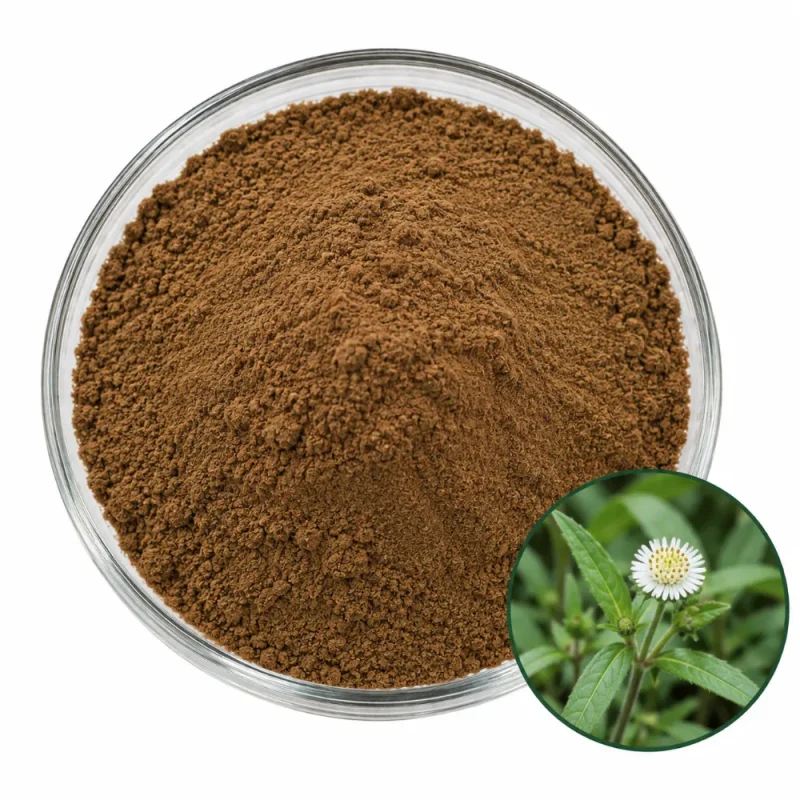
Eclipta alba Extract 1–2.5% Bitters

The dried aerial parts of Eclipta alba, the false daisy known in Ayurveda as bhringraj, are the only starting material in this extract, and the root and seed are excluded. Ethanol extraction takes up the coumestans, flavonoids and bitter principles of the herb, and the concentrate is dried to a light brown powder.

The primary grade is 2.5% bitters, with a 1% grade as the lower end, and no named assay method is attached to the grades. The powder is 80 mesh and slightly soluble in water. The 2.5% grade fits capsules and tablets, while the 1% grade fits herbal blends and drink powders.

Bitters Standardization & Grades

Bitters is a taste-defined class and not a single compound. In Eclipta alba the bitter-tasting fraction includes the coumestans wedelolactone and demethylwedelolactone, thiophene derivatives, and saponin-type compounds, together with flavonoids such as luteolin and apigenin glycosides. The botanical entity is Eclipta alba (L.) Hassk., and the extract is standardized to bitters because bitterness is the quality that separates a herb extract from a milled herb and the one formulators have to manage in a finished product.

GradeAssay & MethodWhere It Fits
1% BittersClass figure, no named methodHerbal blends, drink powders
2.5% BittersClass figure, no named methodCapsules and tablets

Grade choice follows bitterness and fill weight. The 2.5% grade is the stronger, more concentrated bitter extract and gives a smaller fill, while the 1% grade is milder, bulkier and keeps more of the herb’s green-brown matrix. Eclipta has no 10:1 extract or milled herb row in the catalog, so the standardized extract is the form to use when a bitters figure has to appear in the specification of the Eclipta alba extract.

Bitters Analysis & Purity Risks

Because bitterness is a sensory property, it is usually expressed as a bitterness value, the highest dilution at which a panel still detects a bitter taste. A chemical proxy, such as a summed HPLC peak group for the coumestans, can also be used. No method is named for the grade, so the figure is the bitters level found by the procedure supplied with the lot. It cannot be converted into an HPLC value for wedelolactone or compared with a number from a different procedure.

For identity, an HPLC fingerprint of the herb is read beside the bitters figure. Wedelolactone and demethylwedelolactone are the characteristic coumestan peaks, and the luteolin and apigenin glycosides form a flavonoid cluster. The pattern shows whether the material is Eclipta herb and not a look-alike plant.

Purity risks follow from the botanical group. Eclipta alba and Eclipta prostrata are names used for the same or closely related plants, and plant databases treat them as one species under the second name, so literature and trade names must be read carefully. Sphagneticola trilobata, another daisy, also contains wedelolactone and is sometimes confused with it. The stated species and the stated aerial part protect identity better than one bitters figure does.

Sample preparation for chemical proxies uses extraction into a polar solvent and filtration, with the sample protected from light because coumestans darken under strong light. Sensory work needs a controlled series of dilutions and a trained panel.

Raw material handling also matters. The herb is collected in the rainy season, washed free of mud and shade-dried, because a herb dried in strong sun loses green color and some wedelolactone. A well-dried herb is dark green and brittle, whereas a damp lot blackens and smells musty.

Typical Specifications

Specification ItemProduct Information
Latin NameEclipta alba
Plant PartLeaf & Herb
ProcessingEthanol Extraction
Compound ClassPolyphenols
Common NameEclipta, False Daisy, Bhringraj
Ingredient TypeStandardized Extract
Marker Compound(s)Bitters (bitter-tasting principles of the herb)
Primary Grade2.5% Bitters
Available Grades1% · 2.5% Bitters
AppearanceLight Brown powder
Solubility / DispersibilitySlightly Soluble in Water
Quality Parameters
Moisture (LOD)≤5.0%
Total Ash≤5.0%
Particle Size80 mesh
Heavy MetalsLead ≤2 ppm · Arsenic ≤1 ppm · Cadmium ≤1 ppm · Mercury ≤0.1 ppm
MicrobiologyTPC ≤1,000 cfu/g · Yeast & Mold ≤100 cfu/g · E. coli Negative · Salmonella Negative/25 g
Shelf Life24 months in unopened original packaging, cool and dry storage

Applications by Grade

2.5% Grade for Compact Capsules

The 2.5% grade of Eclipta alba extract reaches a bitters target in a small fill, which suits compact capsules. The powder is fine and slightly hygroscopic, so fill in a dry room and use a flow agent to keep fill weights steady.

1% Grade in Herbal Powder Blends

Herbal powder blends carry the 1% grade alongside other leaf and root extracts used in the Ayurvedic tradition. Add it in stages to a free-flowing carrier, because the low-density herb powder segregates when it is dumped into a large blender at once.

2.5% Grade in Tablet Blends

Tablets of the 2.5% grade need a dry binder and a glidant, and a film coat covers the intense bitterness of the herb. Check hardness and disintegration after storage, as the fibrous matrix swells slowly in humid air.

1% Grade in Drink Powders

Stick-pack drink powders pair the 1% grade of the extract with ginger, lemon or tulsi-style flavors that carry its green, bitter character. The cup is hazy and brown, and cool water gives the cleanest dispersion in the finished cup.

1% Grade in Sachet Premixes

Sachets dilute the 1% grade with a bulking carrier so the filler can weigh an accurate dose. A foil laminate holds the aroma and protects the coumestans from light, which otherwise darkens the powder. Seal quality is worth a leak test, since moisture entering a small pinhole speeds the color change.

2.5% Grade for Contract Blending

Contract blenders place the 2.5% grade in multi-ingredient powders where a herb matrix is wanted. Bitterness carries across adjacent runs, so a dry purge and dedicated scoops protect the products that follow. The dark herb dust also shows on pale surfaces, which makes cleaning easy to verify by eye.

Technical & Quality Considerations

Eclipta alba extract is a light brown powder with a mild, grassy, earthy odor and a persistent bitter taste. It is slightly soluble in water, so a solution turns hazy brown, with part of the polar fraction dissolved and the coumestans largely in suspension. Cool dispersion keeps the flavor cleaner than hot water.

Wedelolactone is a polyphenolic coumestan with a catechol group, so it oxidizes in air and light and chelates iron to form dark complexes. The powder darkens during storage, and contact with iron-containing minerals turns it gray to black, which is why the herb is traditionally used as a natural dye. Stainless contact surfaces, low-iron fillers and light-protective packaging limit the change.

Scale-up of Eclipta extract calls for a fine screen to break the soft herb lumps, then a premix with part of the carrier. First fills are weighed against target, drums are stored sealed and cool, and a desiccant liner is useful in humid regions. Closed charging limits the dark, staining dust.

Formulation with other ingredients needs a trial. Iron-fortified premixes will discolor visibly, and alkaline buffers speed oxidation of the coumestans, so an accelerated stability study at elevated temperature shows early whether a combination is sound.

Color is a distinctive feature of the herb and shapes how Eclipta alba extract behaves in a finished product. Bhringraj juice turns black on standing, and the extract carries the same tendency in a milder form, with the tan powder darkening in humid air and the aqueous dispersion turning gray-brown within hours. Acidic bases and antioxidants such as ascorbic acid slow the change. Opaque packaging keeps a capsule or tablet from showing the shift, while a clear bottle will show a gradual darkening of the contents.

Packaging & Commercial Supply

Essencefield supports product evaluation, formulation trials, commercial orders, and ongoing ingredient supply. Packaging, storage, and shipping arrangements are determined by product characteristics, order quantity, stability requirements, and destination-market needs.

Supply ItemGeneral Information
SampleAvailable upon request for formulation, testing, and supplier evaluation
Order Quantities100 g · 1 kg · 5 kg · 25 kg · 100 kg · 500 kg · Bulk
Sample Lead TimeTypically 5–7 days after sample confirmation
Production Lead TimeTypically 15–30 days after order and specification confirmation
PackagingSuitable protective inner packaging with bags, cartons, drums, or other appropriate outer packaging
StorageStore in tightly sealed, suitable protective packaging in a cool, dry environment. Protect from moisture, heat, and direct sunlight. Specific storage conditions follow the approved product specification.
DocumentationCOA · Product Specification · TDS · SDS · Applicable declarations (as applicable)

Final order quantities, lead times, packaging, documentation, and shipping arrangements are confirmed according to the selected product and commercial requirements.

Request Ingredient Specifications & Quote

Share your target specification, application, quantity, and documentation needs. We’ll help confirm suitable options, samples, and commercial supply details.