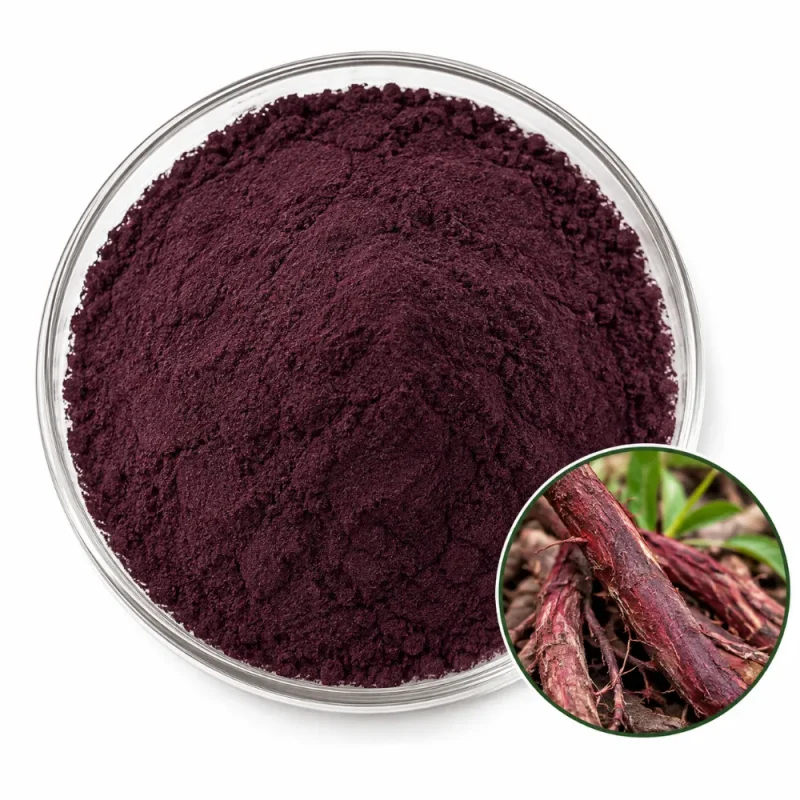
Gromwell Root Extract 10–30% Shikonin / Naphthoquinones

Gromwell root extract takes the dried root of Lithospermum erythrorhizon, the purple gromwell known in the Chinese trade as zi cao, as its only starting material, and the leaf, stem and the similar roots of Arnebia species are excluded. Ethanol extraction takes up the lipophilic naphthoquinone pigments of the root bark, and the concentrate is dried to a purple-red powder.

Shikonin and related naphthoquinones are measured by HPLC, with a primary grade of 30% and a lower grade of 10%. The powder is 80 mesh and insoluble in water. The 30% grade fits capsules and lipid-based fills that need a small dose, while the 10% grade fits blends in which the root matrix and color are wanted.

Shikonin Standardization & Grades

Shikonin is a red naphthoquinone pigment and the signature compound of the gromwell root, where it occurs mostly as esters: acetylshikonin, isobutyrylshikonin, beta,beta-dimethylacrylshikonin and others, held in the root bark. Its optical mirror image, alkannin, comes from other plants of the borage family. The botanical entity is Lithospermum erythrorhizon Siebold & Zucc., and the extract is standardized to shikonin and its derivatives together because the esters are the stable, colored form of the pigment in the root, and HPLC sums them cleanly.

GradeAssay & MethodWhere It Fits
10% Shikonin / NaphthoquinonesHPLCBlends and colored fills, higher inclusion
30% Shikonin / NaphthoquinonesHPLCCapsules and lipid fills, small dose

Grade choice follows dose, color and fill weight. The 30% grade carries three times the naphthoquinone load of the 10% grade per gram and a much deeper color, so a capsule reaches its target with a fraction of the powder, while the 10% grade is bulkier and lighter in shade. The single compound is available as Shikonin. The standardized extract is the row to use when a naphthoquinone figure has to appear in the specification of the gromwell root extract.

Shikonin Analysis & Purity Risks

HPLC separates shikonin and its esters on a reversed-phase column and quantifies the peaks against a reference standard, with detection in the visible range around 520 nm, where the naphthoquinones absorb strongly and most other phenolics do not. The result is shikonin and its derivatives, counted as a sum. A UV reading at a lower wavelength would count other phenolics, and neither a UV nor a gravimetric pigment figure can be converted into the HPLC sum.

For identity, the fingerprint of the root is read beside the sum. Acetylshikonin, isobutyrylshikonin and dimethylacrylshikonin appear as a recognizable cluster, and the balance of the esters is characteristic of Lithospermum erythrorhizon. The free shikonin peak is usually smaller than its esters, and a high free share suggests hydrolysis.

Purity risks follow from the botanical group. The trade name zi cao covers more than one plant: Arnebia euchroma, Arnebia guttata and Lithospermum erythrorhizon are all sold, and their naphthoquinone esters differ in proportion and, for some, in stereochemistry. For that reason the stated species and the stated root part belong to the identity. Shikonin is also a dye, and material intended for coloring is not the same lot as one intended as an ingredient.

Sample preparation uses a nonpolar or mid-polar solvent that dissolves the pigment esters, and the solution is protected from light, since naphthoquinones fade under strong light. Samples are injected promptly, because the esters hydrolyze in alkaline solution.

Raw material handling also matters. The root is dug, cleaned and dried in shade, because heat and sun degrade the pigment, and the pigment is concentrated in the thin outer bark that flakes off during handling. A well-dried root is dark purple and fragrant, while a damp lot is dull and brown.

Typical Specifications

Specification ItemProduct Information
Latin NameLithospermum erythrorhizon
Plant PartRoot & Rhizome
ProcessingEthanol Extraction
Compound ClassQuinones
Common NameGromwell Root, Purple Gromwell, Zi Cao
Ingredient TypeStandardized Extract
Marker Compound(s)Shikonin and related naphthoquinones (shikonin esters)
Primary Grade30% Shikonin / Naphthoquinones (HPLC)
Available Grades10% · 30% Shikonin / Naphthoquinones (HPLC)
AppearancePurple Red powder
Solubility / DispersibilityInsoluble in Water
Quality Parameters
Moisture (LOD)≤5.0%
Total Ash≤5.0%
Particle Size80 mesh
Heavy MetalsLead ≤2 ppm · Arsenic ≤1 ppm · Cadmium ≤1 ppm · Mercury ≤0.1 ppm
MicrobiologyTPC ≤1,000 cfu/g · Yeast & Mold ≤100 cfu/g · E. coli Negative · Salmonella Negative/25 g
Shelf Life24 months in unopened original packaging, cool and dry storage

Applications by Grade

30% Grade for Compact Capsules

The 30% grade of gromwell root extract reaches a naphthoquinone target in a very small fill, which suits compact capsules. The pigment stains shells, hoppers and hands, so fill in a closed system and use opaque capsules.

10% Grade in Lipid-Based Fills

The 10% grade disperses in an oil carrier, which suits softgel-style or liquid-fill capsules and keeps the lipophilic pigment away from water. Mill the powder fine first and choose a fresh, antioxidant-stabilized oil for the carrier.

30% Grade in Tablet Blends

Tablets of the 30% grade need a dry binder and a glidant, and a film coat limits dust and color transfer. The deeply colored powder shows in white tablets, so a pigmented or opaque coat hides it.

10% Grade in Sachet Premixes

Sachets of the 10% grade are carrier-based as well, with a bulking agent that gives the filler an accurate dose to weigh. The extract is insoluble in water, so the label should call for stirring, and the cup takes a purple-red tint.

10% Grade in Colored Blend Applications

Where a deep purple-red tone is wanted in a powder blend, the 10% grade colors the mix. The pigment shifts with pH, so test the blend at the intended pH and storage conditions before fixing the recipe.

30% Grade in Stepwise Dilutions

Where a dose is small, the 30% grade is diluted in stages with a bulking carrier before it reaches the filler. Because the tint is intense, mixing uniformity can be judged by eye on a test batch.

Technical & Quality Considerations

Gromwell root extract is a purple-red powder with a faint, sweet-woody odor and a bitter taste. A liquid format needs a suspension system or a lipid carrier, since the extract is insoluble in water. The naphthoquinone esters dissolve in ethanol, in oils and in other nonpolar media but hardly in water, which is why a lipid dispersion gives better uniformity than an aqueous mix.

Shikonin is a natural pH indicator. It is red in acid, violet in neutral solution and blue in alkaline media, so the color of a product depends on its pH, and an alkaline mineral can turn a red powder violet. It also fades under light and heat and reacts with amines, and metal ions shift the shade. Opaque packaging, a stable acidic or neutral base and cool storage keep the color steady.

The root extract is screened and premixed with part of the carrier in production, with a weight check on the first capsules. The pigment stains equipment and clothing, so use dedicated tools, gloves and a closed charging system. Drums are stored sealed, cool and away from light.

Compatibility with other ingredients needs a trial, since mineral salts and amino-containing ingredients change the shade. An accelerated stability study shows early whether a combination is sound.

Cleaning and cross-contamination control are practical points for a pigment this strong. Gromwell root extract stains stainless steel, plastic scoops and conveyor belts, and traces transfer into the next product as a pink or purple tint. Dedicated tools, a solvent wipe-down for equipment that tolerates it, and a visual check under white light before the next run are standard measures, and the deep color makes any residue easy to see.

Packaging & Commercial Supply

Essencefield supports product evaluation, formulation trials, commercial orders, and ongoing ingredient supply. Packaging, storage, and shipping arrangements are determined by product characteristics, order quantity, stability requirements, and destination-market needs.

Supply ItemGeneral Information
SampleAvailable upon request for formulation, testing, and supplier evaluation
Order Quantities100 g · 1 kg · 5 kg · 25 kg · 100 kg · 500 kg · Bulk
Sample Lead TimeTypically 5–7 days after sample confirmation
Production Lead TimeTypically 15–30 days after order and specification confirmation
PackagingSuitable protective inner packaging with bags, cartons, drums, or other appropriate outer packaging
StorageStore in tightly sealed, suitable protective packaging in a cool, dry environment. Protect from moisture, heat, and direct sunlight. Specific storage conditions follow the approved product specification.
DocumentationCOA · Product Specification · TDS · SDS · Applicable declarations (as applicable)

Final order quantities, lead times, packaging, documentation, and shipping arrangements are confirmed according to the selected product and commercial requirements.

Request Ingredient Specifications & Quote

Share your target specification, application, quantity, and documentation needs. We’ll help confirm suitable options, samples, and commercial supply details.