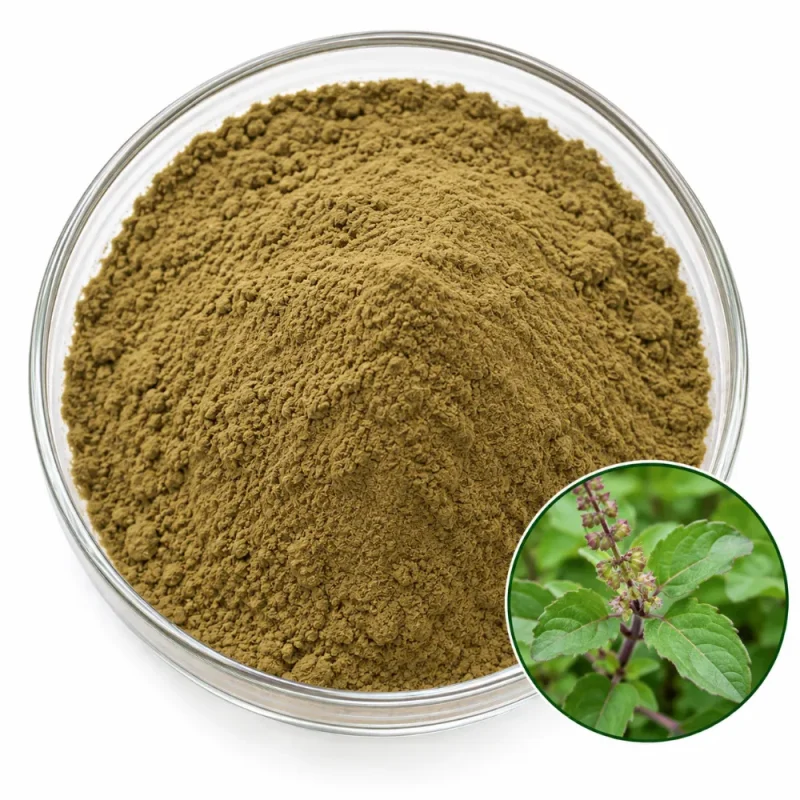
Holy Basil Extract 2–2.5% Ursolic Acid

Holy basil, the Ocimum species known in India as tulsi, supplies the leaf for this extract, and ethanol extraction concentrates its triterpenoid fraction around ursolic acid. The result is a light brown powder, milled to 80 mesh, that does not dissolve in water and carries the leafy, resinous matrix of the plant.

Ursolic acid is measured by HPLC and offered as a 2–2.5% range, with 2.5% as the primary grade and 2% as the lower grade. The narrow range keeps lot-to-lot dosing predictable, and the oil-compatible powder fits capsules, tablets and oil-based fills.

Ursolic Acid Standardization & Grades

Ursolic acid is a pentacyclic triterpenoid carboxylic acid of the ursane type, and it is the standardization marker for this holy basil extract because it is stable, measurable and found in the waxy leaf surface of Ocimum sanctum L. The same compound occurs in rosemary, apple peel and other plants, so the figure describes the compound and not the botanical. The botanical identity is fixed by the species, the leaf part and the fingerprint.

GradeAssay & MethodWhere It Fits
2% Ursolic AcidHPLCBlends, oil-based fills
2.5% Ursolic AcidHPLCCapsules and tablets

The two grades sit close together, so the choice is about batch availability and fill weight, not about a different product. At 2.5% the same ursolic acid target needs about twenty percent less powder than at 2%. Holy basil is also supplied as a 10:1 ratio extract without a marker figure, the Holy Basil Extract Powder, and as a dried leaf powder, Holy Basil (Tulsi) Powder. The standardized grade is the one to specify when a defined ursolic acid figure has to appear on the spec.

Ursolic Acid Analysis & Purity Risks

HPLC separates ursolic acid from its structural isomer oleanolic acid, which elutes very close and is the main analytical difficulty. A column and gradient that resolve the two peaks are essential, because a method that merges them reports a total of both triterpenoid acids as ursolic acid and overstates the figure. Detection is at a low UV wavelength, since the molecule has only a weak chromophore, and the result is expressed on the dry extract.

For identity, the chromatographic fingerprint of the leaf extract shows ursolic acid beside other triterpenoids and phenolic compounds typical of Ocimum, such as rosmarinic acid. The distinctive aromatic leaf matrix also separates it from material that has been spiked with purified ursolic acid.

Purity risks come from botanical identity and from the marker itself. Several basil species carry the Ocimum name, and Ocimum basilicum (sweet basil) and Ocimum gratissimum are different plants with different leaf chemistry, so the stated species and leaf part are part of the specification. Databases also treat the name Ocimum sanctum as a synonym of Ocimum tenuiflorum, which is why trade documents may show either name. Because ursolic acid is available as an inexpensive purified compound, a figure that is not matched by the expected fingerprint deserves a second look.

Sample preparation needs care because the acid is poorly soluble. The extract is dissolved in methanol or ethanol with sonication, and the solution is filtered before injection. Incomplete dissolution gives a low result that is easy to mistake for a weak lot, so analysts check that no powder remains on the filter and that the standard and the sample are dissolved in the same solvent.

The leaf is the only part used in this holy basil extract. Stems carry less of the waxy triterpenoid coating, and flowering spikes and seeds have a different chemistry, so a figure obtained from mixed aerial material is not equivalent to a leaf-based grade. The leaf is harvested before full seed set, dried at moderate temperature and cleaned of stem fragments before extraction.

Typical Specifications

Specification ItemProduct Information
Latin NameOcimum sanctum
Plant PartLeaf & Herb
ProcessingEthanol Extraction
Compound ClassTriterpenoids, Terpenoids
Common NameHoly Basil, Tulsi
Ingredient TypeStandardized Extract
Marker Compound(s)Ursolic Acid
Primary Grade2.5% Ursolic Acid (HPLC)
Available Grades2% · 2.5% Ursolic Acid (HPLC)
AppearanceLight Brown powder
Solubility / DispersibilityInsoluble in Water
Quality Parameters
Moisture (LOD)≤5.0%
Total Ash≤5.0%
Particle Size80 mesh
Heavy MetalsLead ≤2 ppm · Arsenic ≤1 ppm · Cadmium ≤1 ppm · Mercury ≤0.1 ppm
MicrobiologyTPC ≤1,000 cfu/g · Yeast & Mold ≤100 cfu/g · E. coli Negative · Salmonella Negative/25 g
Shelf Life24 months in unopened original packaging, cool and dry storage

Applications by Grade

2.5% Grade in Waxy-Powder Capsule Fills

The 2.5% grade of holy basil extract reaches an ursolic acid target in a modest fill, which suits two-piece capsules. The waxy, water-repellent powder clings to hopper walls and tamping pins, so a flow agent and a dry room keep capsule weights consistent through the run.

2.5% Grade in Resinous Tablet Blends

Tablets of the 2.5% grade need a dry binder and a lubricant system that copes with the waxy leaf matrix, which sticks to punches in humid rooms. A film coat limits dust and covers the resinous, clove-like aroma of the leaf.

2% Grade in Oil-Based Softgel Fills

The 2% grade disperses in an oil carrier, which suits softgel-style fills and liquid-filled capsules. Mill the powder fine before dispersion, because coarse triterpenoid particles settle in the oil, and keep the fill under gentle agitation while it is dispensed.

2% Grade in Shake-Before-Use Sticks

In stick packs, the 2% grade is blended with a bulking carrier so the filler can meter a dose of this water-repellent powder. Because the extract floats on water, label directions should call for stirring or shaking, and a fine grind avoids visible specks.

2.5% Grade in Herbal Tea Powders

Instant herbal tea powders pair the 2.5% grade with a carrier that has some surface activity, which pulls the waxy particles into suspension. The aroma of the leaf is a selling point here, so avoid heat that drives off volatiles during blending and drying.

Technical & Quality Considerations

Holy basil extract is a light brown powder with a leafy, resinous aroma, and that character carries through both grades. It does not dissolve in water, and ursolic acid is only sparingly soluble in lipid and alcohol phases at room temperature, which limits clear liquid formats. Oil or ethanol-rich bases and suspension systems work better than plain aqueous drinks.

Ursolic acid is a stable, saturated-skeleton triterpenoid with one free carboxylic acid group. It tolerates heat and moderate acidity well, and it is not prone to oxidation in the dry state. The leaf matrix around it contains phenolics and volatile material that darken slowly in humid air, so sealed packaging and a desiccant sachet hold the shade of the lot.

In production, the powder is sieved before use and premixed with part of the carrier, since a hydrophobic powder tends to form lumps on first contact with a wet mass. Closed charging and local extraction limit airborne fine dust, which is greenish brown and clings to equipment and clothing.

Color and aroma are worth checking in every lot. A greener shade can point to more chlorophyll-bearing leaf matrix, while a dull dark brown can point to heat damage during drying or concentration. Both are visible before any assay result arrives.

Wet granulation of this extract needs a wetting agent, because the powder repels water. A small amount of a food-grade surfactant or an alcohol-based binder improves distribution. An accelerated stability study at elevated temperature shows early whether the combined product stays free-flowing and whether the ursolic acid figure holds across the shelf life.

Packaging & Commercial Supply

Essencefield supports product evaluation, formulation trials, commercial orders, and ongoing ingredient supply. Packaging, storage, and shipping arrangements are determined by product characteristics, order quantity, stability requirements, and destination-market needs.

Supply ItemGeneral Information
SampleAvailable upon request for formulation, testing, and supplier evaluation
Order Quantities100 g · 1 kg · 5 kg · 25 kg · 100 kg · 500 kg · Bulk
Sample Lead TimeTypically 5–7 days after sample confirmation
Production Lead TimeTypically 15–30 days after order and specification confirmation
PackagingSuitable protective inner packaging with bags, cartons, drums, or other appropriate outer packaging
StorageStore in tightly sealed, suitable protective packaging in a cool, dry environment. Protect from moisture, heat, and direct sunlight. Specific storage conditions follow the approved product specification.
DocumentationCOA · Product Specification · TDS · SDS · Applicable declarations (as applicable)

Final order quantities, lead times, packaging, documentation, and shipping arrangements are confirmed according to the selected product and commercial requirements.

Request Ingredient Specifications & Quote

Share your target specification, application, quantity, and documentation needs. We’ll help confirm suitable options, samples, and commercial supply details.