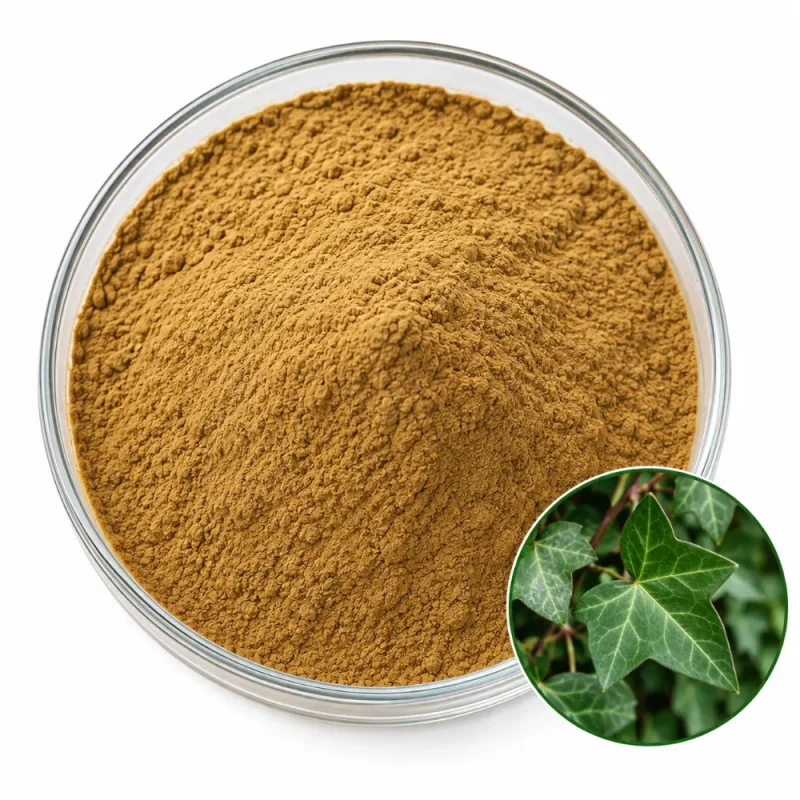
Ivy Leaf Extract 5–10% Hederacoside C

The leaves of Hedera helix, the common English ivy, are extracted with ethanol to give this ivy leaf extract, which is standardized for one dominant saponin. The concentrate is dried to a green powder that dissolves in water and is milled to 80 mesh.

Hederacoside C is measured by HPLC and offered as a 5–10% range, with 10% as the primary grade and 5% as the lower grade. The higher grade fits small-fill capsules and tablets, and the lower grade suits drink and syrup powders.

Hederacoside C Standardization & Grades

Hederacoside C is a bidesmosidic triterpenoid saponin built on the aglycone hederagenin, with a sugar chain at the carbon-3 position and a second chain at carbon 28. It is the principal saponin of the leaf of Hedera helix L., and ivy leaf extracts are standardized to it because it is the compound that best tracks the saponin fraction of the leaf and is easy to quantify. Smaller saponins such as alpha-hederin appear as hydrolysis products of hederacoside C.

GradeAssay & MethodWhere It Fits
5% Hederacoside CHPLCDrink and syrup powders
10% Hederacoside CHPLCCapsules and tablets

At 10% the extract carries twice the marker of the 5% grade per gram, which makes a smaller capsule fill possible. The 5% grade dissolves quickly and handles like a typical leaf extract in beverage mixes. Ivy is also supplied as a 10:1 ratio extract without a marker figure, the Ivy Extract Powder, and as the aglycone, Hederagenin 98%. The aglycone is a different molecule from hederacoside C, and the two are not interchangeable in a specification.

Ivy is traded in several forms, so the form should be named in the specification. A dry leaf extract standardized to hederacoside C is a different product from a fresh-leaf liquid preparation, and the two cannot be compared by weight. The extract described here is a dry powder defined by the leaf part and by a hederacoside C content, and it carries no fresh-leaf volatiles.

Hederacoside C Analysis & Purity Risks

HPLC separates hederacoside C from alpha-hederin, hederasaponin B and the other saponins of the leaf on a reversed-phase column. Saponins of this type have little UV absorbance, so detection is at a low wavelength or with a detector that does not depend on a chromophore. The figure is hederacoside C itself, quantified against a reference standard, and it is lower than a colorimetric saponin total of the same lot.

The ratio of hederacoside C to its hydrolysis products is a quality signal. The bidesmosidic saponin loses its carbon-28 sugar chain under enzymatic or alkaline conditions and becomes a monodesmosidic saponin such as alpha-hederin, which is more hemolytic and more surface-active. A well-handled lot therefore shows hederacoside C as the dominant peak, and a large alpha-hederin peak points to enzyme action during drying or extraction.

The botanical risk is one of naming. Other plants carry “ivy” in the common name, including ground ivy (Glechoma hederacea), a mint-family herb, Boston ivy (Parthenocissus), and poison ivy (Toxicodendron), none of which is related to Hedera. Within the genus, Hedera helix is distinguished from Persian and Nepalese ivies by leaf shape and saponin pattern, so the stated species and the leaf part are part of the identity.

Raw material is harvested from the juvenile, lobed leaf form or the adult entire-leaf form, which have different saponin levels. The extraction of leaves that were not dried promptly leads to enzymatic loss of the marker, which shows up in the fingerprint as a flattened hederacoside C peak.

Sample preparation affects the result. Saponins dissolve in aqueous alcohol, and the solution is filtered through a membrane that does not adsorb them, because some filter materials bind saponins and lower the reading. Foam in the autosampler vial can cause dosing errors, so the sample is allowed to settle before injection and the vial headspace is kept small.

Typical Specifications

Specification ItemProduct Information
Latin NameHedera helix
Plant PartLeaf & Herb
ProcessingEthanol Extraction
Compound ClassSaponins
Common NameIvy, English Ivy
Ingredient TypeStandardized Extract
Marker Compound(s)Hederacoside C
Primary Grade10% Hederacoside C (HPLC)
Available Grades5% · 10% Hederacoside C (HPLC)
AppearanceGreen powder
Solubility / DispersibilityWater Soluble
Quality Parameters
Moisture (LOD)≤5.0%
Total Ash≤5.0%
Particle Size80 mesh
Heavy MetalsLead ≤2 ppm · Arsenic ≤1 ppm · Cadmium ≤1 ppm · Mercury ≤0.1 ppm
MicrobiologyTPC ≤1,000 cfu/g · Yeast & Mold ≤100 cfu/g · E. coli Negative · Salmonella Negative/25 g
Shelf Life24 months in unopened original packaging, cool and dry storage

Applications by Grade

10% Grade in Foaming Capsule Fills

The 10% grade of ivy leaf extract delivers a hederacoside C target in a small fill, which suits two-piece capsules. The saponin-rich powder is hygroscopic and trapped air makes it foam in humid rooms, so keep the filling room dry and use a flow agent.

10% Grade in Green-Tinted Tablets

Tablets of the 10% grade keep a green-brown color from the leaf chlorophyll degradation products, which shows through a clear coat. An opaque tinted coat fixes the color, protects the saponin from light and moisture, and hides the grassy smell during bottling.

5% Grade in Syrup Powder Bases

Dry syrup bases can carry the 5% grade, which dissolves in sugar solutions to a green-brown liquid. Saponins foam during reconstitution, so a defoamer is used in the dry mix, and the label should allow a short rest after shaking so the foam can settle.

5% Grade in Instant Beverage Mixes

Instant drink mixes use the 5% grade at gram level. The grassy, slightly bitter note sits well under mint, honey and lemon flavors, and the powder should be stirred into water slowly so that the saponins do not build a foam that traps undissolved lumps.

10% Grade in Lozenge Blends

Compressed lozenges can carry the 10% grade with a dry sugar-free base. The low dose and the dense saponin powder blend well with menthol and eucalyptus-type flavors, and a final moisture check on the tablet mass avoids sticking on the punches.

Technical & Quality Considerations

Ivy leaf extract is a green to green-brown powder with a grassy, faintly bitter character. It dissolves in water to a clear to slightly hazy green-brown solution, and the saponins are strong surfactants, so agitation produces a persistent foam. This foaming is the most visible physical trait of the extract and shapes how mixers, fillers and bottle headspace are specified.

Hederacoside C is stable in neutral to mildly acidic solution, but alkaline conditions and some enzymes remove its second sugar chain and convert it to alpha-hederin. High-pH premixes and warm, enzyme-containing preparations should therefore be avoided. Strong light bleaches the chlorophyll-related color of the powder over weeks, so opaque packaging keeps the shade.

The dry powder takes up moisture readily and cakes when damp. Moisture-proof liners and a desiccant sachet protect the powder from caking in storage.

In production, sieve the powder before use and premix it with part of the carrier. Foam control matters on liquid lines, where low-shear mixing and a vacuum or deaeration step avoid air entrainment. An accelerated stability run with the intended pack shows early whether color, flow and the hederacoside C figure hold.

Color is a quick check on every lot. A green to green-brown shade is expected for ivy leaf extract, while a dark brown cast points to heat damage or oxidation during concentration. A grassy, slightly sweet smell is normal, and a fermented or sour note can mean that the leaf was stored damp.

Packaging & Commercial Supply

Essencefield supports product evaluation, formulation trials, commercial orders, and ongoing ingredient supply. Packaging, storage, and shipping arrangements are determined by product characteristics, order quantity, stability requirements, and destination-market needs.

Supply ItemGeneral Information
SampleAvailable upon request for formulation, testing, and supplier evaluation
Order Quantities100 g · 1 kg · 5 kg · 25 kg · 100 kg · 500 kg · Bulk
Sample Lead TimeTypically 5–7 days after sample confirmation
Production Lead TimeTypically 15–30 days after order and specification confirmation
PackagingSuitable protective inner packaging with bags, cartons, drums, or other appropriate outer packaging
StorageStore in tightly sealed, suitable protective packaging in a cool, dry environment. Protect from moisture, heat, and direct sunlight. Specific storage conditions follow the approved product specification.
DocumentationCOA · Product Specification · TDS · SDS · Applicable declarations (as applicable)

Final order quantities, lead times, packaging, documentation, and shipping arrangements are confirmed according to the selected product and commercial requirements.

Request Ingredient Specifications & Quote

Share your target specification, application, quantity, and documentation needs. We’ll help confirm suitable options, samples, and commercial supply details.