
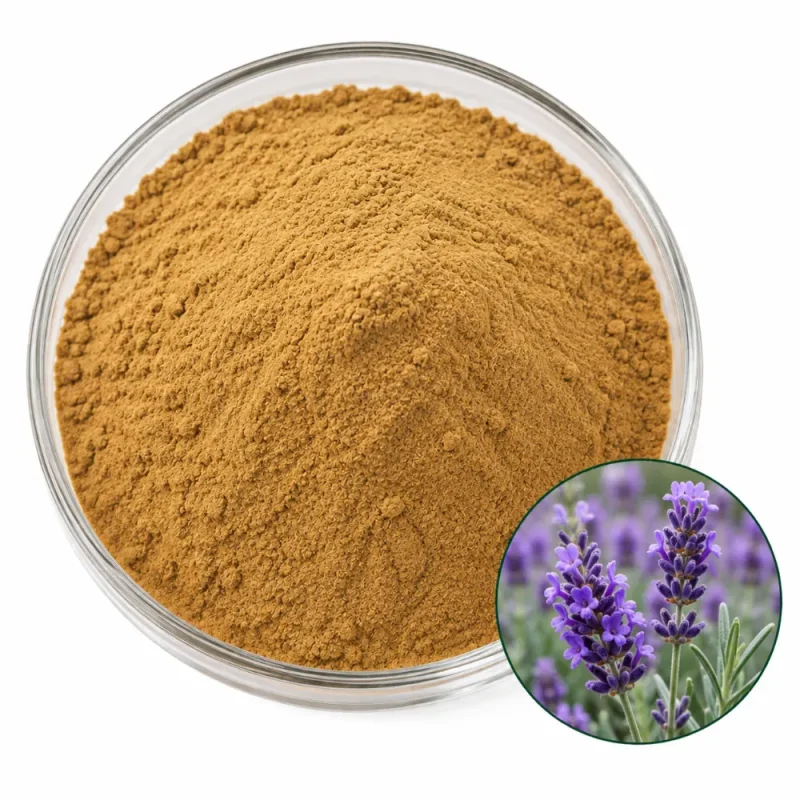
Polyphenol Standardization & Grades
Lavender flowers carry two chemical fractions: the essential oil, rich in linalool and linalyl acetate, and a polar phenolic fraction made of rosmarinic acid, caffeic acid derivatives, luteolin glycosides and coumarins. The ethanol-extracted powder described here is defined by the second fraction. Lavandula angustifolia Mill. is standardized to total polyphenols because that figure captures the phenolic fraction as a whole, while the volatile oil is largely absent from a dried powder extract.
| Grade | Assay & Method | Where It Fits |
|---|---|---|
| 5% Polyphenols | UV (Folin-Ciocalteu) | Drink mixes, high-inclusion blends |
| 30% Polyphenols | UV (Folin-Ciocalteu) | Capsules and tablets |
The 30% grade carries six times the phenolic load of the 5% grade per gram, so a capsule fill can be much smaller, while the 5% grade dissolves quickly and blends at gram-level inclusion. Lavender is also supplied as a 10:1 ratio extract without a marker figure, the Lavender Extract Powder, and as a milled flower, Lavender Flower Powder. The standardized extract is the one to specify when a polyphenol figure has to appear on the specification.
The flower is the part used. Dried lavender flower buds and florets are separated from stalk and leaf before extraction, because the stalks add fiber and little phenolic content. Lavender is also cultivated for its essential oil, and oil-distilled flower waste is sometimes used for extracts. The material here is defined by the flower and by the phenolic fraction, not by volatile oil content.


