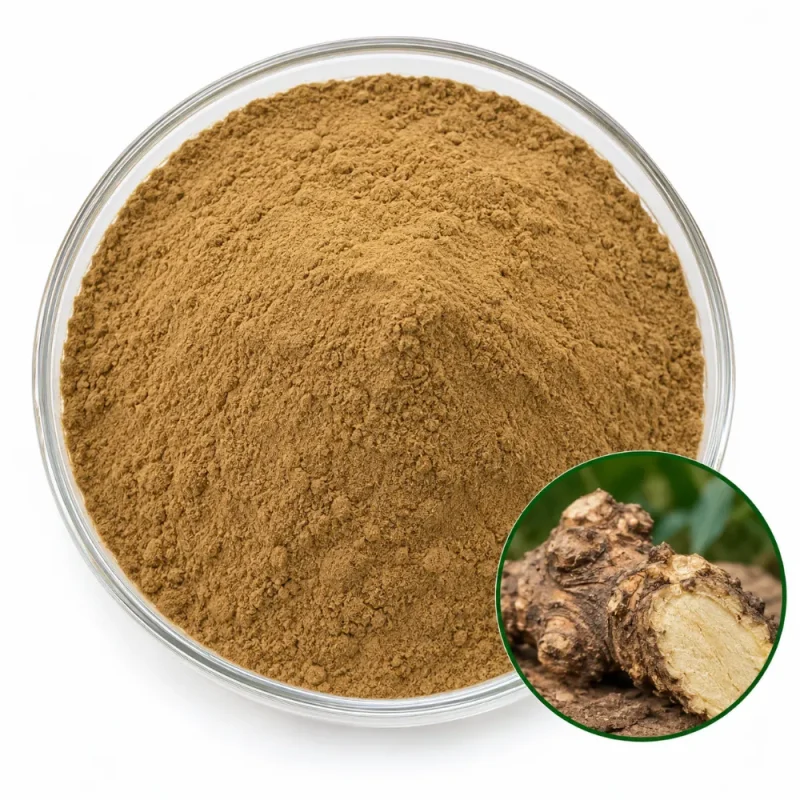
Notopterygium Incisum Extract 1–10% Notopterol

The root and rhizome of Notopterygium incisum, an umbellifer of the high western Chinese plateaus known in herbal trade as qianghuo, are extracted with ethanol to give this Notopterygium incisum extract. The concentrate is dried and milled to a light brown, 80 mesh powder that does not dissolve in water, with a resinous, celery-like aroma.

Notopterol is measured by HPLC and offered as a 1–10% range, with 10% as the primary grade and 1% as the lower grade. Isoimperatorin is tracked as a second marker. The higher grade suits compact capsules, while the lower grade suits oil fills and powder blends that can carry more of the root.

Notopterol Standardization & Grades

Notopterol is a prenylated furanocoumarin, a tricyclic compound in which a furan ring is fused to a coumarin core and carries a hydroxylated isoprenyl side chain. It is one of the characteristic lipophilic constituents of Notopterygium incisum K.C.Ting ex H.T.Chang, and it appears with isoimperatorin, another furanocoumarin, and with volatile oil, phenolic acids and sterols. A Notopterygium incisum extract is standardized to notopterol because it is a defined, measurable member of the furanocoumarin fraction.

GradeAssay & MethodWhere It Fits
1% NotopterolHPLCOil-based fills, blends
10% NotopterolHPLCCapsules, small fill weight

The span is wide, so grade choice follows dose and carrier. At 10% the extract carries ten times the notopterol of the 1% grade per gram, which allows a compact capsule. At 1% the powder keeps more of the root matrix and the aromatic oil and is easier to blend at gram-level inclusion. The same root is also supplied as a 10:1 ratio extract without a marker figure, the Notopterygium Root Extract Powder, and as a milled root, Notopterygium Root Powder.

The root and rhizome are the only part used. Leaves and stems of this plant carry a different chemistry and are not part of this identity.

The harvest of the raw root is part of the identity. Qianghuo grows slowly at altitude, and the root and rhizome are dug in autumn, cleaned and dried before extraction. The thick rhizome portions, which look like a silkworm in the trade description, carry the most volatile oil, while thin lateral roots carry less. A lot with a high share of thin root shows a lower marker share.

Notopterol Analysis & Purity Risks

HPLC separates notopterol from isoimperatorin, bergapten and the other furanocoumarins on a reversed-phase column and detects them in the UV, where the coumarin chromophore absorbs strongly. Each is quantified against its own reference standard. The compounds are close relatives, with similar spectra and retention, so the resolution of the pair notopterol and isoimperatorin from neighboring peaks is the main method requirement.

Light affects the analysis. Furanocoumarins are photoreactive, and solutions left in clear glass can lose peak area as the molecules dimerize or add to solvents. Samples are therefore prepared in amber glassware and run promptly, and a standard that has stood on the bench is replaced before it is used for calibration.

Identity is read from the fingerprint. The notopterol and isoimperatorin pair, with the volatile oil and the phenolic acids, forms a pattern typical of qianghuo. This pattern separates it from the root drugs sold as substitutes, and a lot with a correct marker figure and a different pattern is examined further.

Botanical substitution is the main purity risk. Two plants are accepted as qianghuo in pharmacopeias, Notopterygium incisum and the broad-leaved Notopterygium franchetii, and both appear in trade. Other umbellifer roots, such as those of Angelica pubescens (duhuo) or Ligusticum species, are different drugs with different markers and are sometimes sold under the same trade name. Databases also treat the name Notopterygium incisum as a synonym, so papers may show another name. Species and root part are both fixed in the identity of this extract.

Raw root that is dug early, stored damp or heated loses the volatile fraction, and the extract is darker and less aromatic.

Sample preparation affects the reading. The powder is dissolved in methanol or ethanol with sonication, and the solution is filtered before injection, because undissolved resin blocks columns and lowers the apparent notopterol result. Incomplete dissolution gives a low number that can be mistaken for a weak lot, so complete extraction is confirmed with a spiked sample.

Typical Specifications

Specification ItemProduct Information
Latin NameNotopterygium incisum
Plant PartRoot & Rhizome
ProcessingEthanol Extraction
Compound ClassPolyphenols
Common NameNotopterygium, Qianghuo
Ingredient TypeStandardized Extract
Marker Compound(s)Notopterol; Isoimperatorin
Primary Grade10% Notopterol (HPLC)
Available Grades1% · 10% Notopterol (HPLC)
AppearanceLight Brown powder
Solubility / DispersibilityInsoluble in Water
Quality Parameters
Moisture (LOD)≤5.0%
Total Ash≤5.0%
Particle Size80 mesh
Heavy MetalsLead ≤2 ppm · Arsenic ≤1 ppm · Cadmium ≤1 ppm · Mercury ≤0.1 ppm
MicrobiologyTPC ≤1,000 cfu/g · Yeast & Mold ≤100 cfu/g · E. coli Negative · Salmonella Negative/25 g
Shelf Life24 months in unopened original packaging, cool and dry storage

Applications by Grade

10% Grade in Aromatic Capsule Fills

The 10% grade of Notopterygium incisum extract reaches a notopterol target in a small fill, which suits two-piece capsules. The oily, aromatic powder clings to hopper walls and tamping pins, so a flow agent and a dry filling room keep fill weights steady.

10% Grade in Light-Protected Tablets

Tablets of the 10% grade need a dry binder and an opaque film coat, since furanocoumarins react in light. An amber bottle with a desiccant holds the marker level, and the coat covers the strong, pungent aroma of the root.

1% Grade in Oil-Phase Softgels

The 1% grade disperses in an oil carrier, in which furanocoumarins dissolve far better than in water. This suits softgel-style fills and liquid-filled capsules, and a nitrogen blanket and an antioxidant slow oxidation during storage.

1% Grade in Herbal Powder Blends

Dry herbal blends carry the 1% grade beside other ground roots and rhizomes of the same tradition. The extract is finer than the cut root, so it is premixed with part of the carrier, and the resinous, celery-like aroma of the root is checked against a retained sample after blending.

10% Grade in Stick-Pack Premixes

Stick-pack premixes use the 10% grade in a bulking carrier so the filler can meter an accurate dose of this water-insoluble powder. Label directions should call for shaking, because the powder floats, and an opaque film protects the marker from light.

Technical & Quality Considerations

Notopterygium incisum extract is a light brown powder with a resinous, pungent and celery-like aromatic note. It does not dissolve in water. Notopterol dissolves in ethanol and in lipids, so oil, alcohol-containing and emulsified bases give a more uniform product than a plain aqueous mix.

Furanocoumarins are stable to moderate heat in the dry state, but they are sensitive to light, which dimerizes and degrades them, and to strong alkali, which opens the lactone ring. Opaque packaging, low warehouse light and neutral to mildly acidic bases protect the marker. The hydroxylated side chain of notopterol is also prone to oxidation in solution.

The dry powder is slightly tacky and tends to cake in a warm warehouse. Airborne dust of this root is aromatic and irritating, so closed charging and local extraction protect the filling area.

A short accelerated stability run in the intended pack shows early whether aroma, color and the notopterol figure hold across the shelf life.

A quick check at receipt is useful. A light brown, fine powder with a pungent, celery-like aroma is expected for Notopterygium incisum extract, while a flat smell and a dark shade point to oxidation of the volatile fraction. Both are visible before any assay result arrives.

Packaging & Commercial Supply

Essencefield supports product evaluation, formulation trials, commercial orders, and ongoing ingredient supply. Packaging, storage, and shipping arrangements are determined by product characteristics, order quantity, stability requirements, and destination-market needs.

Supply ItemGeneral Information
SampleAvailable upon request for formulation, testing, and supplier evaluation
Order Quantities100 g · 1 kg · 5 kg · 25 kg · 100 kg · 500 kg · Bulk
Sample Lead TimeTypically 5–7 days after sample confirmation
Production Lead TimeTypically 15–30 days after order and specification confirmation
PackagingSuitable protective inner packaging with bags, cartons, drums, or other appropriate outer packaging
StorageStore in tightly sealed, suitable protective packaging in a cool, dry environment. Protect from moisture, heat, and direct sunlight. Specific storage conditions follow the approved product specification.
DocumentationCOA · Product Specification · TDS · SDS · Applicable declarations (as applicable)

Final order quantities, lead times, packaging, documentation, and shipping arrangements are confirmed according to the selected product and commercial requirements.

Request Ingredient Specifications & Quote

Share your target specification, application, quantity, and documentation needs. We’ll help confirm suitable options, samples, and commercial supply details.