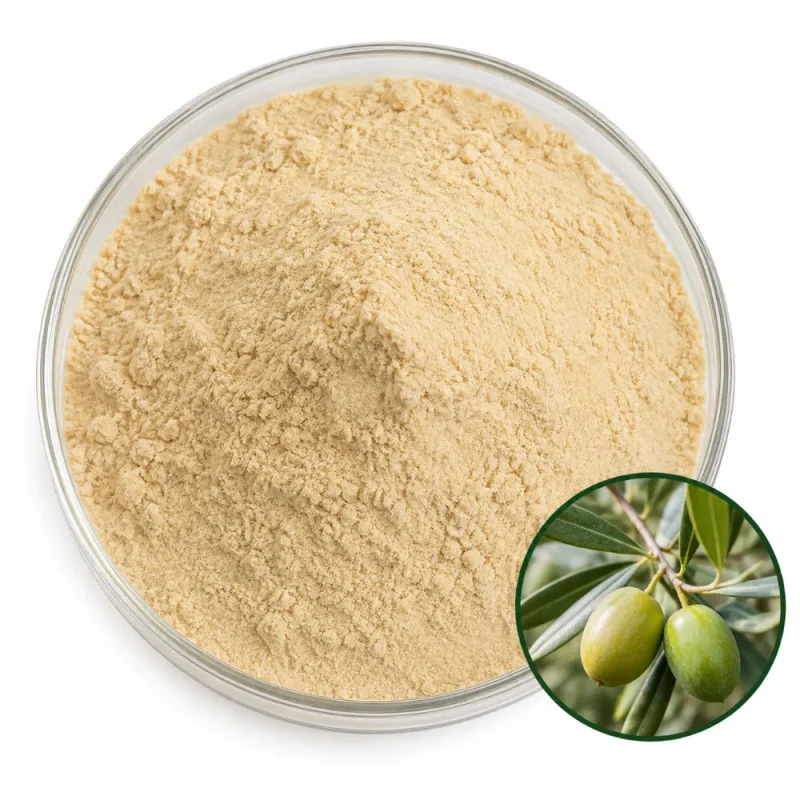
Olive Fruit Extract 10–40% Hydroxytyrosol

The fruit of Olea europaea, the olive of the Mediterranean basin, is extracted to give this olive fruit extract, which is standardized for its principal phenylethanoid. The concentrate is dried and milled to a light brown, 80 mesh powder that dissolves in water to a clear amber solution with a mild olive note.

Hydroxytyrosol is measured by HPLC and offered as a 10–40% range, with 40% as the primary grade and 10% as the lower grade. A purer isolate belongs to the phytochemical range, not to this extract. The higher grade fits small-fill capsules and tablets, and the lower grade fits drink powders.

Hydroxytyrosol Standardization & Grades

Hydroxytyrosol is 3,4-dihydroxyphenylethanol, a small phenylethanoid with a catechol ring. In the olive fruit it is released when the bitter secoiridoid oleuropein and related compounds are hydrolyzed during ripening, curing and processing, so the level in an extract reflects how the fruit was treated. Olea europaea L. fruit extract is standardized to hydroxytyrosol because that is the compound that defines the fruit-derived phenolic fraction, and the figure shows how concentrated the extract is.

GradeAssay & MethodWhere It Fits
10% HydroxytyrosolHPLCDrink powders, higher-inclusion blends
40% HydroxytyrosolHPLCCapsules and tablets, small fill weight

The span is wide, so grade choice follows dose and carrier. At 40% the extract carries four times the hydroxytyrosol of the 10% grade per gram, which allows a compact capsule. The 10% grade retains more of the fruit matrix and dissolves quickly into beverages. The same fruit is also supplied as a 10:1 ratio extract without a marker figure, the Olive Fruit Extract Powder, and the leaf of the same tree has its own standardized extract, Olive Leaf Extract 10–40% Oleuropein, which is built on a different marker. The plain 10:1 leaf extract is the Olive Leaf Extract Powder.

The fruit is the only part used. Olive leaf, oil and pomace are separate materials with other markers, and they are not part of this identity.

The fruit is the part used. Olives are harvested at a defined ripeness, because the oleuropein content that feeds hydroxytyrosol falls as the fruit ripens, and green fruit gives a different phenolic profile from black fruit. The stone is removed or crushed before extraction in some processes, and a lot should state which approach is used, since stone material adds lignin and little hydroxytyrosol.

Hydroxytyrosol Analysis & Purity Risks

HPLC separates hydroxytyrosol from tyrosol, oleuropein, verbascoside and the other olive phenolics on a reversed-phase column and detects it in the UV, where the catechol ring absorbs. The result is hydroxytyrosol itself, quantified against a reference standard. Hydroxytyrosol is small and polar, so it elutes early, and the column and gradient have to keep it apart from the solvent front and from tyrosol, its close relative.

The profile of the companions matters. Free hydroxytyrosol rises as oleuropein and its esters are hydrolyzed, so a fruit extract with a high hydroxytyrosol share and a low oleuropein share is a more fully hydrolyzed material than a leaf extract. The ratio of the two is a useful signal of how the extract was made and how stable it will be.

Hydroxytyrosol oxidizes readily. The ortho-diphenol group is converted to a quinone in air, especially at neutral to alkaline pH and in the presence of trace metals, and the quinone polymerizes to brown products. Sample solutions are therefore acidified and analyzed promptly, and standards are prepared fresh, because a standard left in neutral solution decays within hours.

Purity risks follow from the naming and the source. Hydroxytyrosol is sold from several olive streams, including fruit, leaf and the aqueous by-product of oil milling, and these differ in the companion compounds that accompany it. Synthetic or semi-synthetic hydroxytyrosol is chemically identical and can be added, which the companion pattern would not support. The stated species and the fruit part are part of the identity.

Fruit harvested at different ripeness stages carries different levels of oleuropein and hydroxytyrosol, so the raw-material specification includes maturity.

Sample preparation affects the reading. Hydroxytyrosol is stabilized by dissolving the extract in dilute acid or in a methanol-water mixture containing an antioxidant, and the solution is filtered and injected within a short time. A sample left in neutral water turns pink within hours, and the area of the hydroxytyrosol peak falls, so careful timing is part of the method.

Typical Specifications

Specification ItemProduct Information
Latin NameOlea europaea
Plant PartFruit & Berry
ProcessingEthanol Extraction
Compound ClassPolyphenols
Common NameOlive, Olive Fruit
Ingredient TypeStandardized Extract
Marker Compound(s)Hydroxytyrosol
Primary Grade40% Hydroxytyrosol (HPLC)
Available Grades10% · 40% Hydroxytyrosol (HPLC)
AppearanceLight Brown powder
Solubility / DispersibilityWater Soluble
Quality Parameters
Moisture (LOD)≤5.0%
Total Ash≤5.0%
Particle Size80 mesh
Heavy MetalsLead ≤2 ppm · Arsenic ≤1 ppm · Cadmium ≤1 ppm · Mercury ≤0.1 ppm
MicrobiologyTPC ≤1,000 cfu/g · Yeast & Mold ≤100 cfu/g · E. coli Negative · Salmonella Negative/25 g
Shelf Life24 months in unopened original packaging, cool and dry storage

Applications by Grade

40% Grade in Oxidation-Prone Capsule Fills

The 40% grade of olive fruit extract reaches a hydroxytyrosol target in a small fill, which suits two-piece capsules. The catechol darkens in moist air, so a dry filling room, sealed hoppers and a quick turnaround from drum to capsule protect the color of the powder.

40% Grade in Oxygen-Barrier Tablets

Tablets of the 40% grade need a dry binder and a moisture- and oxygen-barrier coat, because the phenol browns on the tablet surface. A bottle with an oxygen absorber and a desiccant holds the pale brown color through the shelf life.

10% Grade in Acidified Drink Powders

The 10% grade of olive fruit extract dissolves readily into instant drink powders and stick packs. A small amount of citric or ascorbic acid in the premix keeps the solution acidic and slows browning, and a mild, slightly bitter olive note is expected in the cup.

10% Grade in Oil-Blend Premixes

Premixes for oil-based foods use the 10% grade in a fat-compatible carrier, where hydroxytyrosol acts as an antioxidant for the oil phase. Dispersion is the main task, because the polar powder does not dissolve in oil, so fine milling and good mixing are used.

40% Grade in Contract Blending

Contract blenders use the 40% grade as a concentrated component in multi-ingredient powders. Blend in stages, since a low inclusion of a fine powder segregates in transport, and log moisture at charging because the phenol degrades faster in damp blends.

Technical & Quality Considerations

Olive fruit extract is a light brown powder with a mild, fruity and slightly bitter olive character. It dissolves in water to a clear amber solution, and hydroxytyrosol itself is highly soluble in water and in ethanol, so both aqueous and hydroalcoholic liquid formats are workable.

The catechol group is the stability-limiting feature. In neutral to alkaline solution, and in the presence of oxygen and trace metals, hydroxytyrosol oxidizes and the solution darkens through pink to brown. Acidic bases, antioxidants such as ascorbic acid, chelating agents and low-oxygen packaging slow the change. The dry powder is more stable but browns in humid air.

The dry powder takes up moisture and cakes. Closed charging and local extraction keep phenolic dust out of the air at the filler.

At the line, avoid contact of the powder with alkaline fillers and iron-bearing equipment, which accelerate browning. A short accelerated stability run in the intended pack shows early whether color, flow and the hydroxytyrosol figure hold across the shelf life.

A quick check at receipt is useful. A light brown, fine powder with a mild fruity and slightly bitter note is expected for olive fruit extract, while a dark pink or gray cast points to oxidized catechol and a sour smell suggests damp storage. Both are visible before any assay result arrives.

Packaging & Commercial Supply

Essencefield supports product evaluation, formulation trials, commercial orders, and ongoing ingredient supply. Packaging, storage, and shipping arrangements are determined by product characteristics, order quantity, stability requirements, and destination-market needs.

Supply ItemGeneral Information
SampleAvailable upon request for formulation, testing, and supplier evaluation
Order Quantities100 g · 1 kg · 5 kg · 25 kg · 100 kg · 500 kg · Bulk
Sample Lead TimeTypically 5–7 days after sample confirmation
Production Lead TimeTypically 15–30 days after order and specification confirmation
PackagingSuitable protective inner packaging with bags, cartons, drums, or other appropriate outer packaging
StorageStore in tightly sealed, suitable protective packaging in a cool, dry environment. Protect from moisture, heat, and direct sunlight. Specific storage conditions follow the approved product specification.
DocumentationCOA · Product Specification · TDS · SDS · Applicable declarations (as applicable)

Final order quantities, lead times, packaging, documentation, and shipping arrangements are confirmed according to the selected product and commercial requirements.

Request Ingredient Specifications & Quote

Share your target specification, application, quantity, and documentation needs. We’ll help confirm suitable options, samples, and commercial supply details.