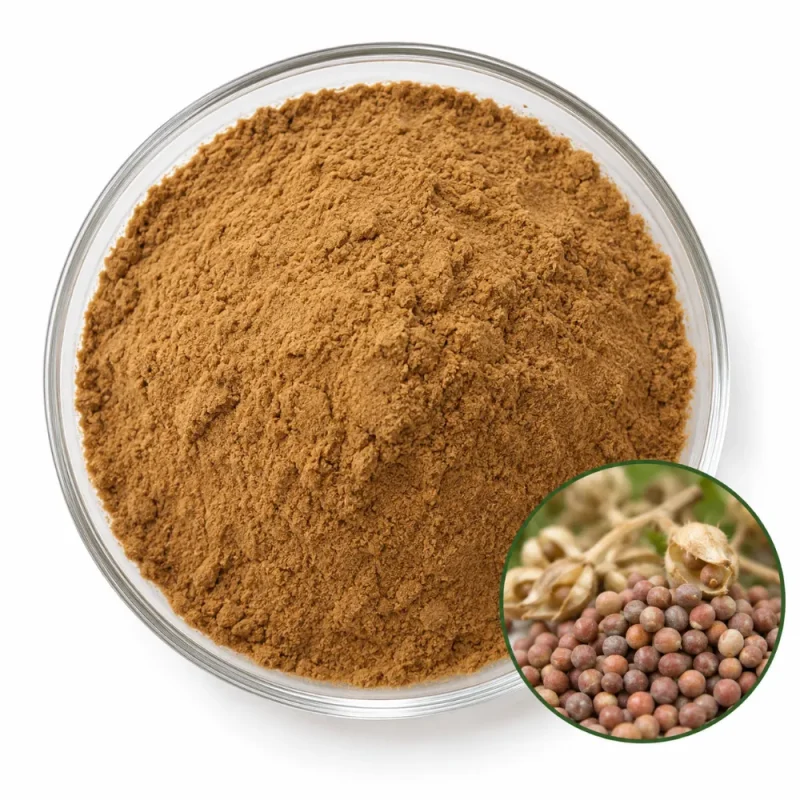
Radish Seed Extract 0.5–0.8% Alkaloids

Radish seed extract is prepared from the ripe seeds of Raphanus sativus L., the garden radish of the family Brassicaceae, and not from the fleshy root. Ethanol extraction takes up the seed’s alkaloid fraction, and the concentrate is dried to a light brown powder.

The alkaloid content is set at 0.5–0.8%, with a primary grade of 0.8% and a lower grade of 0.5%. The powder is 80 mesh and slightly soluble in water. Both grades suit capsules, tablets and dry blends where a seed-derived extract is specified.

Radish Seed Alkaloid Standardization & Grades

Alkaloids are nitrogen-containing plant compounds, and in Brassicaceae seeds the fraction includes choline esters of phenolic acids, of which sinapine is the best known. The botanical entity is Raphanus sativus L., and the part is the seed, which is a different raw material from the root sold as vegetable powder. Radish seed extract is standardized to total alkaloids because this is the measurable class that distinguishes the seed fraction from the sulfur compounds and oil that dominate the rest of the seed.

GradeAssay & MethodWhere It Fits
0.5% AlkaloidsTotal alkaloidsDry blends, higher inclusion
0.8% AlkaloidsTotal alkaloidsCapsules and tablets, lower inclusion

The two grades are close, so the choice is a matter of inclusion rate and cost per gram of alkaloid. The 0.8% grade needs about five eighths of the powder to reach the same alkaloid load, which helps where fill weight is limited. The 0.5% grade is the simpler choice in blends where bulk is not a constraint. The same seed is sold as Radish Seed Extract Powder with a 10:1 ratio and no marker figure, while the root is supplied as Radish Powder, a different material.

Radish Seed Alkaloid Analysis & Purity Risks

An alkaloid percentage is a class figure, and the number depends on how the class is measured. A total can come from acid–base partition followed by weighing, from a dye-complex reading in the visible range, or from adding up marker alkaloids by HPLC. These routes count different things, so a result is comparable only with another result on the same basis, and a total cannot be converted into an HPLC figure for single compounds.

For radish seed, the alkaloid fraction is small beside the other seed constituents. Glucosinolates and their breakdown products, such as the isothiocyanates that give radish its pungent note, are sulfur compounds and sit outside an alkaloid figure. So does the fatty oil of the seed, which is rich in erucic acid. A lot that was not defatted carries more oil into the powder, and the oil lowers the alkaloid share and shortens shelf stability.

Purity risks follow from the material class. Seeds of other Brassica crops, such as mustard and rapeseed, look similar and carry a comparable alkaloid family, so seed identity is confirmed by botanical inspection before extraction. The root and the seed are different raw materials, and a root-derived powder has a very different profile. Seed lots of an old harvest lose freshness, and rancid oil can raise the peroxide level and give a fatty off-note to the finished powder.

Sample preparation matters when the class figure is small. A sample of a few hundred milligrams is dissolved, the matrix is cleaned by acid–base partition, and the blank is run beside it, so that the brown color of the powder is not read as alkaloid.

Typical Specifications

Specification ItemProduct Information
Latin NameRaphanus sativus
Plant PartSeed & Grain
ProcessingEthanol Extraction
Compound ClassAlkaloids
Common NameRadish Seed, Garden Radish Seed
Ingredient TypeStandardized Extract
Marker Compound(s)Total alkaloids
Primary Grade0.8% Alkaloids
Available Grades0.5% · 0.8% Alkaloids
AppearanceLight Brown powder
Solubility / DispersibilitySlightly Soluble in Water
Quality Parameters
Moisture (LOD)≤5.0%
Total Ash≤5.0%
Particle Size80 mesh
Heavy MetalsLead ≤2 ppm · Arsenic ≤1 ppm · Cadmium ≤1 ppm · Mercury ≤0.1 ppm
MicrobiologyTPC ≤1,000 cfu/g · Yeast & Mold ≤100 cfu/g · E. coli Negative · Salmonella Negative/25 g
Shelf Life24 months in unopened original packaging, cool and dry storage

Applications by Grade

0.8% Grade for Capsule Fills

The 0.8% grade reaches its alkaloid target in a smaller fill, which suits two-piece capsules with limited space. The light brown powder carries a faint seed-like odor, so a flow agent and a closed filling line keep the room clean.

0.5% Grade in Dry Blends

Dry blends with other seed extracts take the 0.5% grade as a bulkier component. Sieve it with the carrier before the main mix, because the fine particles stick to scoops and mixer walls once they pick up moisture.

0.8% Grade in Tablet Blends

Tablets of the 0.8% grade need a dry binder and a glidant. The seed extract compacts as a slightly oily solid, so tablet hardness and disintegration time are checked after storage, and a film coat limits moisture pickup and odor.

0.5% Grade for Stick-Pack Premixes

Stick-pack premixes of the 0.5% grade are made with a bulking carrier so that the filler can weigh an accurate dose. The extract is only slightly soluble, so it is dosed as a suspended powder and is not used in clear drinks.

0.8% Grade in Soft-Chew Bases

Soft chews take the 0.8% grade when a small dose is spread through a large base. Add it after the main cook, because long heating deepens the brown color and can bring out a bitter, pungent note from the sulfur compounds that remain.

0.5% Grade for Seed-Extract Blends

Multi-extract blends use the 0.5% grade to add a seed-derived component without raising the pungent note too far. It pairs with other pale seed extracts, and the blend is homogenized in two steps so that the small share of radish seed extract spreads evenly through the batch.

Technical & Quality Considerations

Radish seed extract is a light brown powder with a mild, slightly pungent seed odor. It is slightly soluble in water, so a solution turns hazy brown, with part of the alkaloid fraction dissolved and the oily, lipophilic part left in suspension. The sulfur-containing compounds that remain in a seed extract break down on heating and in moist conditions, and the pungent note intensifies. Keep the powder dry and cool in handling, and avoid long hot-holding of a wet blend.

Alkaloids of this kind react with iron and can darken the powder when it contacts carbon steel. Stainless contact surfaces and low-iron carriers are the better choice. The residual seed oil oxidizes slowly under light and oxygen, so drums are sealed and flushed, and clear packs are kept out of direct light.

Heat and moisture also work on the glucosinolate residue through the seed’s own myrosinase, if any enzyme activity survives extraction. Where the powder is stored warm and damp, the isothiocyanate smell can build up in the sealed bag, so radish seed extract is kept in low-humidity storage with liners that close tightly.

For scale-up, premix the powder with a small share of the carrier and verify fill weight at each lot change. A retained sample from each lot allows color, odor and flow to be compared by eye before release, and the odor check is the quickest way to catch an oxidized seed lot.

Packaging & Commercial Supply

Essencefield supports product evaluation, formulation trials, commercial orders, and ongoing ingredient supply. Packaging, storage, and shipping arrangements are determined by product characteristics, order quantity, stability requirements, and destination-market needs.

Supply ItemGeneral Information
SampleAvailable upon request for formulation, testing, and supplier evaluation
Order Quantities100 g · 1 kg · 5 kg · 25 kg · 100 kg · 500 kg · Bulk
Sample Lead TimeTypically 5–7 days after sample confirmation
Production Lead TimeTypically 15–30 days after order and specification confirmation
PackagingSuitable protective inner packaging with bags, cartons, drums, or other appropriate outer packaging
StorageStore in tightly sealed, suitable protective packaging in a cool, dry environment. Protect from moisture, heat, and direct sunlight. Specific storage conditions follow the approved product specification.
DocumentationCOA · Product Specification · TDS · SDS · Applicable declarations (as applicable)

Final order quantities, lead times, packaging, documentation, and shipping arrangements are confirmed according to the selected product and commercial requirements.

Request Ingredient Specifications & Quote

Share your target specification, application, quantity, and documentation needs. We’ll help confirm suitable options, samples, and commercial supply details.