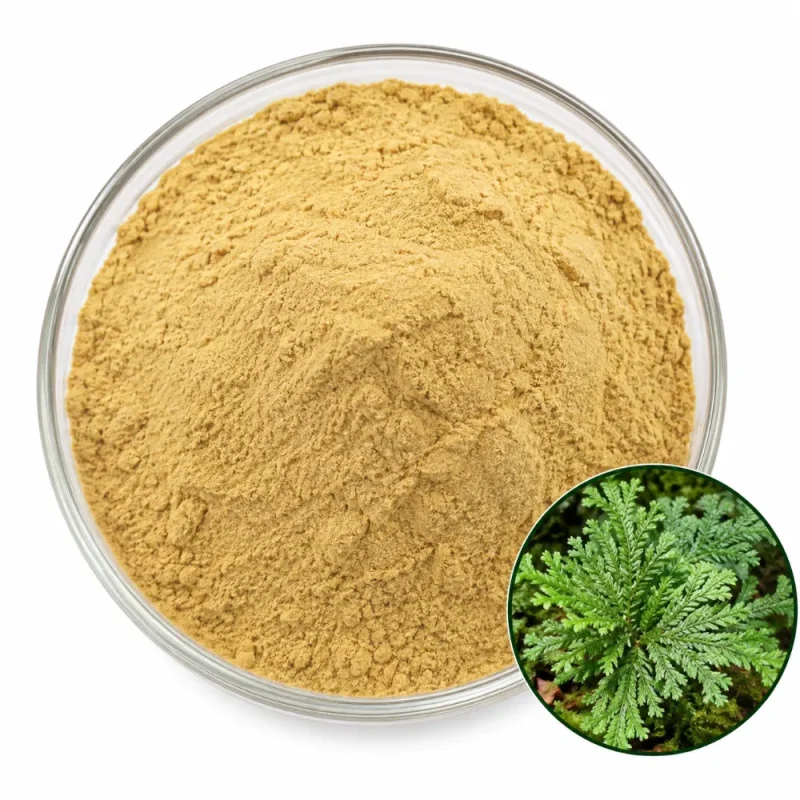
Selaginella Tamariscina Extract 5–30% Amentoflavone

Selaginella tamariscina extract is prepared from the aerial parts of the resurrection spikemoss, Selaginella tamariscina (P.Beauv.) Spring, a fern ally of the family Selaginellaceae. Ethanol extraction concentrates the biflavonoid fraction, and the concentrate is dried to a light brown powder.

Amentoflavone is measured by HPLC, with a primary grade of 30% and a lower grade of 5%. The powder is 80 mesh and insoluble in water. The 30% grade suits capsules and softgel suspensions, while the 5% grade suits larger-inclusion blends.

Amentoflavone Standardization & Grades

Amentoflavone is a biflavonoid, a dimer in which two apigenin units are joined through a carbon bond between the 3′ position of one and the 8” position of the other. Biflavonoids are the signature class of spikemosses, and Selaginella species carry amentoflavone together with robustaflavone, hinokiflavone and related dimers. The extract is standardized to amentoflavone because it is the best defined and most abundant of the series and can be measured against a reference standard.

The botanical entity is Selaginella tamariscina (P.Beauv.) Spring, and the part is the aerial portion of the plant. The species curls into a ball when dry and opens when wetted, and that behavior gives it the name resurrection plant. The purified compound is available separately as Amentoflavone 98%, for work that needs the single molecule.

Selaginella tamariscina extract is made from the dried herb, which is cut, extracted with ethanol and concentrated. Because amentoflavone dissolves poorly in water, the ethanol step is what separates it from the sugars and salts of the plant, and the concentrate that results is several times richer in biflavonoid than the herb itself. This is the reason the product is made with ethanol.

GradeAssay & MethodWhere It Fits
5% AmentoflavoneHPLCBlends, larger inclusion
30% AmentoflavoneHPLCCapsules and softgel suspensions

The 30% grade carries six times the amentoflavone load of the 5% grade per gram, so a capsule reaches its target with a very small fill. The 5% grade is the bulky powder, and it fits blends in which the biflavonoid is one component of a plant-extract mixture and the fill weight is not limiting.

Amentoflavone Analysis & Purity Risks

HPLC separates amentoflavone from the other biflavonoids and from the monomeric flavones of the plant and reads it as a single peak against a reference standard. The result is a specific compound, not a class equivalent, and it is stated on the dry basis. It cannot be compared with a UV total flavonoid figure, since that method counts monomers and dimers together and does not distinguish them.

The biflavonoids are structurally close, and amentoflavone, robustaflavone and hinokiflavone differ only in the position and type of the inter-flavonoid bond. A chromatographic method with enough resolving power is needed to keep their peaks apart, and a method with a short column can merge them and overstate amentoflavone. The fingerprint is therefore read for the pattern of neighboring peaks, not just the main one.

Purity risks follow from the material class. The genus Selaginella is large, and other species are traded under the same names. Selaginella sinensis, for example, is sometimes cited as a source of amentoflavone, but it is a different plant. The aerial portion of Selaginella tamariscina is the defined part. Roots and dead basal material carry less of the compound and more soil, so a lot with a high share of that tissue shows a lower figure.

Because the species grows on rock faces and in dry scrub, soil and mineral carry-over is checked through ash and heavy metals, which are part of the quality parameters of every lot.

Typical Specifications

Specification ItemProduct Information
Latin NameSelaginella tamariscina
Plant PartLeaf & Herb
ProcessingEthanol Extraction
Compound ClassFlavonoids, Polyphenols
Common NameSpikemoss, Resurrection Plant
Ingredient TypeStandardized Extract
Marker Compound(s)Amentoflavone
Primary Grade30% Amentoflavone (HPLC)
Available Grades5% · 30% Amentoflavone (HPLC)
AppearanceLight Brown powder
Solubility / DispersibilityInsoluble in Water
Quality Parameters
Moisture (LOD)≤5.0%
Total Ash≤5.0%
Particle Size80 mesh
Heavy MetalsLead ≤2 ppm · Arsenic ≤1 ppm · Cadmium ≤1 ppm · Mercury ≤0.1 ppm
MicrobiologyTPC ≤1,000 cfu/g · Yeast & Mold ≤100 cfu/g · E. coli Negative · Salmonella Negative/25 g
Shelf Life24 months in unopened original packaging, cool and dry storage

Applications by Grade

30% Grade for Capsule Fills

The 30% grade of Selaginella tamariscina extract reaches its amentoflavone target in a very small fill. The powder is fine and static, so a flow agent, a dry room and a closed filling line stop it bridging in the hopper, and a check weight at the start of each run confirms the fill.

5% Grade in Dry Blends

The 5% grade works in dry blends with other flavonoid-rich extracts. Sieve it with the carrier first, and mix in two steps, because the small share of a pale brown powder spreads unevenly if it is added in one charge to a large batch.

30% Grade for Softgel Suspensions

The insoluble 30% grade is milled into an oil phase for softgel fills. Amentoflavone dissolves only slightly in oil, and the suspension is checked for settling and viscosity before encapsulation to ensure that dosing stays uniform.

5% Grade in Tablet Blends

Tablets of the 5% grade need a dry binder and a glidant. The extract compacts well, and a film coat reduces dusting and hides the brown core, while disintegration is rechecked after storage because the phenolic solid takes up moisture slowly.

30% Grade for Powder Premixes

Premixes carry the 30% grade of Selaginella tamariscina extract in a larger dry blend with a bulking carrier. The powder does not dissolve, so it is intended for products stirred into a thick base and not for clear drinks, where it would settle.

30% Grade for Oil-Based Drops

Oil-based drops carry the 30% grade as a fine suspension in a medium-chain oil. Amentoflavone is only slightly oil soluble, so the particles are milled small and a suspending agent holds them, and the bottle label tells the user to shake before use.

Technical & Quality Considerations

Selaginella tamariscina extract is a light brown powder with a faint grassy scent. Amentoflavone is insoluble in water and only slightly soluble in most oils, so an aqueous product shows a fine suspension that settles on standing. Wetting agents, milling and a viscous carrier improve dispersion, and a pre-wetted slurry added to the batch avoids floating lumps.

The biflavonoid is stable to moderate heat but sensitive to strong light over long periods, and phenolic hydroxyl groups chelate iron. The powder darkens on contact with carbon steel, so stainless surfaces and low-iron fillers are preferred. In humid storage the powder takes up moisture slowly and clumps.

Sealed liners with desiccant keep the powder free flowing. The two grades differ widely in bulk, so a change of grade on the filling line calls for a new check weight. Compare each lot with a retained sample for the depth of color. The tone follows the drying conditions of the plant material and the amount of green tissue in the lot.

Because the plant grows slowly and is gathered from the wild in many regions, lot-to-lot variation in biflavonoid content is wider than in cultivated crops. The standardization step evens out that variation, and blending of raw material lots before extraction is a common way to keep the finished powder consistent from one production run to the next.

Packaging & Commercial Supply

Essencefield supports product evaluation, formulation trials, commercial orders, and ongoing ingredient supply. Packaging, storage, and shipping arrangements are determined by product characteristics, order quantity, stability requirements, and destination-market needs.

Supply ItemGeneral Information
SampleAvailable upon request for formulation, testing, and supplier evaluation
Order Quantities100 g · 1 kg · 5 kg · 25 kg · 100 kg · 500 kg · Bulk
Sample Lead TimeTypically 5–7 days after sample confirmation
Production Lead TimeTypically 15–30 days after order and specification confirmation
PackagingSuitable protective inner packaging with bags, cartons, drums, or other appropriate outer packaging
StorageStore in tightly sealed, suitable protective packaging in a cool, dry environment. Protect from moisture, heat, and direct sunlight. Specific storage conditions follow the approved product specification.
DocumentationCOA · Product Specification · TDS · SDS · Applicable declarations (as applicable)

Final order quantities, lead times, packaging, documentation, and shipping arrangements are confirmed according to the selected product and commercial requirements.

Request Ingredient Specifications & Quote

Share your target specification, application, quantity, and documentation needs. We’ll help confirm suitable options, samples, and commercial supply details.