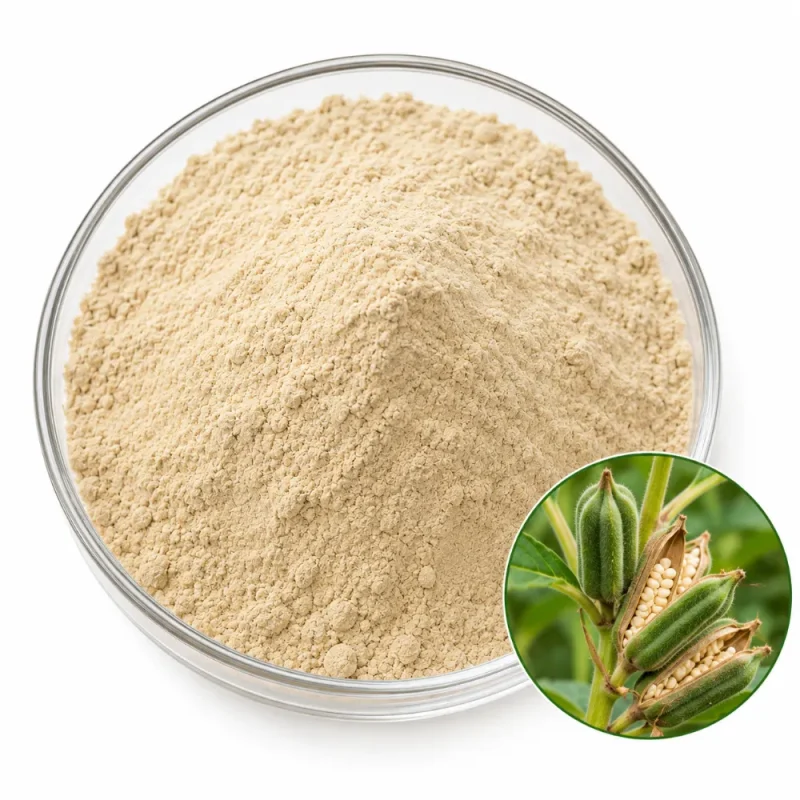
Sesame Extract 65–70% Sesamin + Sesamolin complex

Sesame lignan extract is prepared from the seed of Sesamum indicum L., the sesame plant of the family Pedaliaceae, and is standardized to the sesamin and sesamolin complex. Ethanol extraction concentrates the lignans of the seed, and the concentrate is dried to a light yellow powder.

The sesamin and sesamolin complex is measured by HPLC, with a primary grade of 70% and a lower grade of 65%. The powder is 80 mesh and insoluble in water. It suits capsules, softgel suspensions and oil-phase systems in which a lignan complex with a stated assay is needed.

Sesame Lignan Standardization & Grades

Lignans are dimeric phenylpropanoid compounds. In sesame seed the two principal lignans are sesamin and sesamolin, both with a methylenedioxyphenyl unit and a furofuran core, and both lipophilic. They sit in the oil fraction of the seed together with the fatty oil, tocopherols and sesamol precursors. The extract is standardized to the combined complex because it is the stable, measurable lignan fraction, and because the two compounds are routinely quantified together by HPLC.

The botanical entity is Sesamum indicum L., and the part is the seed. White and black sesame belong to the same species and differ in seed coat. Black sesame seed is supplied in extract and milled form, among them Black Sesame Extract Powder and Black Sesame Powder. The 10:1 ratio extract of the seed, with no marker figure, is the Sesame Seed Extract Powder.

Sesame lignan extract is made from the oil-bearing fraction of the seed. The seed is pressed or solvent-extracted, the lignans are concentrated from the oil by ethanol partition and crystallization-type steps, and the result is dried to a powder. Because the lignans are fat soluble and the starting material is mostly oil, this is a heavily concentrated product, with a very small mass of lignan complex recovered from each kilogram of seed.

GradeAssay & MethodWhere It Fits
65% Sesamin + SesamolinHPLCCapsules, oil-phase systems
70% Sesamin + SesamolinHPLCSoftgel suspensions, small fill

The two grades are close, and the choice depends on inclusion rate and the degree of purification wanted. The 70% grade carries slightly more lignan per gram, so a softgel or capsule reaches the same target with a little less powder. Both grades are read on the same HPLC basis, so a formulator can switch between them by simple weight adjustment.

Sesame Lignan Analysis & Purity Risks

An HPLC assay separates sesamin from sesamolin and from the related lignans of the seed, and reads each peak against a reference standard. The complex is the sum of the two compounds, so a result is comparable only with another that counts the same two. The total also cannot be converted into a UV figure for total phenolics, which measures a different property.

The ratio of sesamin to sesamolin is part of the identity of the lot. Sesamolin is chemically less stable than sesamin. On heat and acid it breaks down, releasing sesamol, a small free phenol. A lot with an unusually low sesamolin share and a high sesamol content has therefore seen heat, and the chromatogram shows it.

Purity risks follow from the material class. Sesame oil and sesame seed are the source of the lignans, and a lot made from roasted seed has already lost part of its sesamolin. The extract is a lipophilic fraction, so residual triglyceride oil dilutes the figure and shortens shelf life by oxidizing. Chromatographic purity at this strength means the oil has been largely removed.

A final point concerns identity. Sesamin is also found in other plants, such as some Piper and Magnolia species, but sesame is the principal commercial source and the one that carries sesamolin.

Typical Specifications

Specification ItemProduct Information
Latin NameSesamum indicum
Plant PartSeed & Grain
ProcessingEthanol Extraction
Compound ClassLignans, Polyphenols
Common NameSesame Lignans
Ingredient TypeStandardized Extract
Marker Compound(s)Sesamin + sesamolin complex
Primary Grade70% Sesamin + Sesamolin complex (HPLC)
Available Grades65% · 70% Sesamin + Sesamolin complex (HPLC)
AppearanceLight Yellow powder
Solubility / DispersibilityInsoluble in Water
Quality Parameters
Moisture (LOD)≤5.0%
Total Ash≤5.0%
Particle Size80 mesh
Heavy MetalsLead ≤2 ppm · Arsenic ≤1 ppm · Cadmium ≤1 ppm · Mercury ≤0.1 ppm
MicrobiologyTPC ≤1,000 cfu/g · Yeast & Mold ≤100 cfu/g · E. coli Negative · Salmonella Negative/25 g
Shelf Life24 months in unopened original packaging, cool and dry storage

Applications by Grade

70% Grade for Softgel Suspensions

The 70% grade is milled into an oil phase for softgel fills. The lignans are oil-soluble to a limited degree, so the particle size and the oil temperature are controlled, and the fill is checked for crystal growth over time on stability storage.

65% Grade in Capsule Fills

The 65% grade reaches its lignan target in a small capsule fill. The pale yellow powder is somewhat waxy and static, so a flow agent and a dry filling room keep the hopper from bridging, and the fill weight is checked at the start of each run.

70% Grade in Oil-Phase Systems

Oil-based liquids and drops carry the 70% grade dissolved in warm oil, or suspended after milling. Because sesamin is only moderately soluble, the oil, temperature and concentration are chosen together, and the solution is cooled slowly to avoid precipitation.

65% Grade for Tablet Blends

Tablets of the 65% grade need a dry binder and a lubricant. The powder is hydrophobic, so a wetting disintegrant helps the tablet break up, and a film coat reduces dusting and hides the pale yellow core.

70% Grade for Powder Premixes

Premixes carry the 70% grade in a dry blend with a bulking carrier. The powder does not dissolve in water, so it is meant for products stirred into thick bases and for oil-containing premixes, not for clear drinks.

65% Grade for Oil-Based Drops

Oil-based drops use the 65% grade warmed into a carrier oil. Sesame oil itself is a natural carrier, but its flavor is strong, so a neutral medium-chain oil gives a cleaner taste. Cooling is slow, and the bottle is checked for haze after a week at room temperature.

Technical & Quality Considerations

Sesame lignan extract is a light yellow powder with a faint nutty scent. It is insoluble in water and moderately soluble in oils and in organic solvents, so aqueous systems show a fine suspension that settles on standing. Wetting agents, milling and a viscous carrier help dispersion, and a pre-dispersion in oil before addition to a water-based product gives a more uniform result.

Sesamin is stable at moderate temperature and at neutral pH, while sesamolin breaks down more readily under heat and acid. A formula with a hot hold at low pH changes the sesamin-to-sesamolin balance and releases sesamol, so the extract is added late in a thermal process. Residual oil in the powder oxidizes slowly in light and air, and sealed, flushed liners protect the lot.

Check fill weight when switching between lots, and compare each lot with a retained sample for color and odor. A rancid note is the earliest sign of oxidation in this lipophilic powder, and it signals a lot that should be reviewed before release.

The powder also behaves as a slightly waxy solid. It melts at a modest temperature, and in hot storage the particles fuse into a hard cake, which is why drums travel and sit in cool conditions. Sieving after storage restores flow, but a lot that has fused repeatedly is reviewed for oxidation and color.

Packaging & Commercial Supply

Essencefield supports product evaluation, formulation trials, commercial orders, and ongoing ingredient supply. Packaging, storage, and shipping arrangements are determined by product characteristics, order quantity, stability requirements, and destination-market needs.

Supply ItemGeneral Information
SampleAvailable upon request for formulation, testing, and supplier evaluation
Order Quantities100 g · 1 kg · 5 kg · 25 kg · 100 kg · 500 kg · Bulk
Sample Lead TimeTypically 5–7 days after sample confirmation
Production Lead TimeTypically 15–30 days after order and specification confirmation
PackagingSuitable protective inner packaging with bags, cartons, drums, or other appropriate outer packaging
StorageStore in tightly sealed, suitable protective packaging in a cool, dry environment. Protect from moisture, heat, and direct sunlight. Specific storage conditions follow the approved product specification.
DocumentationCOA · Product Specification · TDS · SDS · Applicable declarations (as applicable)

Final order quantities, lead times, packaging, documentation, and shipping arrangements are confirmed according to the selected product and commercial requirements.

Request Ingredient Specifications & Quote

Share your target specification, application, quantity, and documentation needs. We’ll help confirm suitable options, samples, and commercial supply details.