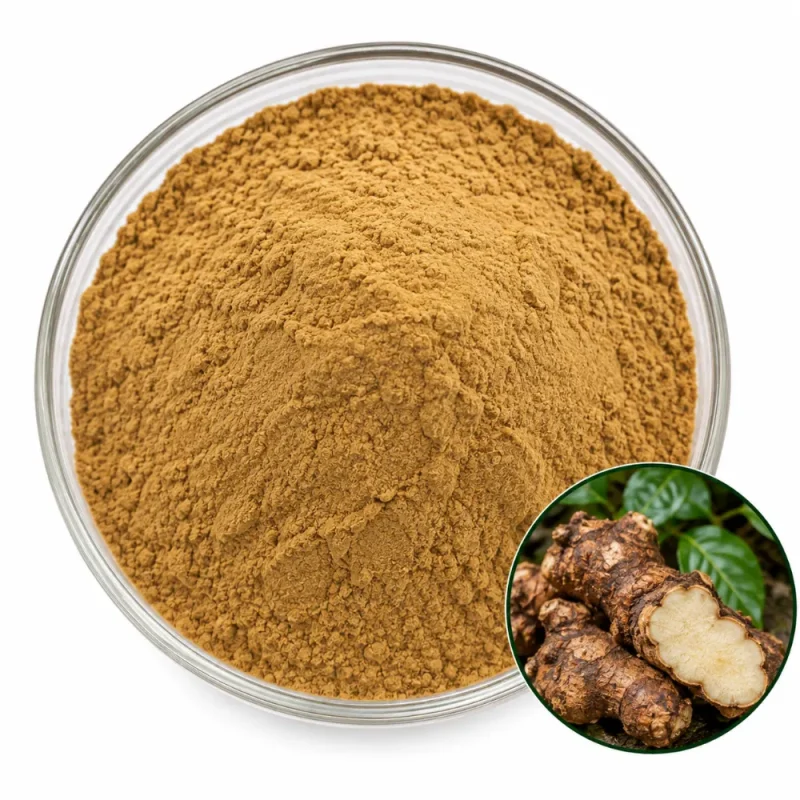
Smilax glabra Extract 10–20% Saponins

Smilax glabra extract is prepared from the rhizome of Smilax glabra Roxb., the plant sold in Chinese medicine as tu fu ling, a climbing member of the family Smilacaceae. Ethanol extraction concentrates the saponin fraction of the rhizome, and the concentrate is dried to a light brown powder that dissolves in water.

Total saponins are measured by UV spectrophotometry, with a primary grade of 20% and a lower grade of 10%. The powder is 80 mesh. The 20% grade suits capsules and tablets, while the 10% grade suits drink powders and blends.

Smilax Saponin Standardization & Grades

Saponins are glycosides with a steroidal or triterpenoid core and one or more sugar chains. The rhizome of Smilax glabra carries steroidal saponins, and it also holds a very different group, the flavanonol glycosides led by astilbin with its isomers neoastilbin and isoastilbin, plus starch and polysaccharides. Smilax glabra extract is standardized to saponins because the class is a stable, measurable index of concentration, and it is a different figure from the astilbin that some suppliers use.

The botanical entity is Smilax glabra Roxb., and the part is the rhizome. Several other Smilax species, among them Smilax china, are used in regional medicine under similar names. The same rhizome is supplied as a 10:1 ratio extract with no marker figure, Smilax Glabra Extract Powder, and the flavanonol is available as a single compound, Astilbin 98%.

Smilax glabra extract is made from rhizome that is washed, sliced, dried, extracted and concentrated. The rhizome is mostly starch, and the extraction step leaves much of that starch behind with the spent slices, so the finished powder is far richer in saponin and flavanonol than the dried slice. The remaining starch fraction explains the slightly sweet, floury character of the powder.

GradeAssay & MethodWhere It Fits
10% SaponinsUVDrink powders, bulk blends
20% SaponinsUVCapsules and tablets, small fill

The 20% grade carries twice the saponin load per gram, so a capsule or a tablet reaches its target with a smaller charge. The 10% grade is bulkier and dissolves with a lower head of foam, which matters in drink powders where foaming at the mixing step is a nuisance.

Smilax Saponin Analysis & Purity Risks

A UV assay does not read saponins directly, because the steroidal core has almost no absorbance of its own. The sample is converted to a colored product, the absorbance is read, and the result is calculated against a reference saponin. The percentage is an equivalent tied to that reference. A UV saponin result cannot be converted into an HPLC figure for individual compounds, nor compared with an astilbin result.

The rhizome is rich in starch and in flavanonol glycosides, and both matter for the assay. Sugars can react with acid-based color reagents and raise the reading, and astilbin absorbs in the UV range and can overlap with the product being read. The sample is therefore cleaned up before the color reaction, or a blank is run beside it, and the HPLC fingerprint is read alongside.

Purity risks follow from the material class. Tu fu ling is traded in several qualities, and the market contains other Smilax species and unrelated rhizomes sold under the same name, such as Heterosmilax species. The rhizome of Smilax glabra is the defined part. Slices that are old, moldy or mixed with other rhizome tissue lower the saponin share and change the color.

Astilbin is also known to isomerize in solution and on heating, which is a reason why the identity review uses the whole flavanonol pattern and does not rely on one peak.

Because the finished powder carries both a saponin fraction and a flavanonol fraction, the two respond differently to processing. Spray drying keeps both, while long evaporation at high temperature lowers the flavanonol fraction first. The drying route of a lot is part of its record, and the fingerprint of the batch is compared with the retained sample.

Typical Specifications

Specification ItemProduct Information
Latin NameSmilax glabra
Plant PartRoot & Rhizome
ProcessingEthanol Extraction
Compound ClassSaponins
Common NameSmilax glabra, Tu Fu Ling
Ingredient TypeStandardized Extract
Marker Compound(s)Total saponins (steroidal glycosides)
Primary Grade20% Saponins (UV)
Available Grades10% · 20% Saponins (UV)
AppearanceLight Brown powder
Solubility / DispersibilityWater Soluble
Quality Parameters
Moisture (LOD)≤5.0%
Total Ash≤5.0%
Particle Size80 mesh
Heavy MetalsLead ≤2 ppm · Arsenic ≤1 ppm · Cadmium ≤1 ppm · Mercury ≤0.1 ppm
MicrobiologyTPC ≤1,000 cfu/g · Yeast & Mold ≤100 cfu/g · E. coli Negative · Salmonella Negative/25 g
Shelf Life24 months in unopened original packaging, cool and dry storage

Applications by Grade

20% Grade for Capsule Fills

The 20% grade reaches its saponin target in a small capsule fill. The powder is hygroscopic and mildly sticky, so a dry filling room and a flow agent prevent bridging in the hopper, and a check weight at the start of each run confirms the fill.

10% Grade in Drink Powders

The 10% grade dissolves in cold water to a clear light brown drink with a mild, starchy sweetness. The saponins foam when stirred, so a short stir and a low-shear mixer keep the head low, and a mild flavor base works better than strong spices.

20% Grade in Tablet Blends

Tablets of the 20% grade need a dry binder and a lubricant. Coating the tablet cuts moisture uptake and conceals the brown tablet core. Hardness is rechecked after storage because the saponin-rich solid softens in humid air, and tablet edges chip more easily.

10% Grade for Stick-Pack Mixes

Stick-pack mixes pair the 10% grade with a bulking carrier at larger fill weight. The starch fraction can bind water, so the packing room is kept dry and the filler is checked for clogging by damp powder.

20% Grade in Soft-Chew Bases

Soft chews take the 20% grade where a high-strength ingredient is spread through a large base. Add it after the main cook, because long heating darkens the color, and disperse it in a portion of the syrup first to avoid lumps.

10% Grade for Powder Premixes

Premixes carry the 10% grade in a larger dry blend. Sift it with the bulking ingredient first and mix in two steps, since the sugary, starch-rich fraction clumps if a damp ingredient is added and the lumps dissolve slowly.

Technical & Quality Considerations

Smilax glabra extract is a light brown powder with a mild, earthy, slightly sweet root scent. It is water soluble, and the solution is clear to slightly hazy light brown, foaming on agitation because the saponins lower surface tension. The dosing step on a filling line therefore uses gentle mixing, deaeration or a food-compatible antifoam. The glycosides tolerate neutral and mildly acidic liquids, and only a strongly acidic, hot medium breaks the sugar chains down over time.

The flavanonol fraction is more sensitive to heat and light than the saponins. Astilbin and its isomers can convert into each other and slowly oxidize, so prolonged hot-holding changes the pattern and deepens the color. The extract is added late in a thermal process where possible. Phenolic constituents also chelate iron, so stainless contact surfaces and low-iron fillers are preferred.

The powder takes up moisture and cakes in humid storage, which also darkens the color. Drums closed with a liner and desiccant, kept cool, preserve the loose texture. Compare each lot with a retained sample for tone, and run a new check weight when the line changes between the two grades, since they differ widely in bulk.

Packaging & Commercial Supply

Essencefield supports product evaluation, formulation trials, commercial orders, and ongoing ingredient supply. Packaging, storage, and shipping arrangements are determined by product characteristics, order quantity, stability requirements, and destination-market needs.

Supply ItemGeneral Information
SampleAvailable upon request for formulation, testing, and supplier evaluation
Order Quantities100 g · 1 kg · 5 kg · 25 kg · 100 kg · 500 kg · Bulk
Sample Lead TimeTypically 5–7 days after sample confirmation
Production Lead TimeTypically 15–30 days after order and specification confirmation
PackagingSuitable protective inner packaging with bags, cartons, drums, or other appropriate outer packaging
StorageStore in tightly sealed, suitable protective packaging in a cool, dry environment. Protect from moisture, heat, and direct sunlight. Specific storage conditions follow the approved product specification.
DocumentationCOA · Product Specification · TDS · SDS · Applicable declarations (as applicable)

Final order quantities, lead times, packaging, documentation, and shipping arrangements are confirmed according to the selected product and commercial requirements.

Request Ingredient Specifications & Quote

Share your target specification, application, quantity, and documentation needs. We’ll help confirm suitable options, samples, and commercial supply details.