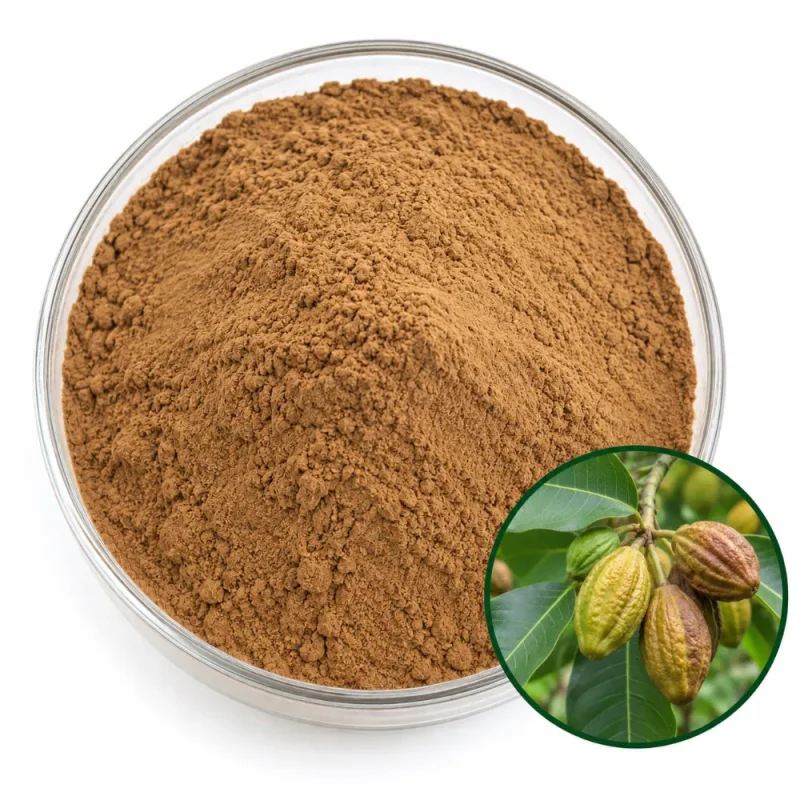
Terminalia chebula Extract 20–50% Tannins

Terminalia chebula extract is prepared from the dried mature fruit of the chebulic myrobalan, Terminalia chebula Retz., a tree of the family Combretaceae called haritaki in India. Ethanol extraction takes up the hydrolyzable tannins of the fruit, and the concentrate is dried to a light brown, water-soluble powder.

Total tannins are measured by UV spectrophotometry, with a primary grade of 50% and a lower grade of 20%. The powder is 80 mesh. The 50% grade suits capsules and tablets, while the 20% grade suits drink powders and blends.

Haritaki Tannin Standardization & Grades

Tannins are polyphenols that bind proteins. The fruit of Terminalia chebula is among the richest sources of hydrolyzable tannins, led by chebulagic acid and chebulinic acid, with gallic acid, ellagic acid and corilagin. These are esters of gallic and ellagic acid with a glucose core, and they break down to the simple acids on heating and storage. Terminalia chebula extract is standardized to tannins because the class dominates the chemistry of the fruit and can be read by a repeatable UV method.

The botanical entity is Terminalia chebula Retz., and the part is the mature dried fruit. Leaves and bark are not used. Haritaki is one of the three fruits of triphala, with bibhitaki and amla, which come from different trees. The same fruit is supplied as a 10:1 ratio extract with no marker figure, Chebulic Myrobalan Extract Powder, as the milled fruit, Haritaki Powder, and within the three-fruit blend Triphala Extract Powder.

GradeAssay & MethodWhere It Fits
20% TanninsUVDrink powders, bulk blends
50% TanninsUVCapsules and tablets, small fill

The 50% grade carries two and a half times the tannin load of the 20% grade per gram, so a capsule or tablet reaches its target with a small charge. The 20% grade is bulkier and less sharply astringent in a dissolved drink. Both grades are read on the same UV basis, so scaling between them is a matter of weight.

The extract is made from dried fruit that is deseeded, crushed, extracted, filtered and concentrated. The seed kernel carries little tannin, and removing it concentrates the fruit wall, which is the tannin-rich tissue.

Haritaki Tannin Analysis & Purity Risks

A UV tannin assay reads phenolic hydroxyl groups with a color reagent and calculates the result against a reference phenol, usually gallic acid. Some protocols subtract phenols that do not bind hide powder, and others do not, so a result is comparable only with one obtained on the same protocol. A UV tannin figure cannot be converted into an HPLC value for chebulagic acid, and a titration result gives yet another number.

An HPLC fingerprint is run in parallel for identity. Chebulagic acid and chebulinic acid are the signature peaks of haritaki, and they separate it from bibhitaki, whose fruit is dominated by other esters, and from amla, whose tannins are of the emblicanin type. The ratio of free gallic acid to the large esters shows how the fruit was dried and extracted, because hydrolysis raises gallic acid at the expense of the esters.

Purity risks follow from the material class. The fruit is graded by size and maturity in the traditional trade, and immature fruit has a different tannin level. The seed carries oil and little tannin, so lots with a high seed share read lower. The mature fruit of Terminalia chebula is the defined part. The three triphala fruits are sometimes blended, and a blend is a different product from haritaki alone.

Dust and soil on dried fruit are removed before extraction, since they carry ash and metals into the powder.

Fruit maturity changes the result. Immature fruit, which is picked early and sold as black haritaki, is smaller and darker and carries a different tannin level from the mature yellow-brown fruit. The grade scale for Terminalia chebula extract assumes mature fruit, and lots of mixed maturity are blended before extraction to even out the figure.

Typical Specifications

Specification ItemProduct Information
Latin NameTerminalia chebula
Plant PartFruit & Berry
ProcessingEthanol Extraction
Compound ClassPolyphenols
Common NameHaritaki, Chebulic Myrobalan
Ingredient TypeStandardized Extract
Marker Compound(s)Tannins (chebulagic acid, chebulinic acid)
Primary Grade50% Tannins (UV)
Available Grades20% · 50% Tannins (UV)
AppearanceLight Brown powder
Solubility / DispersibilityWater Soluble
Quality Parameters
Moisture (LOD)≤5.0%
Total Ash≤5.0%
Particle Size80 mesh
Heavy MetalsLead ≤2 ppm · Arsenic ≤1 ppm · Cadmium ≤1 ppm · Mercury ≤0.1 ppm
MicrobiologyTPC ≤1,000 cfu/g · Yeast & Mold ≤100 cfu/g · E. coli Negative · Salmonella Negative/25 g
Shelf Life24 months in unopened original packaging, cool and dry storage

Applications by Grade

50% Grade for Capsule Fills

The 50% grade reaches its tannin target in a small capsule fill. This sour solid picks up moisture quickly, so a dry filling room and a flow agent prevent bridging, and a check weight at the start of each run confirms the fill.

20% Grade in Drink Powders

The 20% grade dissolves in cold water to a clear to hazy brown drink with a sour, puckering taste. A sweet or fruity flavor base covers the dryness, and the finished pH is tested, because gallic acid released over shelf life sharpens the sour note.

50% Grade in Tablet Blends

Tablets of the 50% grade need a dry binder and a lubricant. A film coat masks the puckering taste and limits moisture pickup, and hardness is rechecked after storage because the polyphenol-rich compact softens in humid air.

20% Grade for Herbal Premixes

Premixes carry the 20% grade with other fruit and herb extracts in a bulking carrier. Mix the brown particles with part of the carrier first, since the astringent powder clumps and a direct charge to a large batch leaves hot spots.

50% Grade in Instant Granules

Instant granules for water take the 50% grade with a soluble carrier. The tannins dissolve readily, and the granule is dried gently, since long heat hydrolyzes the esters, raises free gallic acid and darkens the color.

20% Grade for Lozenge Bases

Lozenges take the 20% grade where a sour, astringent fruit note is part of the profile. Add it late in the cook to preserve the profile, and test the finished lozenge for color change over storage.

Technical & Quality Considerations

Terminalia chebula extract is a light brown powder with a sour, woody scent and a strongly astringent taste. It dissolves in water to a hazy brown solution of low pH. Hydrolyzable tannins break down in hot, wet and acidic conditions, releasing gallic acid, which stays dissolved, and ellagic acid, which is nearly insoluble and can form a fine sediment.

Tannins bind iron and form dark blue-black complexes, so carbon steel and iron-containing fillers darken the powder and the solution. Stainless steel contact parts and carriers low in iron avoid this. They also bind proteins, and a drink with whey, casein or gelatin can turn cloudy, so a protein-compatibility trial is part of formula development.

The powder is strongly hygroscopic and cakes in humid storage. Keep the drum sealed, with desiccant in the liner and a cool room around it, and the powder stays free of lumps. Compare each lot with a retained sample for color and taste, since the tone moves between tan and dark brown with the fruit lot, and run a new check weight when the line changes between the two grades.

Packaging & Commercial Supply

Essencefield supports product evaluation, formulation trials, commercial orders, and ongoing ingredient supply. Packaging, storage, and shipping arrangements are determined by product characteristics, order quantity, stability requirements, and destination-market needs.

Supply ItemGeneral Information
SampleAvailable upon request for formulation, testing, and supplier evaluation
Order Quantities100 g · 1 kg · 5 kg · 25 kg · 100 kg · 500 kg · Bulk
Sample Lead TimeTypically 5–7 days after sample confirmation
Production Lead TimeTypically 15–30 days after order and specification confirmation
PackagingSuitable protective inner packaging with bags, cartons, drums, or other appropriate outer packaging
StorageStore in tightly sealed, suitable protective packaging in a cool, dry environment. Protect from moisture, heat, and direct sunlight. Specific storage conditions follow the approved product specification.
DocumentationCOA · Product Specification · TDS · SDS · Applicable declarations (as applicable)

Final order quantities, lead times, packaging, documentation, and shipping arrangements are confirmed according to the selected product and commercial requirements.

Request Ingredient Specifications & Quote

Share your target specification, application, quantity, and documentation needs. We’ll help confirm suitable options, samples, and commercial supply details.