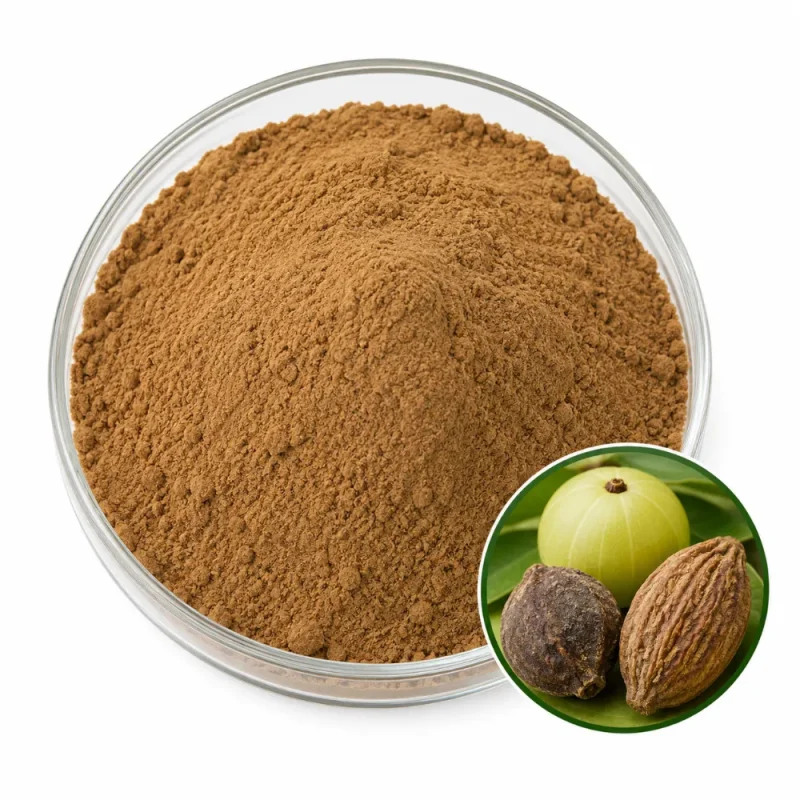
Triphala Extract 40% Tannins

Triphala extract, as listed on this specification, is prepared from the dried fruit of Terminalia chebula Retz., a tree of the family Combretaceae, and is standardized to tannins. Ethanol extraction concentrates the hydrolyzable tannins of the fruit, and the concentrate is dried to a light brown powder that dissolves in water.

Total tannins are measured by UV spectrophotometry as a single grade of 40%. The powder is 80 mesh. It suits capsules, tablets, drink granules and herbal blends where an extract sold under the name triphala is specified with a stated tannin figure.

Triphala Tannin Standardization & Grades

The name triphala means three fruits in Sanskrit, and in traditional practice it refers to a combination of haritaki, bibhitaki and amla. On this specification the botanical entity is the fruit of Terminalia chebula Retz., the haritaki component, and that entity is what the tannin figure describes. Buyers who need the full three-fruit combination should read the botanical line of the specification before using the name as a guide to composition.

Tannins are polyphenols large enough to bind proteins. The fruit of Terminalia chebula carries hydrolyzable tannins led by chebulagic acid and chebulinic acid, with gallic acid, ellagic acid and corilagin, and these esters of gallic and ellagic acid with a glucose core dominate its chemistry. The extract is standardized to tannins at 40% because the class is the defining one for the fruit and a UV method gives a repeatable figure.

This is a single grade, so there is no grade table. The 40% powder is the one the specification is written around. The same fruit is supplied at graded strengths as Terminalia chebula Extract 20–50% Tannins, as a 10:1 ratio extract with no marker figure, the Chebulic Myrobalan Extract Powder, and as the combination extract Triphala Extract Powder.

Production starts with dried fruit that is deseeded and crushed, then extracted, filtered and concentrated. The seed kernel carries little tannin, and removing it concentrates the fruit wall, which holds most of the tannin.

Triphala Tannin Analysis & Purity Risks

In the UV tannin assay a color reagent responds to phenolic hydroxyl groups, and the absorbance is calculated against a reference phenol such as gallic acid. Some protocols subtract the phenols that do not bind hide powder and others do not, so a result compares only with one obtained on the same protocol. The UV figure cannot be turned into an HPLC value for chebulagic acid, and titration would return a third number.

An HPLC fingerprint is run in parallel for identity. Chebulagic acid and chebulinic acid are the signature peaks of the fruit, and they separate it from bibhitaki, whose fruit is dominated by other esters, and from amla, whose tannins are of the emblicanin type. A true three-fruit blend would show all three patterns in one chromatogram, while a haritaki-only extract shows the first. The pattern therefore tells a buyer which material a lot really is.

The ratio of free gallic acid to the large esters shows how the fruit was dried and extracted, because heat and moisture hydrolyze the esters and raise gallic acid at their expense. Ellagic acid, which forms during hydrolysis, is nearly insoluble and appears as a fine sediment when a stored solution is held cold.

Purity risks follow from the material class. Name-based confusion is the first: lots sold as triphala differ in composition, and a certificate that states the botanical names settles the question. The mature fruit is the defined part, and immature fruit has a different tannin level. Dust and soil on dried fruit carry ash and metals, and the fruit is cleaned before extraction.

Typical Specifications

Specification ItemProduct Information
Latin NameTerminalia chebula
Plant PartFruit & Berry
ProcessingEthanol Extraction
Compound ClassPolyphenols
Common NameTriphala, Haritaki Fruit
Ingredient TypeStandardized Extract
Marker Compound(s)Tannins (chebulagic acid, chebulinic acid)
Primary Grade40% Tannins (UV)
AppearanceLight Brown powder
Solubility / DispersibilityWater Soluble
Quality Parameters
Moisture (LOD)≤5.0%
Total Ash≤5.0%
Particle Size80 mesh
Heavy MetalsLead ≤2 ppm · Arsenic ≤1 ppm · Cadmium ≤1 ppm · Mercury ≤0.1 ppm
MicrobiologyTPC ≤1,000 cfu/g · Yeast & Mold ≤100 cfu/g · E. coli Negative · Salmonella Negative/25 g
Shelf Life24 months in unopened original packaging, cool and dry storage

Applications by Grade

Capsule Fills at 40%

Capsules take the 40% triphala powder at moderate fill weight. The sour solid picks up moisture quickly and tastes puckering, so a dry filling room, a flow agent and a check weight at the start of a run keep the fill steady and the shells sound.

Tablet Blends with Fruit Tannin

Tablets of triphala extract need a dry binder and a lubricant. A film coat masks the dry, puckering taste and blocks moisture, and hardness is rechecked after storage because the polyphenol-rich compact softens in humid air.

Instant Herbal Granules

Granules for water carry the 40% triphala powder with a soluble carrier. The tannins dissolve readily, and the granule is dried gently, since long heat hydrolyzes the esters, raises free gallic acid and darkens the color of the granule.

Herbal Powder Premixes

In premixes the 40% triphala powder travels with other fruit and herb extracts in a bulking carrier. Blend it into a small portion of the carrier first, because a single charge to a large batch leaves hot spots of intense astringency.

Stick-Pack Drink Mixes

Stick-pack drink mixes use the powder at low gram weight with a carrier. It dissolves to a clear to hazy brown drink with a sour, drying taste, and a sweet or fruity base covers the dryness without a strong sweetener.

Lozenge and Chew Bases

Lozenges and soft chews take the triphala powder where a sour, astringent fruit note is part of the profile. Add it late in the cook, then test the finished pH, because tannin-type material can toughen a protein-based gel.

Technical & Quality Considerations

Triphala extract is a light brown powder with a sour, woody scent and a strongly astringent taste. It dissolves in water to a hazy brown solution of low pH. Hydrolyzable tannins break down in hot, wet and acidic conditions, releasing gallic acid, which stays dissolved, and ellagic acid, which does not. A drink held hot for a long time therefore darkens and may throw a fine sediment.

Iron reacts with the tannins to give blue-black complexes, which is why carbon steel and iron-bearing fillers darken both powder and solution. Stainless steel contact parts and low-iron carriers avoid this. The tannins also bind proteins, and a drink containing whey, casein or gelatin can turn cloudy, so a compatibility trial is run before a formula is fixed.

The powder is strongly hygroscopic. Humid air turns it sticky and then hard, so liners stay closed, desiccant rides in the drum, and storage is cool. Judge each lot against a retained sample for color and taste, and repeat the check weight whenever the filling line is restarted.

Packaging & Commercial Supply

Essencefield supports product evaluation, formulation trials, commercial orders, and ongoing ingredient supply. Packaging, storage, and shipping arrangements are determined by product characteristics, order quantity, stability requirements, and destination-market needs.

Supply ItemGeneral Information
SampleAvailable upon request for formulation, testing, and supplier evaluation
Order Quantities100 g · 1 kg · 5 kg · 25 kg · 100 kg · 500 kg · Bulk
Sample Lead TimeTypically 5–7 days after sample confirmation
Production Lead TimeTypically 15–30 days after order and specification confirmation
PackagingSuitable protective inner packaging with bags, cartons, drums, or other appropriate outer packaging
StorageStore in tightly sealed, suitable protective packaging in a cool, dry environment. Protect from moisture, heat, and direct sunlight. Specific storage conditions follow the approved product specification.
DocumentationCOA · Product Specification · TDS · SDS · Applicable declarations (as applicable)

Final order quantities, lead times, packaging, documentation, and shipping arrangements are confirmed according to the selected product and commercial requirements.

Request Ingredient Specifications & Quote

Share your target specification, application, quantity, and documentation needs. We’ll help confirm suitable options, samples, and commercial supply details.