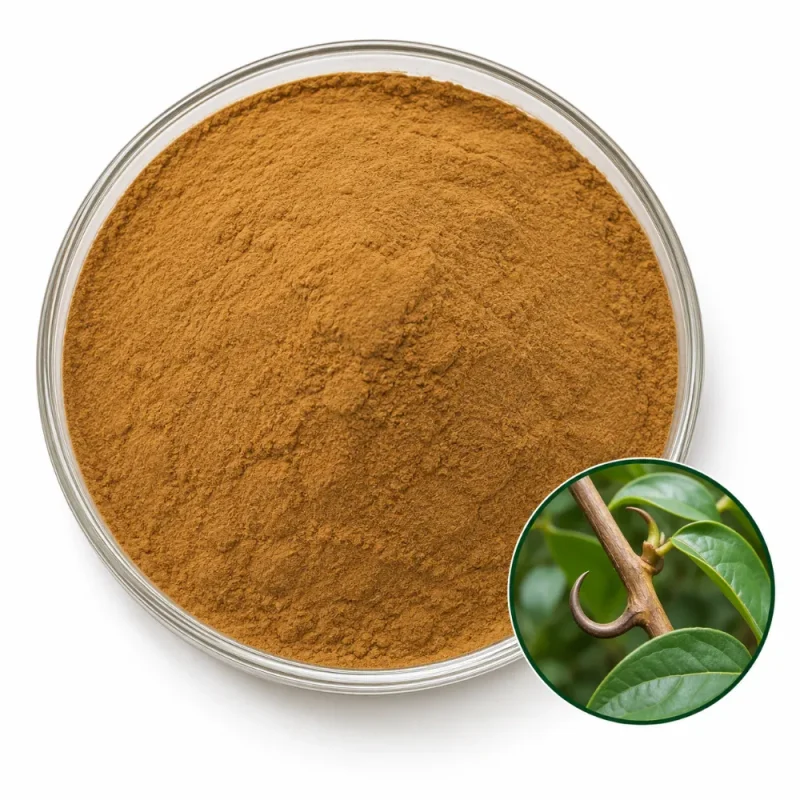
Uncaria Rhynchophylla Extract 5–20% Total Alkaloids

Uncaria rhynchophylla extract is prepared from the hook-bearing stems of Uncaria rhynchophylla (Miq.) Miq., a climbing shrub of the family Rubiaceae whose curved hooks are the traditional medicinal part. Ethanol extraction concentrates the indole and oxindole alkaloids of the stem, and the concentrate is dried to a light brown powder.

Total alkaloids are set at 5–20%, with a primary grade of 20% and a lower grade of 5%. The powder is 80 mesh and slightly soluble in water. The 20% grade suits capsules and tablets, while the 5% grade suits blends at larger inclusion.

Uncaria Alkaloid Standardization & Grades

The stems and hooks of Uncaria rhynchophylla carry tetracyclic oxindole alkaloids, rhynchophylline and isorhynchophylline, with the indole alkaloids corynoxeine, hirsutine and hirsuteine. Rhynchophylline and isorhynchophylline are stereoisomers that convert into each other in solution until an equilibrium is reached. Uncaria rhynchophylla extract is standardized to total alkaloids because the class covers this interconverting family, and the figure shows how far the stem has been concentrated.

The botanical entity is Uncaria rhynchophylla (Miq.) Miq., and the part is the hook-bearing stem. The curved hooks are modified branches, and the straight stem between them holds less alkaloid. The species is different from Uncaria tomentosa, the cat’s claw of South America, which is used for its bark and carries pentacyclic oxindole alkaloids of another type. The same stem is supplied as a 10:1 ratio extract with no marker figure, the Uncaria Hook Extract Powder.

GradeAssay & MethodWhere It Fits
5% Total AlkaloidsTotal alkaloidsBlends, larger inclusion
20% Total AlkaloidsTotal alkaloidsCapsules and tablets, small fill

The 20% grade carries four times the alkaloid load per gram, so a capsule or tablet reaches its target with a small charge. The 5% grade is bulkier and easier to blend. A formulator can scale between the grades by weight alone, since both are expressed on the same basis.

The extract is made from hook-bearing stems that are cut, dried, ground and extracted, then concentrated and purified. Higher strengths come from acid-base partition steps that take the alkaloids into acidic water, remove neutral material and recover the bases at higher pH.

Uncaria Alkaloid Analysis & Purity Risks

Total alkaloids are a class figure, and the number depends on the route of measurement. A total can be obtained by acid-base partition followed by weighing, by a dye-complex color reaction against a reference alkaloid, or by summing the HPLC peaks of the individual alkaloids. These routes count different things, so a result is comparable only with another on the same route. It cannot be converted into an HPLC figure for rhynchophylline.

The data record for this product names rhynchophylline as a secondary marker. It is described here without numbers. Rhynchophylline and its isomer isorhynchophylline interconvert in solution, and the equilibrium is shifted by pH and temperature, so an HPLC method that measures only one of them gives a result that depends on sample handling. For this reason the sum of the pair is read, with the sample kept cool and near neutral pH.

For identity, the HPLC fingerprint shows the group of oxindole and indole alkaloids that characterizes the hook. Hirsutine and corynoxeine are present with the first two, and the pattern distinguishes Uncaria rhynchophylla from other Uncaria species of the Chinese hook-vine group.

Purity risks follow from the material class. Stems without hooks dilute the alkaloid fraction, and old, hard stems carry less. Alkaloid content falls during prolonged boiling and during slow, hot drying, so the starting material is dried promptly. Cat’s claw bark is a different raw material with another alkaloid pattern, and it is not accepted as a source.

Stem age adds another variable. Young hooks collected in autumn carry more alkaloid than old, lignified stems, and the hooks are cut with a short length of stem attached. Uncaria rhynchophylla extract made from well-cut hooks gives a steadier alkaloid figure than extract made from mixed stem lengths.

Typical Specifications

Specification ItemProduct Information
Latin NameUncaria rhynchophylla
Plant PartBark & Stem
ProcessingEthanol Extraction
Compound ClassAlkaloids
Common NameUncaria, Gou Teng, Chinese Cat’s Claw
Ingredient TypeStandardized Extract
Marker Compound(s)Total alkaloids (rhynchophylline, isorhynchophylline)
Primary Grade20% Total Alkaloids
Available Grades5% · 20% Total Alkaloids
AppearanceLight Brown powder
Solubility / DispersibilitySlightly Soluble in Water
Quality Parameters
Moisture (LOD)≤5.0%
Total Ash≤5.0%
Particle Size80 mesh
Heavy MetalsLead ≤2 ppm · Arsenic ≤1 ppm · Cadmium ≤1 ppm · Mercury ≤0.1 ppm
MicrobiologyTPC ≤1,000 cfu/g · Yeast & Mold ≤100 cfu/g · E. coli Negative · Salmonella Negative/25 g
Shelf Life24 months in unopened original packaging, cool and dry storage

Applications by Grade

20% Grade for Capsule Fills

The 20% grade reaches its alkaloid target in a small capsule fill. The powder is fine, slightly bitter and static, so a closed filling line, dust extraction and a flow agent keep the hopper from bridging and the fill weight steady.

5% Grade in Dry Blends

The 5% grade blends with other stem and leaf extracts in dry mixes where alkaloids are one marker among several. Mix it with part of the carrier before the main charge, because the pale brown particles spread unevenly if they are added in one lot.

20% Grade in Tablet Blends

Tablets of the 20% grade need a dry binder and a lubricant. A film coat masks the bitter taste and limits moisture pickup, and disintegration is rechecked after storage because the alkaloid-rich compact softens in humid air.

5% Grade for Stick-Pack Mixes

Stick-pack mixes use the 5% grade with a bulking carrier at higher gram weight. The extract is only slightly soluble, and its solubility rises under mildly acidic conditions, so a fruit-acid base gives a clearer cup than a neutral one.

20% Grade for Softgel Suspensions

For softgels, the 20% grade is milled into an oil phase. Alkaloid free bases dissolve moderately in oil, but the extract carries other material, so the fill mass is checked for settling and viscosity before encapsulation.

5% Grade for Granulated Formats

Granulated formats take the 5% grade through dry compaction or light wet granulation. Moisture and heat during drying should be kept low, because alkaloids degrade slowly under both, and the granule is packed with a moisture barrier.

Technical & Quality Considerations

Uncaria rhynchophylla extract is a light brown powder with a faint woody scent and a bitter taste. Solubility in water is slight and moves with pH. The alkaloids form salts and dissolve in mildly acidic water, while toward neutral and alkaline pH they come out as free bases and the solution turns hazy. A formulator adjusts pH to get the clarity wanted.

Rhynchophylline is heat and pH sensitive. Prolonged heating, strong alkali or strong acid shifts the isomer ratio and degrades the oxindole ring, so the extract is added late in a thermal process. Light also affects alkaloids over long exposure, and opaque, sealed liners protect the powder. Phenolic constituents bind iron, so stainless surfaces and low-iron fillers are preferred.

Damp storage causes slow moisture uptake and lumping. Desiccant liners and cool storage keep it free flowing. The retained sample is the reference for color and bitterness, and a change of grade on the line calls for a new check weight, since the powders differ in bulk.

Packaging & Commercial Supply

Essencefield supports product evaluation, formulation trials, commercial orders, and ongoing ingredient supply. Packaging, storage, and shipping arrangements are determined by product characteristics, order quantity, stability requirements, and destination-market needs.

Supply ItemGeneral Information
SampleAvailable upon request for formulation, testing, and supplier evaluation
Order Quantities100 g · 1 kg · 5 kg · 25 kg · 100 kg · 500 kg · Bulk
Sample Lead TimeTypically 5–7 days after sample confirmation
Production Lead TimeTypically 15–30 days after order and specification confirmation
PackagingSuitable protective inner packaging with bags, cartons, drums, or other appropriate outer packaging
StorageStore in tightly sealed, suitable protective packaging in a cool, dry environment. Protect from moisture, heat, and direct sunlight. Specific storage conditions follow the approved product specification.
DocumentationCOA · Product Specification · TDS · SDS · Applicable declarations (as applicable)

Final order quantities, lead times, packaging, documentation, and shipping arrangements are confirmed according to the selected product and commercial requirements.

Request Ingredient Specifications & Quote

Share your target specification, application, quantity, and documentation needs. We’ll help confirm suitable options, samples, and commercial supply details.