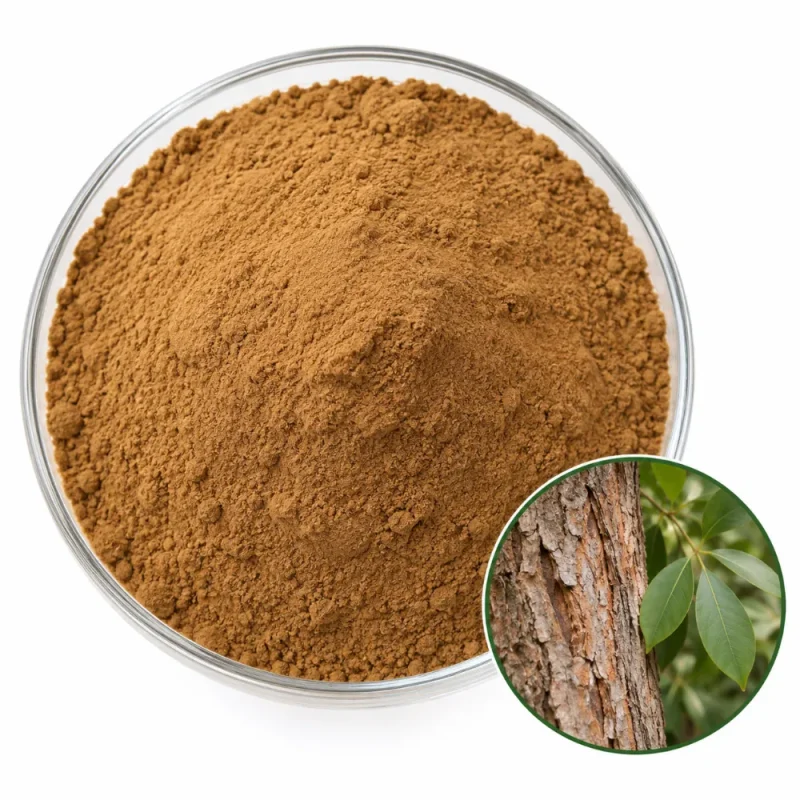
Varuna Bark Extract 20–30% Saponins

Varuna bark extract is prepared from the stem bark of Crataeva nurvala Buch.-Ham., the three-leaved caper tree of the family Capparaceae, which grows along rivers and in moist forests of South Asia. Ethanol extraction concentrates the saponin and triterpenoid fraction of the bark, and the concentrate is dried to a light brown powder that dissolves in water.

Total saponins are measured by UV spectrophotometry, with a primary grade of 30% and a lower grade of 20%. The powder is 80 mesh. Both grades suit capsules, tablets and herbal blends where a varuna bark extract with a stated saponin figure is specified.

Varuna Saponin Standardization & Grades

A saponin is a glycoside built on a steroid or triterpene skeleton that carries one or more sugar chains. The bark of the varuna tree is better known for its triterpenes, among them lupeol, betulinic acid and their relatives, together with flavonoids such as quercetin and rutin, glucosinolates and tannins. The saponin class is the figure used to describe this extract, and it expresses how far the bark has been concentrated. The data record for this product also mentions specialty grades that stress lupeol, and these are not part of this specification.

The botanical entity is Crataeva nurvala, and the part is the stem bark. The genus name is spelled Crateva in current botanical databases, and the two spellings refer to the same group of trees. Other tree barks, such as that of Crateva religiosa, are sold as varuna in some regions. No sibling form of this bark is currently listed, so the specification does not link to another page.

GradeAssay & MethodWhere It Fits
20% SaponinsUVHerbal blends, larger inclusion
30% SaponinsUVCapsules and tablets, small fill

The two grades are close, and the choice follows inclusion rate and fill weight. The 30% grade carries half as much again as the 20% grade per gram, so a capsule or a tablet reaches its target with a smaller charge. The 20% grade is bulkier, and it blends more easily into formulas with several herbal components.

The extract is made from bark that is cleaned of cork and lichen, dried, ground and extracted. The concentrate is filtered and dried, and the process leaves behind the woody fiber that makes up most of the bark mass.

Varuna Saponin Analysis & Purity Risks

A UV assay does not read saponins directly, because the aglycone core has little absorbance. The saponins are first converted to a colored product with a reagent, and its absorbance is compared with a reference saponin curve. The percentage is an equivalent tied to that reference. It cannot be converted into an HPLC figure for individual compounds, nor compared with a lupeol result.

The reaction is not specific to saponins. Other triterpenes, sterols and some phenolics respond in the same test, and the bark is rich in triterpenes that are not glycosides. A lot with high free triterpene content can therefore read higher than its glycoside load. The sample is cleaned up before the reaction, and the HPLC fingerprint, read with a detector that does not depend on UV absorbance, shows whether the profile fits varuna.

Lupeol, which is a pentacyclic triterpene alcohol, is a separate marker. It is lipophilic, almost insoluble in water, and sits in the less polar fraction of the extract. Its level is not part of the saponin figure, and a grade defined by lupeol needs its own HPLC or GC method, so it is described here only as a constituent.

Purity risks follow from the material class. Several trees with similar bark are used under the name varuna, and their triterpene and glucosinolate content differs. The stem bark of Crataeva nurvala is the defined part, and leaf and root are not accepted. Bark that includes much outer cork, or that was collected from young branches, dilutes the saponin share.

Typical Specifications

Specification ItemProduct Information
Latin NameCrataeva nurvala
Plant PartBark & Stem
ProcessingEthanol Extraction
Compound ClassSaponins
Common NameVaruna, Three-Leaved Caper
Ingredient TypeStandardized Extract
Marker Compound(s)Total saponins
Primary Grade30% Saponins (UV)
Available Grades20% · 30% Saponins (UV)
AppearanceLight Brown powder
Solubility / DispersibilityWater Soluble
Quality Parameters
Moisture (LOD)≤5.0%
Total Ash≤5.0%
Particle Size80 mesh
Heavy MetalsLead ≤2 ppm · Arsenic ≤1 ppm · Cadmium ≤1 ppm · Mercury ≤0.1 ppm
MicrobiologyTPC ≤1,000 cfu/g · Yeast & Mold ≤100 cfu/g · E. coli Negative · Salmonella Negative/25 g
Shelf Life24 months in unopened original packaging, cool and dry storage

Applications by Grade

30% Grade for Capsule Fills

The 30% grade of varuna bark extract reaches its saponin target in a small capsule fill. The powder is hygroscopic and slightly sticky when damp, so a dry filling room and a flow agent keep the hopper from bridging, and a check weight at the start of each run confirms the fill.

20% Grade in Herbal Blends

The 20% grade of varuna bark extract blends with other bark and root extracts in dry herbal mixes. Mix the brown powder with part of the carrier before the main charge, so that the saponin-rich particles spread evenly and foam does not build up in the mixer.

30% Grade in Tablet Blends

Tablets of the 30% grade need a dry binder and a lubricant that does not itself foam. A film coat keeps moisture out and covers the brown core, and disintegration is rechecked after storage since the saponin-rich compact softens in damp air.

20% Grade for Stick-Pack Mixes

Stick-pack blends carry the 20% grade with a carrier at higher gram weight. The saponins foam when stirred, so a short stir and a mild flavor base give a cleaner result than vigorous shaking in a bottle.

30% Grade for Granulated Formats

Granulated formats take the 30% grade through dry compaction, which avoids the foaming that wet granulation triggers in the mixer. The granule is packed with a moisture barrier, because the surface of a saponin granule is hygroscopic.

20% Grade for Syrup Bases

Syrup bases carry the 20% grade dissolved in a thick, sugar-rich liquid. The saponins foam during mixing, so the syrup is made with a low-shear stirrer and rested before filling, and the finished liquid is checked for haze and color over shelf life.

Technical & Quality Considerations

Varuna bark extract is a light brown powder with a faint woody scent and a slightly bitter, astringent taste. It dissolves in water to a brown solution that foams on agitation, because the saponins lower surface tension. Foam complicates pumping and filling, so a dosing tank uses gentle mixing, deaeration or a food-compatible antifoam. The glycosides stay intact across the neutral to mildly acidic range.

The glucosinolates of the bark break down in the presence of the plant enzyme myrosinase, and the products have a sharp, cabbage-like note. Dry storage and an inactivated extract avoid that smell. The flavonoids and tannins of the bark bind iron, so carbon steel and iron-containing fillers darken the powder, and stainless surfaces are preferred.

Humid air is absorbed by the powder, which cakes if the liner is left open. Preserve its flow with liners that close tightly and a dry store. Compare each lot with a retained sample for color and foam height, and take a new check weight whenever the line changes between the two grades.

Packaging & Commercial Supply

Essencefield supports product evaluation, formulation trials, commercial orders, and ongoing ingredient supply. Packaging, storage, and shipping arrangements are determined by product characteristics, order quantity, stability requirements, and destination-market needs.

Supply ItemGeneral Information
SampleAvailable upon request for formulation, testing, and supplier evaluation
Order Quantities100 g · 1 kg · 5 kg · 25 kg · 100 kg · 500 kg · Bulk
Sample Lead TimeTypically 5–7 days after sample confirmation
Production Lead TimeTypically 15–30 days after order and specification confirmation
PackagingSuitable protective inner packaging with bags, cartons, drums, or other appropriate outer packaging
StorageStore in tightly sealed, suitable protective packaging in a cool, dry environment. Protect from moisture, heat, and direct sunlight. Specific storage conditions follow the approved product specification.
DocumentationCOA · Product Specification · TDS · SDS · Applicable declarations (as applicable)

Final order quantities, lead times, packaging, documentation, and shipping arrangements are confirmed according to the selected product and commercial requirements.

Request Ingredient Specifications & Quote

Share your target specification, application, quantity, and documentation needs. We’ll help confirm suitable options, samples, and commercial supply details.