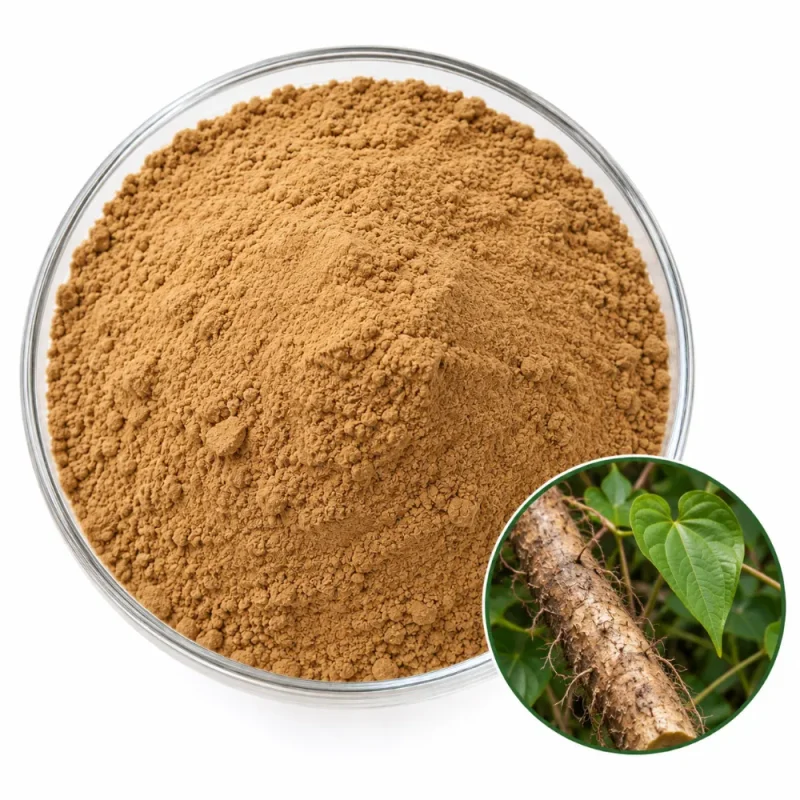
Wild Yam Extract 16–20% Diosgenin

Wild yam extract is prepared from the root of Dioscorea villosa L., the American wild yam of the family Dioscoreaceae, and is standardized to diosgenin. Ethanol extraction and hydrolysis concentrate the steroidal sapogenin of the root, and the concentrate is dried to a light brown powder.

Diosgenin is measured by HPLC, with a primary grade of 20% and a lower grade of 16%. The powder is 80 mesh and insoluble in water. Both grades suit capsules, tablets and oil-phase systems where a diosgenin-standardized root extract is specified.

Diosgenin Standardization & Grades

Diosgenin is a spirostanol sapogenin, the aglycone left when the sugar chains of a steroidal saponin are removed. In the root of wild yam it occurs as part of saponins such as dioscin, in which the sugars are attached to the diosgenin core. Acid hydrolysis releases the aglycone, which is a waxy, lipophilic compound that does not dissolve in water. Wild yam extract is standardized to diosgenin because the sapogenin is the stable, defined marker of the genus and the form that HPLC measures.

The botanical entity is Dioscorea villosa L., and the part is the root. The genus Dioscorea is large. Mexican yam (Dioscorea mexicana), Chinese yam (Dioscorea polystachya) and several Asian species are different plants with different saponin patterns, and some of them are grown for diosgenin production. The same root is supplied as a 10:1 ratio extract with no marker figure, Wild Yam Extract Powder, and as the milled root, Wild Yam Root Powder.

GradeAssay & MethodWhere It Fits
16% DiosgeninHPLCOil-phase systems, blends
20% DiosgeninHPLCCapsules and tablets, small fill

The two grades sit close together, so inclusion rate and fill weight decide between them. The 20% grade carries a quarter more diosgenin per gram than the 16% grade, so a capsule or tablet reaches its target with a little less powder. Both grades are read on the same HPLC basis, so scaling between them is a matter of weight.

The diosgenin level of these grades is much higher than the level that the native root holds. It reflects an extract in which the saponins have been hydrolyzed and the sapogenin has been concentrated, and it is why the powder is insoluble in water while the root itself is rich in starch.

Diosgenin Analysis & Purity Risks

An HPLC assay separates diosgenin from other sapogenins such as yamogenin, its stereoisomer, and from partly hydrolyzed saponins, and reads it as a distinct peak against a reference standard. The result is a specific compound, not a class equivalent. Because diosgenin has almost no UV absorbance above 210 nm, detection uses either a low wavelength or an evaporative light-scattering detector, and the baseline must be clean.

The basis needs care. A figure for free diosgenin counts only the aglycone already present. A figure after acid hydrolysis counts the aglycone released from all the saponins, and it is higher. The grades of this product refer to a material that has been taken through hydrolysis, and a free-diosgenin figure of the native root would be a far lower value. A diosgenin result cannot be compared with a total saponin UV figure.

For identity, the HPLC fingerprint shows the sapogenin pattern, with diosgenin as the major peak and other spirostanols as minor ones. The pattern distinguishes Dioscorea villosa from species grown for steroid production, whose diosgenin level and companion sapogenins differ.

Purity risks follow from the material class. The root is the defined part, and aerial parts are not accepted. Hydrolysis uses a strong acid, so the neutralized and washed powder is checked for residual acid and for the reaction by-products that form at high temperature. Lots made from mixed yam species are identified by their sapogenin pattern.

Root quality shows in the color and the particle behavior of the finished powder. Roots dug in autumn, when the starch content is high, give a more abundant but paler hydrolysate, while roots from wild stands carry more saponin per kilogram. A wild yam extract made from mixed root lots is therefore checked for sapogenin pattern and not only for the diosgenin peak.

Typical Specifications

Specification ItemProduct Information
Latin NameDioscorea villosa
Plant PartRoot & Rhizome
ProcessingEthanol Extraction
Compound ClassSaponins
Common NameWild Yam
Ingredient TypeStandardized Extract
Marker Compound(s)Diosgenin
Primary Grade20% Diosgenin (HPLC)
Available Grades16% · 20% Diosgenin (HPLC)
AppearanceLight Brown powder
Solubility / DispersibilityInsoluble in Water
Quality Parameters
Moisture (LOD)≤5.0%
Total Ash≤5.0%
Particle Size80 mesh
Heavy MetalsLead ≤2 ppm · Arsenic ≤1 ppm · Cadmium ≤1 ppm · Mercury ≤0.1 ppm
MicrobiologyTPC ≤1,000 cfu/g · Yeast & Mold ≤100 cfu/g · E. coli Negative · Salmonella Negative/25 g
Shelf Life24 months in unopened original packaging, cool and dry storage

Applications by Grade

20% Grade for Capsule Fills

The 20% grade of wild yam extract reaches its diosgenin target in a small capsule fill. The powder is fine and waxy, and it clings to equipment, so a flow agent and a dry filling room keep the hopper from bridging, and a check weight at the start of each run confirms the fill.

16% Grade in Oil-Phase Systems

Oil-based liquids and drops use the 16% grade milled into a medium-chain oil. Diosgenin is lipophilic but dissolves only modestly in oil, so the system is built as a fine suspension, with a suspending agent and a slow cooling profile.

20% Grade in Tablet Blends

Tablets of the 20% grade need a hydrophilic binder and a wetting disintegrant, because the waxy powder is hydrophobic and resists water. A film coat reduces dusting and hides the brown core. Disintegration is rechecked after storage, and the tablet weight is monitored during the press run.

16% Grade for Softgel Suspensions

The insoluble 16% grade is milled into a vegetable oil phase for softgel fills. Particle size and viscosity are checked before encapsulation, because the dense particles settle quickly and the dose drifts from the start to the end of a batch.

20% Grade for Powder Premixes

Premixes carry the 20% wild yam grade in a larger dry blend. The waxy particles stick together when warm, so the premix is blended in a cool room with some of the carrier first and sieved before filling.

16% Grade for Thick Smoothie Bases

Smoothie powders and shakes carry the insoluble 16% grade as a suspended solid. A viscous base holds the particles, and a wetting agent is used to prevent floating lumps when the powder meets liquid, and the shake is mixed before use.

Technical & Quality Considerations

Wild yam extract is a light brown powder with a faint earthy scent. It is insoluble in water and only slightly soluble in oils, so an aqueous product shows a fine suspension that settles on standing. Wetting agents, milling and a viscous carrier improve dispersion, and an oil pre-dispersion added to the batch under high shear gives a more uniform result.

Diosgenin is chemically stable. The spirostan ring survives moderate heat, acid and light far better than glycosides do, and the powder keeps well in sealed liners. The residual root fraction is the more reactive part: starch and sugars take up moisture, and the powder darkens and cakes in humid storage. Desiccant liners and cool storage maintain flow.

Compare each lot with a retained sample for color and particle behavior, since the shade moves between tan and brown with the depth of hydrolysis, and take a new check weight whenever the filling line changes between the two grades, because their bulk differs.

Packaging & Commercial Supply

Essencefield supports product evaluation, formulation trials, commercial orders, and ongoing ingredient supply. Packaging, storage, and shipping arrangements are determined by product characteristics, order quantity, stability requirements, and destination-market needs.

Supply ItemGeneral Information
SampleAvailable upon request for formulation, testing, and supplier evaluation
Order Quantities100 g · 1 kg · 5 kg · 25 kg · 100 kg · 500 kg · Bulk
Sample Lead TimeTypically 5–7 days after sample confirmation
Production Lead TimeTypically 15–30 days after order and specification confirmation
PackagingSuitable protective inner packaging with bags, cartons, drums, or other appropriate outer packaging
StorageStore in tightly sealed, suitable protective packaging in a cool, dry environment. Protect from moisture, heat, and direct sunlight. Specific storage conditions follow the approved product specification.
DocumentationCOA · Product Specification · TDS · SDS · Applicable declarations (as applicable)

Final order quantities, lead times, packaging, documentation, and shipping arrangements are confirmed according to the selected product and commercial requirements.

Request Ingredient Specifications & Quote

Share your target specification, application, quantity, and documentation needs. We’ll help confirm suitable options, samples, and commercial supply details.