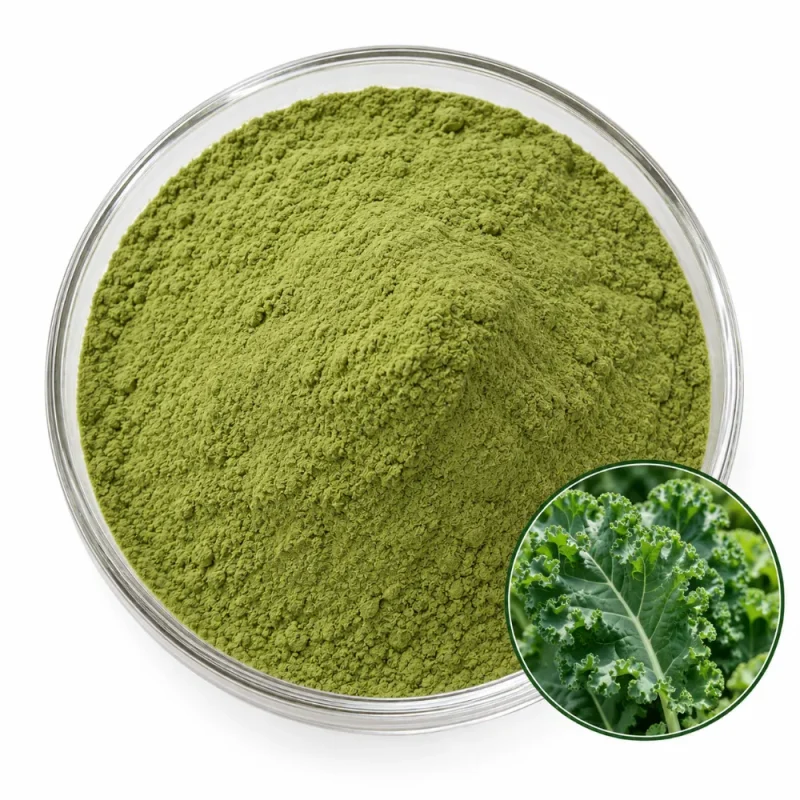
Kale Extract Powder

Kale extract powder uses the leaf of kale, the non-heading leafy form of Brassica oleracea, and excludes the stems, seed and roots. Water extraction concentrates the soluble leaf fraction, and the liquor is dried into a green powder that wets and disperses in water.

Supplied as a 10:1 ratio extract with no marker percentage, it is milled to 80 mesh. No standardized or powder form of kale is listed alongside it, so this ratio extract is the single kale ingredient, and it carries no declared glucosinolate, pigment or flavonoid figure.

Brassica oleracea Identity & Plant Part

The botanical entity is Brassica oleracea L., the species that gives cabbage, broccoli, cauliflower, kohlrabi and kale. Kale is the leafy, non-heading group of that species, grown for its curled or flat leaves. The part used is the leaf. Stems, flower buds, seed and roots are not part of this ingredient.

The species name alone does not identify the ingredient, because the same binomial covers many unrelated vegetables with different parts and composition. The leaf carries glucosinolates, characteristic of the cabbage family, together with chlorophylls, carotenoids and flavonoid glycosides such as kaempferol and quercetin derivatives. Kale is also distinct from mustard greens and collards in the trade, although collards are the same species.

Kale is also sold as a cut or flaked dried leaf. That material is a coarse vegetable cut with the full fiber of the leaf, so it wets and settles differently from a dispersible extract in the same blend.

What 10:1 Means for Kale

A 10:1 ratio records how much kale leaf went into the extract. It is not a content figure for glucosinolates, chlorophyll or flavonoids, and no such figure is attached to this product. The ratio describes concentration of the starting material only, which is why it should be read next to the plant part and the extraction medium.

Kale extract fits formulas that want a concentrated, dispersible leafy-green ingredient without bulk plant fiber. Water extraction leaves the insoluble fiber behind, so the powder behaves differently from a milled kale leaf, which stays as an opaque particulate. Because no sibling form exists, a formula that needs whole kale fiber has to source it separately, and one that needs a dispersible leaf ingredient can use this extract directly.

Typical Specifications

Specification ItemProduct Information
Latin NameBrassica oleracea
Plant PartLeaf & Herb
ProcessingWater Extraction
Common NameKale
Ingredient TypeRatio Extract
Extract Ratio10:1
AppearanceGreen powder
Solubility / DispersibilityWater Dispersible
Quality Parameters
Moisture (LOD)≤5.0%
Total Ash≤5.0%
Particle Size80 mesh
Heavy MetalsLead ≤2 ppm · Arsenic ≤1 ppm · Cadmium ≤1 ppm · Mercury ≤0.1 ppm
MicrobiologyTPC ≤1,000 cfu/g · Yeast & Mold ≤100 cfu/g · E. coli Negative · Salmonella Negative/25 g
Shelf Life24 months in unopened original packaging, cool and dry storage

Application Areas

Green Drink Powder Mixes

Kale extract adds a green tint and a mild brassica note to dry drink mixes. It disperses to a hazy green liquid, so it suits opaque, flavored drinks, and citrus or green-apple bases cover the cabbage-family aroma. Dry mixes hold the green longest when sealed and kept dark.

Kale Dry-Mix Sticks

Single-serve sticks combine the extract with other vegetable and fruit powders. A dense fine extract can settle from a lighter base, so particle size is matched across the components before the blend goes onto a filling line.

Two-Piece Capsule Fills

Kale extract fills into two-piece capsules after premixing with a flow aid. Because it disperses and does not dissolve, disintegration is worth testing on the finished fill. Opaque capsules keep the green powder from showing through the shell, and fill weight is worth checking early.

Dry-Mix Nutrition Bars

The extract goes into the dry mix before the binder syrup is added. It adds little bulk beside a milled leaf, and its green tint is easiest to hide in cocoa or date-based bars, where the cabbage-family note also falls below the chocolate flavor.

Formulation Notes

The powder is green with a faint cabbage-family aroma and a bitter, slightly sulfurous taste. A dispersion in water is hazy and green, and the fine solids sink slowly.

Chlorophyll browns under acid and heat, so the green holds best in neutral, cool processing, and low-pH drinks will shift its color. Premix with a flowing carrier before capsule filling to prevent bridging. Close the liner after each draw once the kale extract bag is open, since damp leaf extracts cake and darken.

Packaging & Commercial Supply

Essencefield supports product evaluation, formulation trials, commercial orders, and ongoing ingredient supply. Packaging, storage, and shipping arrangements are determined by product characteristics, order quantity, stability requirements, and destination-market needs.

Supply ItemGeneral Information
SampleAvailable upon request for formulation, testing, and supplier evaluation
Order Quantities100 g · 1 kg · 5 kg · 25 kg · 100 kg · 500 kg · Bulk
Sample Lead TimeTypically 5–7 days after sample confirmation
Production Lead TimeTypically 15–30 days after order and specification confirmation
PackagingSuitable protective inner packaging with bags, cartons, drums, or other appropriate outer packaging
StorageStore in tightly sealed, suitable protective packaging in a cool, dry environment. Protect from moisture, heat, and direct sunlight. Specific storage conditions follow the approved product specification.
DocumentationCOA · Product Specification · TDS · SDS · Applicable declarations (as applicable)

Final order quantities, lead times, packaging, documentation, and shipping arrangements are confirmed according to the selected product and commercial requirements.

Request Ingredient Specifications & Quote

Share your target specification, application, quantity, and documentation needs. We’ll help confirm suitable options, samples, and commercial supply details.