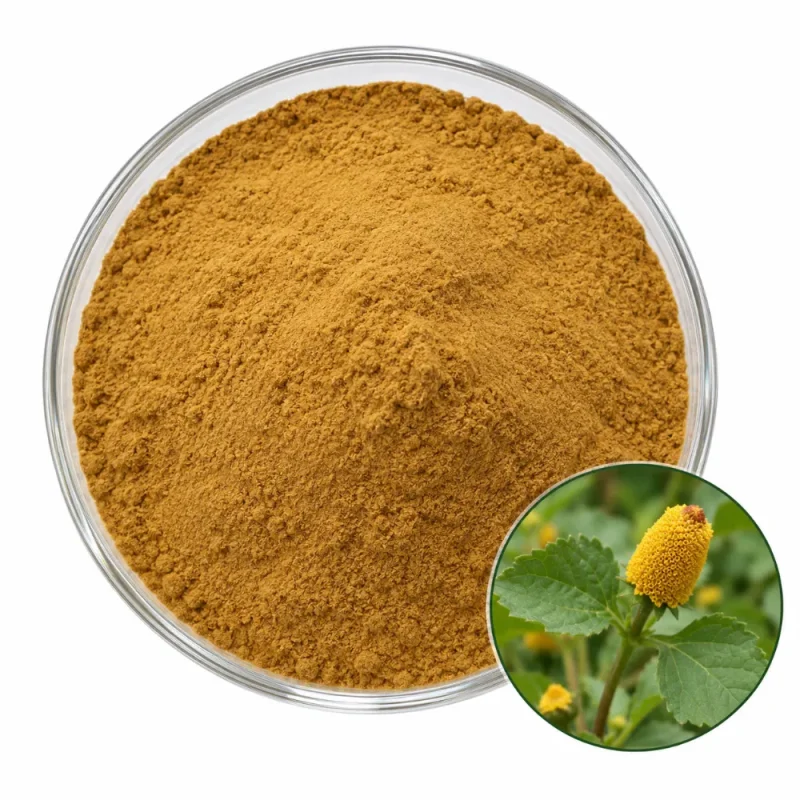
Acmella oleracea Extract 10–60% Spilanthol

The flower heads of Acmella oleracea, the paracress or toothache plant also known as jambu, are the source of this extract, which does not use the stems or the unrelated Spilanthes species sold under older names. Ethanol extraction concentrates the lipophilic alkylamide spilanthol, and the liquor is dried to a light brown powder.

The primary grade is 60% spilanthol by HPLC, with 10% as the lower end of the range. The powder is 80 mesh and insoluble in water. The 60% grade serves softgels, capsules and sensate flavor systems at very small doses, while the 10% grade suits dry blends and powdered premixes that keep more of the flower matrix.

Spilanthol Standardization & Grades

Spilanthol is an unsaturated fatty acid amide, an alkylamide with a long conjugated chain ending in an isobutylamide group. It is responsible for the tingling, salivating and slightly numbing sensation of the flower and is the standardization target because it is the dominant active principle and can be resolved by HPLC. The botanical entity is Acmella oleracea (L.) R.K.Jansen, and the part used is the flower head, where spilanthol is most concentrated.

GradeAssay & MethodWhere It Fits
10% SpilantholHPLCDry blends and powdered premixes
60% SpilantholHPLCSoftgels, capsules and sensate flavor systems

Grade choice follows dose, fill weight and the strength of the sensation. The 60% grade holds six times the spilanthol load per gram of the 10% grade, so even a trace dose produces a pronounced tingle, and it is handled as a potent flavor-type ingredient. The 10% grade keeps more of the flower lipids and plant matrix and is easier to meter. The sibling product from the same flower is the Spilanthes Extract Powder, an unstandardized extract that carries no spilanthol figure.

The botanical name has changed over time. The plant was long sold as Spilanthes oleracea and Spilanthes acmella, and both names still appear on older labels. Buyers who compare quotes should confirm the current name, the flower as the stated part and the compound named, because stems and leaves contain far less spilanthol than the flower heads.

Because spilanthol is lipophilic and potent, the grade also behaves differently from most botanical powders: it dissolves in oils and alcohol, not in water, and the sensory effect begins within seconds of contact with the mouth. These properties drive both the formats and the safety margins in handling.

Spilanthol Analysis & Purity Risks

The marker is measured by HPLC, which separates spilanthol from its geometric isomers and from the related alkylamides on a reversed-phase column, identifies the peak by retention time and its characteristic UV spectrum and quantifies it against a reference standard. A total alkylamide or colorimetric reading cannot name spilanthol and is not comparable with the HPLC figure.

The conjugated triene system is the weak point. Spilanthol oxidizes and isomerizes in light and air, forming degradation products that no longer give the tingling effect, so a lot with a smaller main peak and extra neighbors has aged or been exposed. The fingerprint also shows minor amides and a nonpolar lipid background, and the proportions are stable enough to be used as a comparison between lots.

Sample preparation uses methanol or acetonitrile, because the compound does not dissolve in water, followed by filtration through a solvent-compatible membrane. The solution is protected from light and injected promptly, because standing in clear glass in the autosampler lowers the result.

Purity risks follow from the botany. Other plants called toothache plant, such as Spilanthes paniculata in some markets, carry different alkylamide patterns, and extracts from stems or whole herb carry less spilanthol per gram of dry matter. A species statement, the flower head as the stated part and the alkylamide fingerprint protect identity better than a percentage alone.

Typical Specifications

Specification ItemProduct Information
Latin NameAcmella oleracea
Plant PartFlower
ProcessingEthanol Extraction
Compound ClassAlkaloids
Common NameParacress, Toothache Plant, Jambu
Ingredient TypeStandardized Extract
Marker Compound(s)Spilanthol (alkylamide of Acmella oleracea flower heads)
Primary Grade60% Spilanthol (HPLC)
Available Grades10% · 60% Spilanthol (HPLC)
AppearanceLight Brown powder
Solubility / DispersibilityInsoluble in Water
Quality Parameters
Moisture (LOD)≤5.0%
Total Ash≤5.0%
Particle Size80 mesh
Heavy MetalsLead ≤2 ppm · Arsenic ≤1 ppm · Cadmium ≤1 ppm · Mercury ≤0.1 ppm
MicrobiologyTPC ≤1,000 cfu/g · Yeast & Mold ≤100 cfu/g · E. coli Negative · Salmonella Negative/25 g
Shelf Life24 months in unopened original packaging, cool and dry storage

Applications by Grade

60% Grade for Softgel Fills

Spilanthol dissolves in oil, so the 60% grade is dispersed or dissolved in a carrier oil for softgel fills. Gentle warming helps, the fill should be protected from light and air during preparation, and the shell must be checked for compatibility with the lipophilic amide.

60% Grade in Sensate Flavor Premixes

Flavor houses use the high grade at trace levels to give a tingling, mouth-watering effect to confectionery. Pre-dilute it in oil or ethanol before blending, because a few milligrams per kilogram already create a strong effect and uneven dosing is quickly noticed.

10% Grade for Lozenge and Gum Bases

Lozenges and chewing gum bases carry the lower grade, which is easier to meter at the dose that gives a gentle tingle. Add it late in the process at low temperature to protect the triene, and combine it with mint or citrus flavors.

10% Grade for Powdered Drink Premixes

Powdered premixes use the lower grade together with an emulsifier carrier, since the amide does not dissolve in water. The finished drink stays cloudy, and the tingle appears immediately on drinking, so a taste trial at the target dose is needed.

10% Grade in Dry Capsule Blends

Dry blends of capsule fillers use the lower grade with a bulking agent. Because the flower matrix is light and electrostatic, a flow aid helps the hopper, and content uniformity should be checked on the first capsules of every run.

Technical & Quality Considerations

The Acmella oleracea extract is a light brown powder with a herbal, slightly citrus odor and an immediate tingling, mouth-watering sensation followed by mild numbness. It is insoluble in water, so it does not form a clear solution, and it dissolves in oils, ethanol and some surfactant systems. The sensory effect means that tasting should be done with a dilute sample in a controlled setting.

Spilanthol is sensitive to light, air and heat, because its conjugated double bonds oxidize and isomerize. Store the drum cool, closed and away from light, flush partly used containers with nitrogen if possible and avoid long hot holds in processing. At production scale, handle the Acmella oleracea powder in a ventilated station, because the dust provokes the tingling effect on mucous membranes.

Equipment cleaning needs care because the active compound sticks to metal and plastic. Wash with warm detergent or an ethanol cleaner, dedicate scoops where possible and compare each Acmella oleracea extract lot with a retained sample for color, odor and flow. Record the date the container was opened, since oxidation proceeds more quickly once the seal is broken.

An Acmella oleracea extract is checked by its tingling effect and its odor, tested only with a very dilute sample. A fresh lot gives a quick, clean tingle, while an oxidized lot smells flat and gives a weaker effect. Keep a retained sample of every Acmella oleracea extract lot, store it cold and dark, and compare the spilanthol peak area of later lots against it.

Packaging & Commercial Supply

Essencefield supports product evaluation, formulation trials, commercial orders, and ongoing ingredient supply. Packaging, storage, and shipping arrangements are determined by product characteristics, order quantity, stability requirements, and destination-market needs.

Supply ItemGeneral Information
SampleAvailable upon request for formulation, testing, and supplier evaluation
Order Quantities100 g · 1 kg · 5 kg · 25 kg · 100 kg · 500 kg · Bulk
Sample Lead TimeTypically 5–7 days after sample confirmation
Production Lead TimeTypically 15–30 days after order and specification confirmation
PackagingSuitable protective inner packaging with bags, cartons, drums, or other appropriate outer packaging
StorageStore in tightly sealed, suitable protective packaging in a cool, dry environment. Protect from moisture, heat, and direct sunlight. Specific storage conditions follow the approved product specification.
DocumentationCOA · Product Specification · TDS · SDS · Applicable declarations (as applicable)

Final order quantities, lead times, packaging, documentation, and shipping arrangements are confirmed according to the selected product and commercial requirements.

Request Ingredient Specifications & Quote

Share your target specification, application, quantity, and documentation needs. We’ll help confirm suitable options, samples, and commercial supply details.