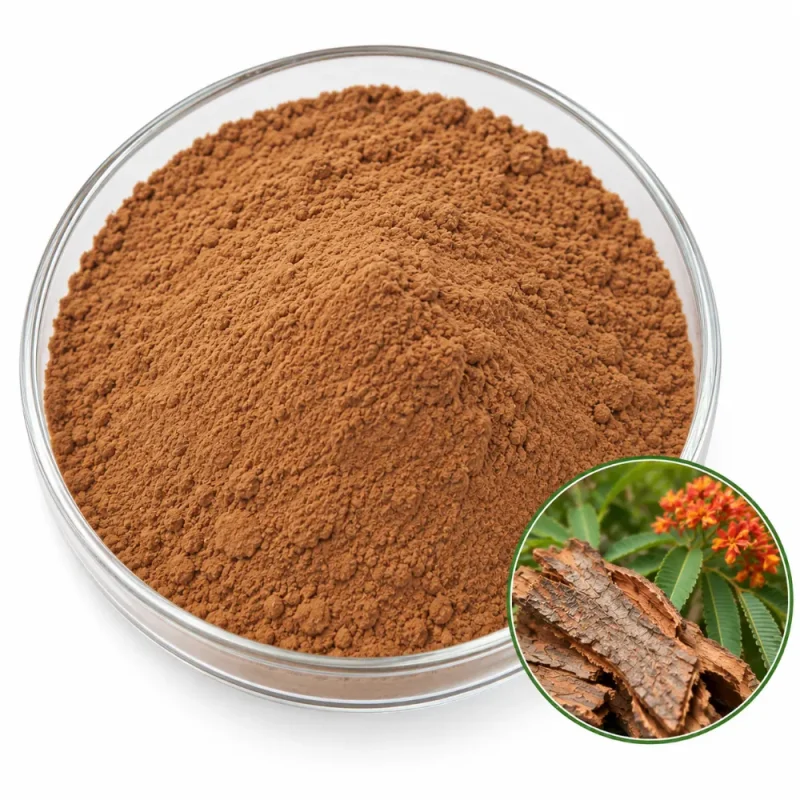
Ashoka Bark Extract 5% Tannins

Ashoka bark extract is prepared from the stem bark of Saraca asoca, the sorrowless tree of Ayurvedic practice, and not from the bark of the false ashoka Polyalthia longifolia, a common ornamental sold under the same Sanskrit name. Ethanol extraction concentrates the condensed tannins of the bark, and the liquor is dried to a light brown, water-soluble powder.

The grade is 5% tannins by UV. The powder is 80 mesh. It is meant for capsules, tablets, drink sticks and dry compounds in which a defined tannin content is wanted inside the full character of a whole-bark extract.

Tannin Standardization & Grades

Tannins in ashoka bark are mainly condensed tannins, polymers built from catechin and epicatechin units and related proanthocyanidins. Monomeric catechin, epicatechin and procyanidin B2 sit beside them, with some leucocyanidin. The grade expresses the tannin class as a whole, because the bark has no single dominant marker. The botanical entity is Saraca asoca (Roxb.) W.J.de Wilde, and the part used is the stem bark.

A 5% tannin level is moderate for a bark extract, and the powder is best viewed as a whole-bark extract with a defined astringent floor, not a tannin concentrate. The remaining weight consists of the monomeric catechins, soluble sugars, minerals and pigments of the bark. The page carries one grade, so there is no ladder of tiers, and the decision concerns dose, taste and the way the tannins interact with the rest of the formula.

The sibling product from the same tree is the Saraca Asoca Extract Powder, a ratio-based extract made from the same bark with no tannin figure. A formulator who wants a defined astringent content will choose the graded product, while one who wants a plain bark extract will find the sibling sufficient.

Buyers who compare ashoka extract quotes should check the species before anything else. The name ashoka is shared by Saraca asoca and by Polyalthia longifolia, a tall evergreen planted along roads in South Asia, and the second is a frequent substitute in the bark trade. They are unrelated plants with different chemistry, so a botanical name and the bark as the stated part are the only reliable identity statement.

Tannin Analysis & Purity Risks

The grade is measured by UV, a spectrophotometric method in which phenolic compounds reduce a reagent to a colored complex that is read at a fixed wavelength. Tannin methods are usually calibrated against a reference phenol such as tannic acid or gallic acid, so the reference changes the number. An HPLC result for catechin or procyanidin B2 counts single compounds and is a different measurement.

Total phenol reagents also react with non-tannin phenols, so a UV figure alone cannot separate true tannins from monomeric catechins. Some methods read the sample before and after treatment with hide powder, which binds tannins, and take the difference. The method used therefore sets what the figure means, and the same method should be applied to every lot.

The fingerprint of the bark shows catechin and epicatechin as sharp peaks in the early part of a reversed-phase run and a broad, unresolved hump of condensed tannins that follows. The size of that hump relative to the monomers describes how tannic the bark is, and a lot with a very small hump has been heavily degraded or has been made from a different part of the tree.

Purity risks follow from the botany. Bark of Polyalthia longifolia and of other trees can resemble ashoka bark in thick pieces, but the tannin pattern and the monomer ratios differ. A named species, the bark as the stated part and a fingerprint with catechins and a condensed tannin hump protect identity better than a percentage.

Typical Specifications

Specification ItemProduct Information
Latin NameSaraca asoca
Plant PartBark & Stem
ProcessingEthanol Extraction
Compound ClassPolyphenols
Common NameAshoka, Sorrowless Tree Bark
Ingredient TypeStandardized Extract
Marker Compound(s)Tannins (condensed tannins and catechins of Saraca asoca bark)
Primary Grade5% Tannins (UV)
AppearanceLight Brown powder
Solubility / DispersibilityWater Soluble
Quality Parameters
Moisture (LOD)≤5.0%
Total Ash≤5.0%
Particle Size80 mesh
Heavy MetalsLead ≤2 ppm · Arsenic ≤1 ppm · Cadmium ≤1 ppm · Mercury ≤0.1 ppm
MicrobiologyTPC ≤1,000 cfu/g · Yeast & Mold ≤100 cfu/g · E. coli Negative · Salmonella Negative/25 g
Shelf Life24 months in unopened original packaging, cool and dry storage

Applications by Grade

5% Grade for Capsule Fills

The single 5% grade is dosed by weight in capsules, and a typical formula needs a generous fill to reach a tannin target. The light brown powder is fine and hygroscopic, so a flow agent and a dry filling room keep the hopper feeding evenly.

Tablet Blends With Bark Extracts

Tablets combine the grade with other bark extracts at moderate inclusion. The tannin matrix absorbs moisture and softens compacts, so a dry binder, an absorbent and a moisture-protective film coat are recommended, followed by a hardness check after storage.

Drink Sticks With Herbal Flavors

Because the powder is water soluble, it dissolves in one stir into a clear to slightly hazy tan solution with a dry, astringent finish. Ginger, cinnamon or citrus flavors suit the bark and cover its puckering mouthfeel.

Dry Herbal Compounds

Dry compounds combine the extract with other bark and root powders in measured ratios. Pre-mix it with a bulking agent, and screen the blend before filling, since tannic powders take up moisture and form hard lumps that are difficult to break down.

Astringent Tea-Style Blends

Tea-style blends use the extract by weight with cardamom, cinnamon and clove, whose warm notes pair well with the dry bark. Keep the dose modest, because astringency builds with each sip and can dominate the cup.

Technical & Quality Considerations

This light brown powder has a faint woody odor and a strongly astringent, slightly bitter taste. It is water soluble, so it dissolves into a clear to slightly hazy tan solution that darkens with concentration. Tannins bind proteins, so milk-based, collagen or plant-protein drinks can turn cloudy or precipitate when the powder is added.

Condensed tannins and catechins oxidize in neutral and alkaline solutions, giving darker brown pigments, and they form dark blue-black complexes with iron. Use stainless steel, keep the pH slightly acidic and avoid long hot holds. At production scale, screen the Ashoka bark extract before dosing and pre-mix it with a portion of the carrier, since the powder cakes in humid rooms.

Compare each lot with a retained sample for color, astringency and flow. Keep the drum closed, cool and dry, record the date it was opened and use older lots first. Clean mixers between this powder and pale products, because tannic residues stain and carry over, and rinse hoppers with warm water before detergent so that the tannins do not set on metal surfaces.

An Ashoka bark extract is checked by dissolving a sample in warm water and noting color, haze and astringency, then adding a drop of iron solution to see the dark complex that true tannins form. Keep a retained sample of every Ashoka bark extract lot, and compare the catechin peaks and the tannin hump with later lots to confirm that the bark and not a substitute was extracted.

Packaging & Commercial Supply

Essencefield supports product evaluation, formulation trials, commercial orders, and ongoing ingredient supply. Packaging, storage, and shipping arrangements are determined by product characteristics, order quantity, stability requirements, and destination-market needs.

Supply ItemGeneral Information
SampleAvailable upon request for formulation, testing, and supplier evaluation
Order Quantities100 g · 1 kg · 5 kg · 25 kg · 100 kg · 500 kg · Bulk
Sample Lead TimeTypically 5–7 days after sample confirmation
Production Lead TimeTypically 15–30 days after order and specification confirmation
PackagingSuitable protective inner packaging with bags, cartons, drums, or other appropriate outer packaging
StorageStore in tightly sealed, suitable protective packaging in a cool, dry environment. Protect from moisture, heat, and direct sunlight. Specific storage conditions follow the approved product specification.
DocumentationCOA · Product Specification · TDS · SDS · Applicable declarations (as applicable)

Final order quantities, lead times, packaging, documentation, and shipping arrangements are confirmed according to the selected product and commercial requirements.

Request Ingredient Specifications & Quote

Share your target specification, application, quantity, and documentation needs. We’ll help confirm suitable options, samples, and commercial supply details.