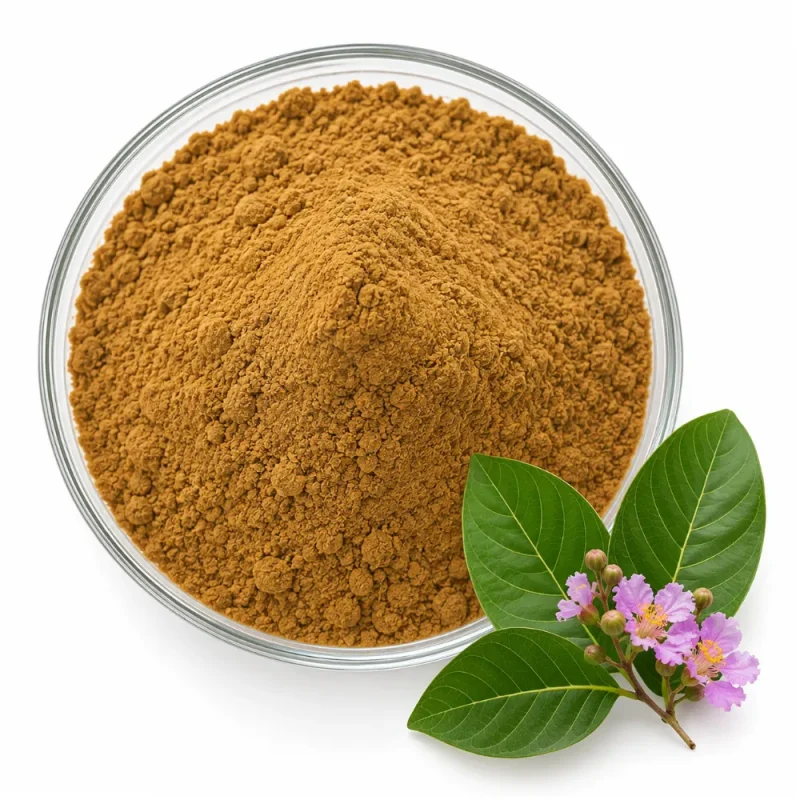
Banaba Leaf Extract 1–10% Corosolic Acid

Banaba leaf extract is prepared from the leaves of Lagerstroemia speciosa, the flowering tree of tropical Asia known as banaba or giant crape myrtle, and not from the flowers, the bark or the seeds. Ethanol extraction takes up the triterpenoid acids of the leaf, and the liquor is dried to a green powder.

The grade range is 1–10% corosolic acid by HPLC, and the primary grade is the 10% end. The powder is 80 mesh and insoluble in water. The 1% grade keeps a fuller leaf profile for blends, while the 10% grade carries a high marker load for compact capsules and tablets.

Corosolic Acid Standardization & Grades

Corosolic acid is 2α-hydroxyursolic acid, a pentacyclic triterpenoid acid. It is closely related to ursolic acid and oleanolic acid, which differ from it by a hydroxyl group or a double-bond position, and it is lipophilic. It is the standardization target because it is the characteristic triterpenoid of banaba leaf and because a pure reference compound exists. The leaf also holds ellagitannins, among them the compound called lagerstroemin, and gallic acid. The botanical entity is Lagerstroemia speciosa (L.) Pers., a tree of the Lythraceae, and the part used is the leaf.

GradeAssay & MethodWhere It Fits
1% Corosolic AcidHPLCCapsule blends and dry premixes
10% Corosolic AcidHPLCCapsules and tablets with small fill

The two grades differ tenfold. The 10% grade is a marker concentrate that supplies a defined load from a small fill. The 1% grade is closer to the leaf, with more of the tannins, chlorophyll and polar solids, so banaba leaf extract at this level suits capsule blends and dry premixes. The leaf is also supplied as a 10:1 ratio extract, the Banaba Leaf Extract Powder, and the purified acid is listed as Corosolic Acid 98%. A purified food-grade product at 98% is a very different material from a leaf extract, and the percentage on a label should be read with the grade name. Banaba leaf extract at 10% is the more concentrated of the two grades, and banaba leaf extract at 1% is the fuller one. The tree is widely planted as an ornamental.

Corosolic Acid Analysis & Purity Risks

Both grades are measured by HPLC against a corosolic acid reference standard. The molecule has no strong chromophore, so UV detection at a very low wavelength, a light-scattering detector or a mass detector is used. The analytical challenge is separation, because corosolic acid, ursolic acid and oleanolic acid are close in structure and elute near one another. A method that does not resolve them reports a sum, not corosolic acid.

A gravimetric triterpenoid figure or a colorimetric terpenoid assay counts every compound of the class, and it cannot be converted into an HPLC corosolic acid result. Sample preparation uses an alcohol diluent, because the acid dissolves poorly in water, and the solution is filtered and run on a reversed-phase column with a controlled gradient.

The chromatogram of a banaba leaf extract shows corosolic acid beside smaller peaks of related triterpenoid acids, and the profile is a fingerprint of the species. A leaf extract also shows the early-eluting tannin peaks that a pure triterpenoid does not.

Purity risks are chemical. Ursolic acid is far more common and less costly than corosolic acid, and a figure for triterpenoid acids can be raised by added ursolic acid if the method does not separate the two. A certificate that shows the resolved corosolic acid peak, with a stated plant part and species, is the first identity check. The leaf is the usual material, and the bark, flower and seed have different chemistry.

Typical Specifications

Specification ItemProduct Information
Latin NameLagerstroemia speciosa
Plant PartLeaf & Herb
ProcessingEthanol Extraction
Compound ClassTriterpenoids, Terpenoids
Common NameBanaba, Crepe Myrtle Leaf
Ingredient TypeStandardized Extract
Marker Compound(s)Corosolic acid (2α-hydroxyursolic acid, pentacyclic triterpenoid acid)
Primary Grade10% Corosolic Acid (HPLC)
Available Grades1% · 10% Corosolic Acid (HPLC)
AppearanceGreen powder
Solubility / DispersibilityInsoluble in Water
Quality Parameters
Moisture (LOD)≤5.0%
Total Ash≤5.0%
Particle Size80 mesh
Heavy MetalsLead ≤2 ppm · Arsenic ≤1 ppm · Cadmium ≤1 ppm · Mercury ≤0.1 ppm
MicrobiologyTPC ≤1,000 cfu/g · Yeast & Mold ≤100 cfu/g · E. coli Negative · Salmonella Negative/25 g
Shelf Life24 months in unopened original packaging, cool and dry storage

Applications by Grade

10% Grade for Compact Capsules

The 10% grade carries the corosolic acid target in a small fill and suits capsules and tablets. The green powder is insoluble in water and cohesive, so a glidant helps hopper flow, and a dry filling room limits caking.

10% Grade in Tablet Blends

Tablets of the 10% grade need a dry binder and a lubricant, because the lipophilic powder is slightly sticky and adheres to punches. Run a compression trial on the full blend and check hardness after storage.

1% Grade in Capsule Blends

The 1% grade fills capsules at a larger weight, which makes metering easier when banaba is one of several ingredients. The green-brown powder carries more of the tannins of the leaf, and it has a grassy, slightly astringent flavor.

1% Grade in Dry Premixes

Dry premixes carry the 1% grade in blends with other leaf extracts. Pre-blend it with a portion of the carrier, because the insoluble green powder tends to form lumps and leave green specks in pale mixes if it is dumped in at once.

1% Grade in Stick Packs

Stick packs carry the 1% grade with a flow agent and a fine carrier. The powder is insoluble in water and gives a green, hazy suspension, so a suspension aid and a note to stir are needed, and the pack should be sealed against moisture.

10% Grade in Oil Suspensions

Softgel and oil-based fills accept the 10% grade as a milled suspension. The acid is lipophilic and the powder blends with oil, but particle size and a suspending agent decide whether the fill stays uniform through storage.

Technical & Quality Considerations

The extract is a green powder with a grassy, leafy odor and a mild, astringent taste. It is insoluble in water, so aqueous systems hold it only as a fine suspension that settles without stirring. The triterpenoid acid is lipophilic and stable at normal processing temperatures, while the leaf pigments and tannins fade and darken with light, heat and contact with iron.

For production, sieve the powder before blending to break up soft agglomerates, and add a glidant, since the lipophilic particles cling to hoppers and feeders. Fold banaba leaf extract into a portion of the carrier before the final mix. Control humidity in weighing and filling, because the powder takes up water slowly and then cakes.

In liquid systems, wet the powder with a small amount of a compatible solvent or a surfactant solution before dilution, and use high-shear mixing so that it does not float. Compare each lot with a retained sample for color, odor and the corosolic acid peak. The green powder stains mixers and hoppers, so schedule clean-down time after a banaba run, and keep the drum sealed, away from light, in a cool store. A retained sample from each lot, tested again near the end of shelf life, shows whether the packaging holds the corosolic acid figure and the green color together, which matters because chlorophyll-derived pigments fade first.

Packaging & Commercial Supply

Essencefield supports product evaluation, formulation trials, commercial orders, and ongoing ingredient supply. Packaging, storage, and shipping arrangements are determined by product characteristics, order quantity, stability requirements, and destination-market needs.

Supply ItemGeneral Information
SampleAvailable upon request for formulation, testing, and supplier evaluation
Order Quantities100 g · 1 kg · 5 kg · 25 kg · 100 kg · 500 kg · Bulk
Sample Lead TimeTypically 5–7 days after sample confirmation
Production Lead TimeTypically 15–30 days after order and specification confirmation
PackagingSuitable protective inner packaging with bags, cartons, drums, or other appropriate outer packaging
StorageStore in tightly sealed, suitable protective packaging in a cool, dry environment. Protect from moisture, heat, and direct sunlight. Specific storage conditions follow the approved product specification.
DocumentationCOA · Product Specification · TDS · SDS · Applicable declarations (as applicable)

Final order quantities, lead times, packaging, documentation, and shipping arrangements are confirmed according to the selected product and commercial requirements.

Request Ingredient Specifications & Quote

Share your target specification, application, quantity, and documentation needs. We’ll help confirm suitable options, samples, and commercial supply details.