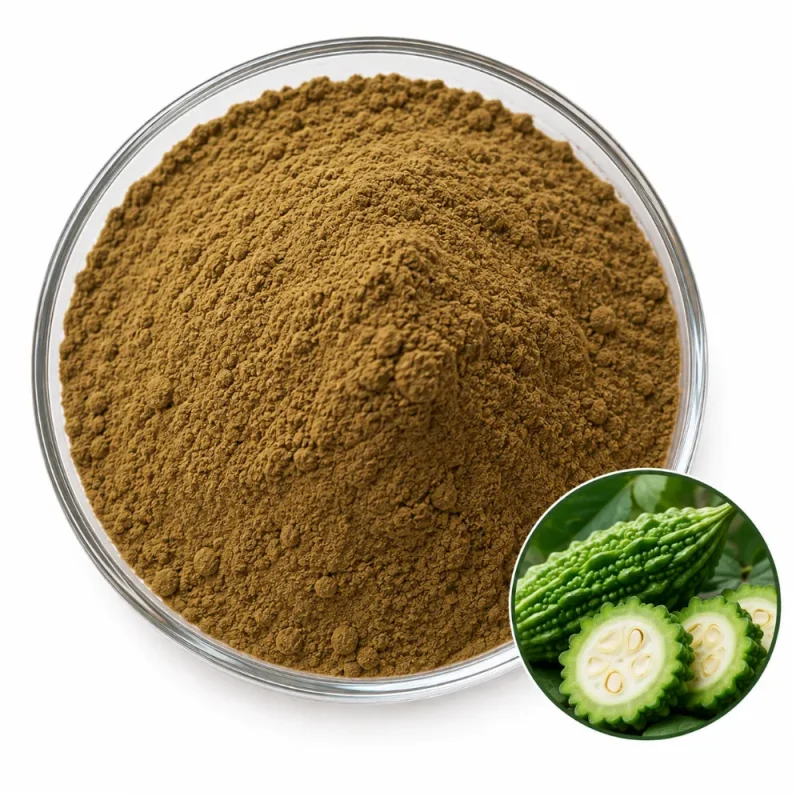
Bitter Melon Extract 0.5–1% Charantin

Bitter melon extract is prepared from the unripe green fruit of Momordica charantia, the climbing gourd grown across Asia, and not from the leaves, shoots or ripe orange fruit. Ethanol extraction takes up the sterol glucosides and saponins of the fruit, and the liquor is dried to a light brown powder.

The grade range is 0.5–1% charantin by HPLC, and the primary grade is the 1% end. The powder is 80 mesh and slightly soluble in water. The 0.5% grade suits blended powders and tea-style mixes, while the 1% grade carries a higher marker load for compact capsules and tablets.

Charantin Standardization & Grades

Charantin is the name given to a mixture of steroidal glucosides, mainly the glucosides of beta-sitosterol and stigmasterol, that is isolated from the fruit. It is a sterol glycoside and not a bitter compound. The strong bitterness of bitter melon comes from a different group, the cucurbitane triterpene glycosides known as momordicosides. The grade names charantin because it is the marker most used in the trade and because it can be measured by HPLC. The botanical entity is Momordica charantia L., a vine of the Cucurbitaceae, and the part used is the green fruit.

GradeAssay & MethodWhere It Fits
0.5% CharantinHPLCBlended powders and tea-style mixes
1% CharantinHPLCCapsules and tablets with small fill

The two grades are close in strength, so the choice is a matter of fill size. The 1% grade packs twice the marker into a capsule of the same weight. The 0.5% grade is easier to meter in blends, and bitter melon extract at this level carries more of the fruit matrix. The data for this product lists total saponins as a secondary figure, which reflects the bitter fraction. The fruit is also supplied as a 10:1 ratio extract, the Bitter Melon Extract Powder, as a juice powder, the Bitter Melon Juice Powder, and as a milled fruit, the Bitter Melon Powder. Those forms carry no charantin figure. Bitter melon extract at 1% is the more concentrated of the two grades, and bitter melon extract at 0.5% is the fuller one. Bitter melon is eaten as a vegetable in Asia, but the extract is a concentrated powder and is dosed by the marker figure, not by the weight of fruit.

Charantin Analysis & Purity Risks

Both grades are measured by HPLC against a charantin reference. Sterol glucosides absorb weakly in the ultraviolet, so a light-scattering or mass detector, or UV at a very low wavelength, is normally used to see the peaks. Because charantin is a mixture, the percentage depends on which members are summed, and a certificate that lists the quantified compounds is more informative than the number alone.

The solubility of the marker shapes the extraction of bitter melon. Sterol glucosides dissolve poorly in water, which is why an alcohol route can enrich them where a water-based route would not. A UV total or a gravimetric saponin figure counts every glycoside that responds, including the bitter cucurbitane glycosides, and cannot be converted into an HPLC charantin result.

Sample preparation uses an alcohol diluent. The powder is dissolved, filtered and injected on a reversed-phase column, and the peaks are identified by retention time against the reference. Moisture in a hygroscopic extract changes the figure on an as-is basis, so the loss on drying belongs with the result.

Purity risks follow from the botany. Bitter melon is a species with two common fruit types, a long, pale, warty Chinese type and a narrow, ridged Indian type, and the leaf, shoot and seed are separate materials with different bitterness. The related gac fruit, Momordica cochinchinensis, is another species. Only the fruit is used here, and a fixed species and part are the first identity checks.

Typical Specifications

Specification ItemProduct Information
Latin NameMomordica charantia
Plant PartFruit & Berry
ProcessingEthanol Extraction
Compound ClassSaponins
Common NameBitter Melon, Bitter Gourd, Karela
Ingredient TypeStandardized Extract
Marker Compound(s)Charantin (mixture of plant sterol glucosides)
Primary Grade1% Charantin (HPLC)
Available Grades0.5% · 1% Charantin (HPLC)
AppearanceLight Brown powder
Solubility / DispersibilitySlightly Soluble in Water
Quality Parameters
Moisture (LOD)≤5.0%
Total Ash≤5.0%
Particle Size80 mesh
Heavy MetalsLead ≤2 ppm · Arsenic ≤1 ppm · Cadmium ≤1 ppm · Mercury ≤0.1 ppm
MicrobiologyTPC ≤1,000 cfu/g · Yeast & Mold ≤100 cfu/g · E. coli Negative · Salmonella Negative/25 g
Shelf Life24 months in unopened original packaging, cool and dry storage

Applications by Grade

1% Grade for Compact Capsules

The 1% grade packs the charantin target into a small fill and suits capsules and tablets. The light brown powder is bitter, slightly soluble and hygroscopic, so fill in a dry room and keep a desiccant in the closure of the bottle.

1% Grade in Tablet Blends

Tablets of the 1% grade need a dry binder and a moisture-tolerant filler, because the powder takes up water and softens compacts. A film coat hides the persistent bitter taste, and a lubricant that is compatible with sticky powders prevents sticking.

0.5% Grade in Tea-Style Mixes

Tea-style mixes use the 0.5% grade with ginger, citrus peel or mint to cover the bitterness. The powder is slightly soluble and leaves a haze, so a filter bag or a note to stir keeps the cup uniform.

0.5% Grade in Drink Powders

Drink powders carry the 0.5% grade with strong fruit flavors and a sweetener. Bitterness is the main limit on dose, and a thickener holds the slightly soluble particles in suspension, so test taste and mouthfeel at the target dose.

0.5% Grade in Gummy Premixes

Gummy premixes accept the 0.5% grade only with a strong flavor system. Add the powder after the main cook and mix well, and test the gummy after storage, since the bitter edge can rise as the sugars settle.

1% Grade in Stick Packs

Stick packs carry the 1% grade at a small fill with a flow agent and a sweet carrier. Seal the packs in moisture-barrier film, because the hygroscopic powder clumps at the seal, and check the taste of the dissolved drink at the target dose.

Technical & Quality Considerations

The extract is a light brown powder with a vegetal, slightly bitter odor and an intense, lingering bitter taste. Saponin-type glycosides lower surface tension, so agitated solutions foam. Sterol glucosides are stable at normal processing temperatures, but they dissolve poorly, and they separate from clear solutions when the temperature falls.

Bitterness is the main limit on dose in drinks, so early taste trials with the final sweetener and flavor system save work later. Dedicated scoops avoid transfer of bitterness to other products.

In liquids, wet the powder with a small amount of alcohol or a surfactant solution before dilution, then mix at high shear so that it does not float. Keep the drum sealed and away from light, compare each lot with a retained sample for color, odor and the charantin peaks, and clean the line after a run, because the bitter residue is persistent and carries into neighboring products. Bitter melon fruit varies in size and bitterness with the type and the harvest stage, and the extraction step evens out part of that variation, but a retained sample from each lot is still the best reference for color and taste.

Packaging & Commercial Supply

Essencefield supports product evaluation, formulation trials, commercial orders, and ongoing ingredient supply. Packaging, storage, and shipping arrangements are determined by product characteristics, order quantity, stability requirements, and destination-market needs.

Supply ItemGeneral Information
SampleAvailable upon request for formulation, testing, and supplier evaluation
Order Quantities100 g · 1 kg · 5 kg · 25 kg · 100 kg · 500 kg · Bulk
Sample Lead TimeTypically 5–7 days after sample confirmation
Production Lead TimeTypically 15–30 days after order and specification confirmation
PackagingSuitable protective inner packaging with bags, cartons, drums, or other appropriate outer packaging
StorageStore in tightly sealed, suitable protective packaging in a cool, dry environment. Protect from moisture, heat, and direct sunlight. Specific storage conditions follow the approved product specification.
DocumentationCOA · Product Specification · TDS · SDS · Applicable declarations (as applicable)

Final order quantities, lead times, packaging, documentation, and shipping arrangements are confirmed according to the selected product and commercial requirements.

Request Ingredient Specifications & Quote

Share your target specification, application, quantity, and documentation needs. We’ll help confirm suitable options, samples, and commercial supply details.