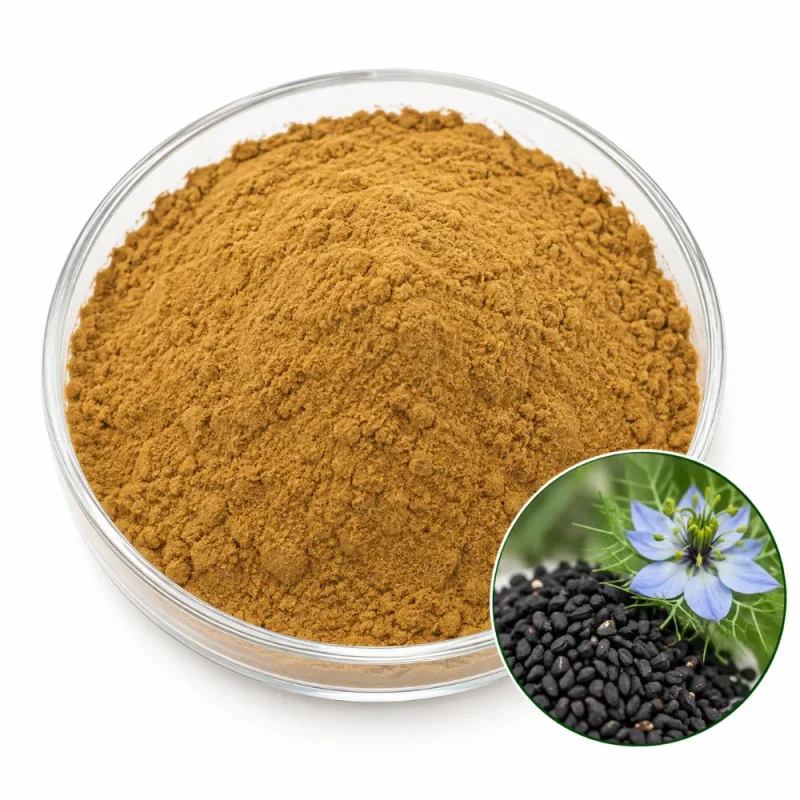
Black Cumin Seed Extract 5–20% Thymoquinone

Black cumin seed extract is prepared from the seeds of Nigella sativa, the annual herb also called black seed or kalonji, and not from true cumin (Cuminum cyminum), from the black caraway of Bunium persicum or from the ornamental love-in-a-mist. Ethanol extraction concentrates the lipophilic quinone fraction of the seed, and the liquor is dried to a brown powder.

The primary grade is 20% thymoquinone by HPLC, with 5% as the lower end of the range. The powder is 80 mesh and insoluble in water. The 20% grade serves softgels, capsules and tablets with a small fill weight, while the 5% grade suits dry blends that keep more of the seed matrix.

Thymoquinone Standardization & Grades

Thymoquinone is a small benzoquinone with a methyl and an isopropyl group, and it is the best known component of the volatile and fixed oil of black seed. It is the standardization target because it is characteristic of the species and can be measured by HPLC. The seed also holds p-cymene, carvacrol, thymohydroquinone and the fixed oil with its linoleic acid. The botanical entity is Nigella sativa L., and the part used is the seed.

GradeAssay & MethodWhere It Fits
5% ThymoquinoneHPLCDry blends keeping the seed matrix
20% ThymoquinoneHPLCSoftgels, capsules and tablets with small fill

Grade choice follows dose, fill weight and the character of the seed. The 20% grade carries four times the thymoquinone load per gram of the 5% grade, so a capsule reaches its target in a smaller fill, and the powder is oilier and more pungent. The 5% grade retains more of the seed protein, fixed oil and fiber-derived material and is bulkier and milder. Siblings from the same seed are the unstandardized Nigella Sativa Seed Extract Powder, the milled Black Cumin Seed Powder and the purified Thymoquinone 98%.

The common name causes frequent confusion. Black cumin is also applied to Bunium persicum, a different aromatic seed of the same family as cumin, and cumin itself is a distinct spice. Buyers who compare thymoquinone quotes should confirm the species, the seed as the stated part and the method, because a thymoquinone figure in an oil and one in a dry powder are not directly comparable.

The data for this plant show that thymoquinone content in the seed varies widely, so an extract graded to a percentage gives the formulator a defined starting point. Without it, a seed powder or an unstandardized extract can differ from lot to lot by a large factor.

Thymoquinone Analysis & Purity Risks

Both grades are measured by HPLC, which separates thymoquinone from thymohydroquinone, dithymoquinone, carvacrol and thymol on a reversed-phase column, identifies the peak by retention time and its characteristic UV spectrum and quantifies against a reference standard. A gravimetric volatile oil test counts every lipophilic compound and is not comparable with the HPLC value.

Thymoquinone is a labile molecule. It is volatile, sensitive to light, and it reduces to thymohydroquinone or dimerizes to dithymoquinone, so the fingerprint carries information about handling. A lot with a large dithymoquinone peak and a small thymoquinone peak has been exposed to light or stored warm. Amber vials, short sample queues and a protected autosampler are therefore part of a sound method.

Sample preparation uses methanol or acetonitrile, followed by sonication and filtration through a solvent-compatible membrane. Thymoquinone adsorbs to some plastics and filters, so a spiked standard is used to check the loss at the laboratory.

Purity risks follow from the botany and the trade. Nigella damascena is an ornamental with a different chemistry, and the seeds of Bunium persicum are sold as black cumin, so the name alone does not identify the plant. Seed oil sold as an ingredient is also a different product from a powdered extract. A named species, the seed as the stated part and a thymoquinone-led fingerprint protect identity better than a percentage.

Typical Specifications

Specification ItemProduct Information
Latin NameNigella sativa
Plant PartSeed & Grain
ProcessingEthanol Extraction
Compound ClassQuinones
Common NameBlack Cumin, Black Seed, Kalonji
Ingredient TypeStandardized Extract
Marker Compound(s)Thymoquinone (benzoquinone of Nigella sativa seed)
Primary Grade20% Thymoquinone (HPLC)
Available Grades5% · 20% Thymoquinone (HPLC)
AppearanceBrown powder
Solubility / DispersibilityInsoluble in Water
Quality Parameters
Moisture (LOD)≤5.0%
Total Ash≤5.0%
Particle Size80 mesh
Heavy MetalsLead ≤2 ppm · Arsenic ≤1 ppm · Cadmium ≤1 ppm · Mercury ≤0.1 ppm
MicrobiologyTPC ≤1,000 cfu/g · Yeast & Mold ≤100 cfu/g · E. coli Negative · Salmonella Negative/25 g
Shelf Life24 months in unopened original packaging, cool and dry storage

Applications by Grade

20% Grade for Oil-Based Softgels

Thymoquinone dissolves in oils far better than in water, so softgel fills disperse the 20% grade in a carrier oil. Prepare the fill under dim light and low oxygen, mill the powder fine and stir during encapsulation, since the compound is light sensitive.

20% Grade in Compact Capsules

In hard capsules, the 20% grade delivers a thymoquinone target in a small fill. The brown powder is oily and cohesive, so a flow agent helps the hopper, and an opaque capsule shell and amber bottle protect the content from light.

20% Grade in Tablet Blends

Tablets of the high grade need a dry binder and an absorbent, since the oily fraction softens compacts and sticks to punches. Keep lubricant levels low, run a compression trial and use an opaque film coat that limits light exposure.

5% Grade for Dry Spice-Style Blends

At 5% the extract is dosed by weight in dry blends, where the warm, peppery and slightly bitter character of black seed sits beside cardamom, coriander and fenugreek. Pre-mix it with a bulking agent to spread the oily powder evenly.

5% Grade for Bar Premixes

In bar premixes the lower grade is used at a moderate inclusion and blended into the dry fraction before the syrup goes in. Honey, date and nut bases soften the pungency, and the dark brown powder disappears into cocoa or carob coatings.

Technical & Quality Considerations

The extract is a brown powder with a spicy, slightly bitter and peppery odor and a pungent taste. It is insoluble in water, so it does not dissolve in drink bases and floats or settles depending on its oil content. Thymoquinone dissolves in oils, ethanol and some surfactant systems, and the choice of carrier decides how stable it is in the product.

Thymoquinone is sensitive to light, heat and oxygen, and the seed lipids oxidize with time, so protect the powder from all three. Use opaque packaging, keep the drum closed and cool and flush partly used containers with nitrogen if possible. At production scale, handle the black cumin seed extract in a ventilated station and pre-mix it with a portion of the carrier before it enters the main blender.

The oily, pungent residue persists on equipment, so wash with warm detergent or an ethanol cleaner and dedicate scoops where possible. Note the opening date on the drum and compare each lot with a retained sample for color, odor and flow. A shift toward a rancid or sharply bitter odor suggests oxidation and should be checked before release.

A black cumin seed extract is checked by odor and by the thymoquinone to dithymoquinone ratio. A peppery, slightly resinous note is typical, and a flat or rancid smell shows oxidation. Keep a retained sample of each black cumin seed extract lot in an amber, tightly closed container, and compare the thymoquinone peak of later lots with it, since the compound loses area quickly when exposed to light.

Packaging & Commercial Supply

Essencefield supports product evaluation, formulation trials, commercial orders, and ongoing ingredient supply. Packaging, storage, and shipping arrangements are determined by product characteristics, order quantity, stability requirements, and destination-market needs.

Supply ItemGeneral Information
SampleAvailable upon request for formulation, testing, and supplier evaluation
Order Quantities100 g · 1 kg · 5 kg · 25 kg · 100 kg · 500 kg · Bulk
Sample Lead TimeTypically 5–7 days after sample confirmation
Production Lead TimeTypically 15–30 days after order and specification confirmation
PackagingSuitable protective inner packaging with bags, cartons, drums, or other appropriate outer packaging
StorageStore in tightly sealed, suitable protective packaging in a cool, dry environment. Protect from moisture, heat, and direct sunlight. Specific storage conditions follow the approved product specification.
DocumentationCOA · Product Specification · TDS · SDS · Applicable declarations (as applicable)

Final order quantities, lead times, packaging, documentation, and shipping arrangements are confirmed according to the selected product and commercial requirements.

Request Ingredient Specifications & Quote

Share your target specification, application, quantity, and documentation needs. We’ll help confirm suitable options, samples, and commercial supply details.