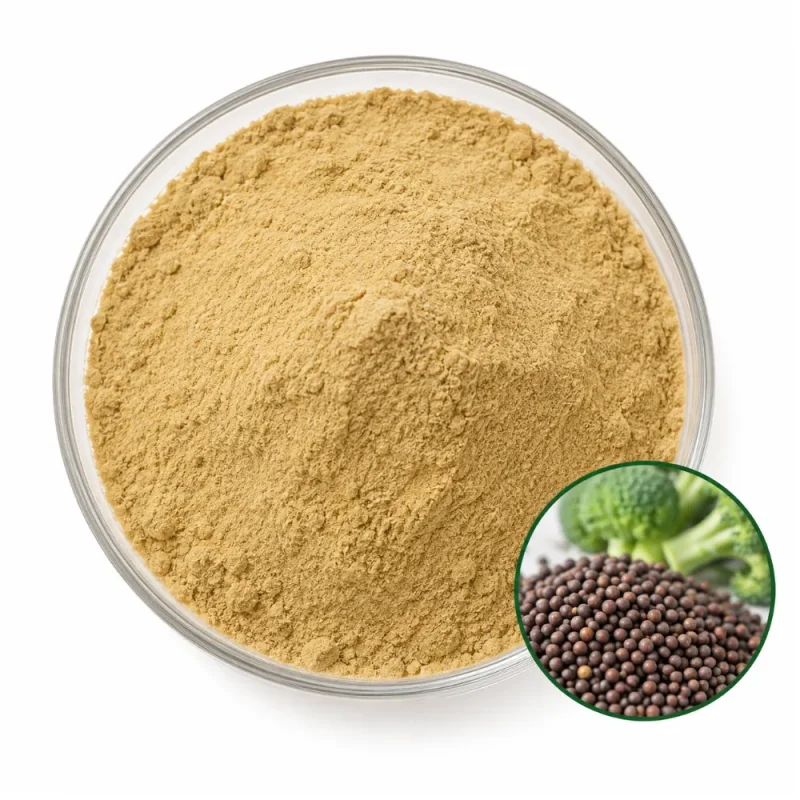
Broccoli Seed Extract 5–30% Glucoraphanin

Broccoli seed extract is prepared from the mature seeds of Brassica oleracea var. italica, the broccoli plant, and not from the florets, the sprouts or the leaves. Ethanol extraction takes up the glucosinolates of the seed, and the liquor is dried to a green powder that dissolves in water.

The grade range is 5–30% glucoraphanin by HPLC, and the primary grade is the 30% end. The powder is 80 mesh and water soluble. The 5% grade suits drink powders and blended premixes, while the 30% grade carries a higher marker load for compact capsules and tablets.

Glucoraphanin Standardization & Grades

Glucoraphanin is a glucosinolate, a sulfur-containing glycoside that is stable while the plant tissue is intact. When the seed or the leaf is crushed and wetted, the plant enzyme myrosinase converts glucoraphanin to the isothiocyanate sulforaphane. The extract is standardized to the precursor because it is the stable form that can be measured as a single compound, and because seeds hold far more of it than the florets. The botanical entity is Brassica oleracea var. italica Plenck, and the part used is the seed.

GradeAssay & MethodWhere It Fits
5% GlucoraphaninHPLCDrink powders and blended premixes
30% GlucoraphaninHPLCCapsules and tablets with small fill

The two grades differ by a factor of six. The 30% grade is a precursor concentrate that supplies a defined load from a small fill. The 5% grade holds more of the seed matrix, the sugars, the proteins and the sinapic acid esters, so broccoli seed extract at this level is bulkier and suits drink powders and blended premixes. The seed is also supplied as a 10:1 ratio extract, the Broccoli Seed Extract Powder, the whole plant as the Broccoli Extract Powder, and the converted isothiocyanate as the purified compound Sulforaphane 98%. A glucoraphanin extract is not a sulforaphane product, and the two should not be read as interchangeable. Broccoli seed is the richest broccoli material for glucoraphanin, while the broccoli floret that is eaten as a vegetable holds much less, so a broccoli extract made from the seed is a very different ingredient from one made from the whole plant. Broccoli seed extract at 30% is the more concentrated of the two grades.

Glucoraphanin Analysis & Purity Risks

Both grades are quantified by HPLC with a glucoraphanin reference standard. Glucosinolates are polar and anionic, so the sample is run on a column suited to polar analytes or analyzed after enzymatic removal of the sulfate group, and the result is calculated back with a response factor. The data for this product lists sulforaphane as a secondary marker, which is measured by a separate method. A UV total or a sulfur-based figure cannot be converted into an HPLC result.

The balance between glucoraphanin and sulforaphane in a lot depends on the enzyme. Myrosinase is deactivated by heat, which is how a seed extract is made stable, and a lot in which the enzyme remains active will convert glucoraphanin to sulforaphane when water is added. Sulforaphane itself is unstable and degrades quickly, so it is present at a much lower level than the precursor.

Sample preparation controls the result. The powder is dissolved and the enzyme is either inactivated or deliberately activated, depending on the figure that is wanted, so the procedure belongs with the number. Heat during extraction or drying lowers the glucoraphanin only if the temperature is excessive.

Purity risks follow from the plant material and the naming. Broccoli seed, sprouts and florets differ greatly in glucosinolate content, and listings for 98% sulforaphane often carry no method or certificate. A stated plant part, a stated variety and the glucoraphanin figure with its method are the first identity checks.

Typical Specifications

Specification ItemProduct Information
Latin NameBrassica oleracea var. italica
Plant PartSeed & Grain
ProcessingEthanol Extraction
Compound ClassOrganosulfur Compounds
Common NameBroccoli Seed, Brassica Seed
Ingredient TypeStandardized Extract
Marker Compound(s)Glucoraphanin (a glucosinolate)
Primary Grade30% Glucoraphanin (HPLC)
Available Grades5% · 30% Glucoraphanin (HPLC)
AppearanceGreen powder
Solubility / DispersibilityWater Soluble
Quality Parameters
Moisture (LOD)≤5.0%
Total Ash≤5.0%
Particle Size80 mesh
Heavy MetalsLead ≤2 ppm · Arsenic ≤1 ppm · Cadmium ≤1 ppm · Mercury ≤0.1 ppm
MicrobiologyTPC ≤1,000 cfu/g · Yeast & Mold ≤100 cfu/g · E. coli Negative · Salmonella Negative/25 g
Shelf Life24 months in unopened original packaging, cool and dry storage

Applications by Grade

30% Grade for Compact Capsules

The 30% grade puts the glucoraphanin target into a small fill, so it suits capsules and tablets. The green powder is water soluble and hygroscopic, so fill in a dry room and keep a desiccant in the closure of the bottle.

30% Grade in Tablet Blends

Tablets of the 30% grade need a dry binder and a moisture-tolerant filler, because the polar glucosinolate powder softens compacts under humidity. A film coat covers the faint sulfurous note and protects the tablet from moisture.

5% Grade in Drink Powders

The 5% grade dissolves in water to a clear to slightly hazy green-yellow drink with a faint cabbage-like note. It suits vegetable and fruit drink mixes where the green color and mild flavor fit the product.

5% Grade in Blended Premixes

Blended premixes use the 5% grade with greens powders and other vegetable extracts. It fills at a larger weight and is easier to meter, and it should be pre-blended with a portion of the carrier to avoid color streaks.

5% Grade in Gummy Premixes

Gummy premixes accept the 5% grade as a soluble powder in warm syrup. Add it after the main cook and keep the hold short, since heat darkens the green color, and check the flavor after storage.

30% Grade in Stick Packs

Stick packs carry the 30% grade at a very small fill with a flow agent and a carrier. Seal the packs in moisture-barrier film, since the polar powder clumps at the seal and the clumps dissolve slowly in the cup.

Technical & Quality Considerations

The extract is a green powder with a faint, cabbage-like sulfur odor and a bitter taste. It is water soluble, and solutions are clear to slightly hazy and yellow-green. Glucoraphanin is stable while the enzyme is inactive, but moisture can restart conversion in a lot that still holds active myrosinase, and a wet, warm setting then produces sulforaphane and a stronger smell.

For production, control humidity in weighing and filling, since the polar powder gains water and cakes. Sieve before blending to break up soft lumps, and fold broccoli seed extract into a portion of the carrier. Dedicated scoops and a sealed liner limit the transfer of the sulfur note to neighboring products, and a fine flow aid helps the 30% grade pass through hoppers and feeders.

In liquids, add the powder under agitation to a base at a moderate pH and avoid long hot holds. A cool, dry store in a sealed liner keeps the powder free-flowing, and a sample tested again near the end of shelf life shows whether the packaging holds the marker figure and the color. Broccoli seed extract is milder in smell than the fresh vegetable, but the sulfur note becomes stronger when a moist drum is left open, so reseal drums promptly. Taste trials in the final drink show whether the bitter edge of the broccoli seed matters at the target dose.

Packaging & Commercial Supply

Essencefield supports product evaluation, formulation trials, commercial orders, and ongoing ingredient supply. Packaging, storage, and shipping arrangements are determined by product characteristics, order quantity, stability requirements, and destination-market needs.

Supply ItemGeneral Information
SampleAvailable upon request for formulation, testing, and supplier evaluation
Order Quantities100 g · 1 kg · 5 kg · 25 kg · 100 kg · 500 kg · Bulk
Sample Lead TimeTypically 5–7 days after sample confirmation
Production Lead TimeTypically 15–30 days after order and specification confirmation
PackagingSuitable protective inner packaging with bags, cartons, drums, or other appropriate outer packaging
StorageStore in tightly sealed, suitable protective packaging in a cool, dry environment. Protect from moisture, heat, and direct sunlight. Specific storage conditions follow the approved product specification.
DocumentationCOA · Product Specification · TDS · SDS · Applicable declarations (as applicable)

Final order quantities, lead times, packaging, documentation, and shipping arrangements are confirmed according to the selected product and commercial requirements.

Request Ingredient Specifications & Quote

Share your target specification, application, quantity, and documentation needs. We’ll help confirm suitable options, samples, and commercial supply details.