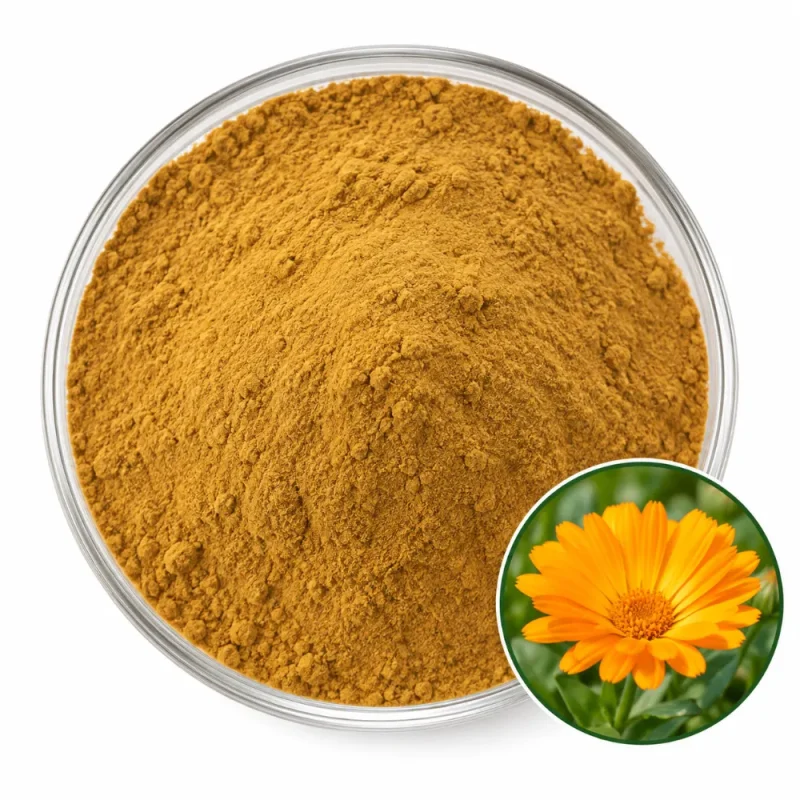
Calendula Extract 1–20% Total Flavonoids

Calendula extract is prepared from the dried flower heads of Calendula officinalis, the pot marigold, and the leaf, stem and unrelated Tagetes marigolds are not part of the starting material. Ethanol extraction takes up the flavonoid glycosides of the florets, and the concentrate is dried to a yellow-orange powder.

Total flavonoids are measured by UV spectrophotometry, with a primary grade of 20% and a lower grade of 1%. The powder is 80 mesh and slightly soluble in water. The 20% grade fits capsules and tablets, while the 1% grade fits drink premixes and blends in which the flower’s yellow-orange tone is wanted.

Total Flavonoids Standardization & Grades

Total flavonoids is a class figure, not a single compound. In the calendula flower it is dominated by glycosides of quercetin and isorhamnetin, among them rutin, narcissin and isoquercitrin, and a UV assay adds them into one number. The botanical entity is Calendula officinalis L., and the extract is standardized to this fraction because it is the stable, measurable phenolic class of the florets, while the triterpene esters and carotenoids of the same flower behave differently and are followed separately. The carotenoids set the yellow-orange color and sit outside the figure, so two lots with the same flavonoid percentage can differ in hue and in the weight of non-flavonoid material they carry.

GradeAssay & MethodWhere It Fits
1% Total FlavonoidsUVDrink premixes, gummy and bar blends
20% Total FlavonoidsUVCapsules and tablets, small fill weight

Grade choice follows dose and color. The 20% grade carries twenty times the flavonoid load of the 1% grade per gram, so a capsule reaches its target in a small fill, while the 1% grade is a bulkier solid that disperses easily into premixes. Calendula is also supplied as a 10:1 ratio extract with no marker figure, the Calendula Flower Extract Powder, and as milled flower, the Calendula Flower Powder. The standardized extract is the row to use when a flavonoid figure has to appear in the specification.

Total Flavonoids Analysis & Purity Risks

A UV assay reads the absorbance of a flavonoid complex and calculates the total against a reference compound, so the result is an equivalent and not a count of individual molecules. Because the choice of reference moves the number, a figure is comparable only with another figure on the same basis. A UV total cannot be converted into an HPLC result for single glycosides, since the two methods measure different things.

For identity, an HPLC fingerprint of the flavonoid glycosides is read beside the total, with rutin, narcissin and isoquercitrin as the usual peaks. The faradiol esters, lipophilic triterpene esters that are characteristic of the flower, serve as a secondary identity marker and are not counted in the flavonoid figure. Carotenoids give the yellow-orange color but are likewise outside the assay.

Purity risks follow from the material class. Pot marigold is easily confused with Tagetes marigolds grown for lutein, which have a different flavonoid and carotenoid profile, and with ornamental calendula types. The flower head is the defined part, because leaf and stem add chlorophyll and dilute the flavonoid fraction. A UV total can also be inflated by other phenolics that react in the same assay, so the fingerprint matters as much as the percentage.

Sample preparation is simple but not trivial. The powder is dissolved in an alcohol-based solvent, a complexing reagent is added, and absorbance is read at a fixed wavelength against a blank, with the calendula extract diluted into the working range of the curve. Because colored carotenoids can add background absorbance at neighboring wavelengths, a sample blank without the reagent is run in parallel so that the yellow-orange tone of the powder is not read as flavonoid.

Typical Specifications

Specification ItemProduct Information
Latin NameCalendula officinalis
Plant PartFlower
ProcessingEthanol Extraction
Compound ClassFlavonoids, Polyphenols
Common NameCalendula, Pot Marigold
Ingredient TypeStandardized Extract
Marker Compound(s)Total flavonoids (quercetin and isorhamnetin glycosides)
Primary Grade20% Total Flavonoids (UV)
Available Grades1% · 20% Total Flavonoids (UV)
AppearanceYellow-Orange powder
Solubility / DispersibilitySlightly Soluble in Water
Quality Parameters
Moisture (LOD)≤5.0%
Total Ash≤5.0%
Particle Size80 mesh
Heavy MetalsLead ≤2 ppm · Arsenic ≤1 ppm · Cadmium ≤1 ppm · Mercury ≤0.1 ppm
MicrobiologyTPC ≤1,000 cfu/g · Yeast & Mold ≤100 cfu/g · E. coli Negative · Salmonella Negative/25 g
Shelf Life24 months in unopened original packaging, cool and dry storage

Applications by Grade

20% Grade for Capsule Fills

The 20% grade reaches a flavonoid target in a small fill, which suits two-piece capsules. Calendula extracts of this kind pick up moisture readily, so fill in a dry room and add a flow agent to keep the yellow-orange powder from bridging in the hopper.

1% Grade in Drink Premixes

The lower grade is bulky enough to carry in stick-pack drink powders at a higher gram weight. It colors the cup yellow-orange and adds a faint herbal note, so citrus or tropical flavor bases hide the note and let the natural color read as intended. A light haze in the cup is normal for this solubility.

20% Grade in Tablet Blends

Tablets of the 20% grade need a dry binder and a glidant, because the extract compacts as a slightly tacky solid. A film coat limits moisture uptake and color transfer onto the punch faces, and disintegration should be checked after storage.

1% Grade for Gummy Bases

Gummies take the 1% grade as a color-contributing ingredient rather than a dose carrier. Add it after the main cook, since long heating dulls the carotenoid hue, and keep the gel pH in the range the pectin or gelatin base needs. A trial batch held at room temperature shows whether the color holds.

20% Grade in Sachet Blends

Sachets of the 20% grade are diluted in steps with a bulking carrier so the filler can weigh an accurate dose. The yellow-orange powder stains laminated film at the seal, so inspect the pack interior for color transfer on early lots.

1% Grade for Bar Blends

In cold-pressed bars the 1% grade is blended into the dry fraction before the syrup is added. Its mild herbal taste sits well under honey, nut or citrus-peel flavors, and the yellow tone is visible in pale bar bases.

Technical & Quality Considerations

The extract is a yellow-orange powder with a faint herbal odor. It is slightly soluble in water, so a solution turns hazy yellow, with part of the flavonoid glycosides dissolved and the lipophilic fraction left in suspension. Quercetin-type glycosides chelate iron, which darkens the color, so stainless contact surfaces and low-iron fillers are the better choice. The carotenoid fraction oxidizes slowly under light and oxygen, and the hue fades.

For scale-up, sieve the powder, premix it with a small share of the carrier and verify fill weight at each lot change, since the grades differ widely in bulk. Tablet and gummy formulas need a moisture check after storage because the material is hygroscopic. Keep drums sealed and flushed, protect clear packs from direct light, and compare each lot with a retained sample for color and flow.

Flower extracts of this type also carry a resinous, slightly sticky fraction, which is why the powder can cake in warm storage and smear on sieves. Sieve in a cool room, use stainless screens that are easy to clean, and avoid stacking drums where they sit near heat. In liquid formats the color is the limiting property: a pale beverage takes on a visible yellow-orange tone at low inclusion, and light-protective packaging keeps that tone stable through shelf life.

Packaging & Commercial Supply

Essencefield supports product evaluation, formulation trials, commercial orders, and ongoing ingredient supply. Packaging, storage, and shipping arrangements are determined by product characteristics, order quantity, stability requirements, and destination-market needs.

Supply ItemGeneral Information
SampleAvailable upon request for formulation, testing, and supplier evaluation
Order Quantities100 g · 1 kg · 5 kg · 25 kg · 100 kg · 500 kg · Bulk
Sample Lead TimeTypically 5–7 days after sample confirmation
Production Lead TimeTypically 15–30 days after order and specification confirmation
PackagingSuitable protective inner packaging with bags, cartons, drums, or other appropriate outer packaging
StorageStore in tightly sealed, suitable protective packaging in a cool, dry environment. Protect from moisture, heat, and direct sunlight. Specific storage conditions follow the approved product specification.
DocumentationCOA · Product Specification · TDS · SDS · Applicable declarations (as applicable)

Final order quantities, lead times, packaging, documentation, and shipping arrangements are confirmed according to the selected product and commercial requirements.

Request Ingredient Specifications & Quote

Share your target specification, application, quantity, and documentation needs. We’ll help confirm suitable options, samples, and commercial supply details.