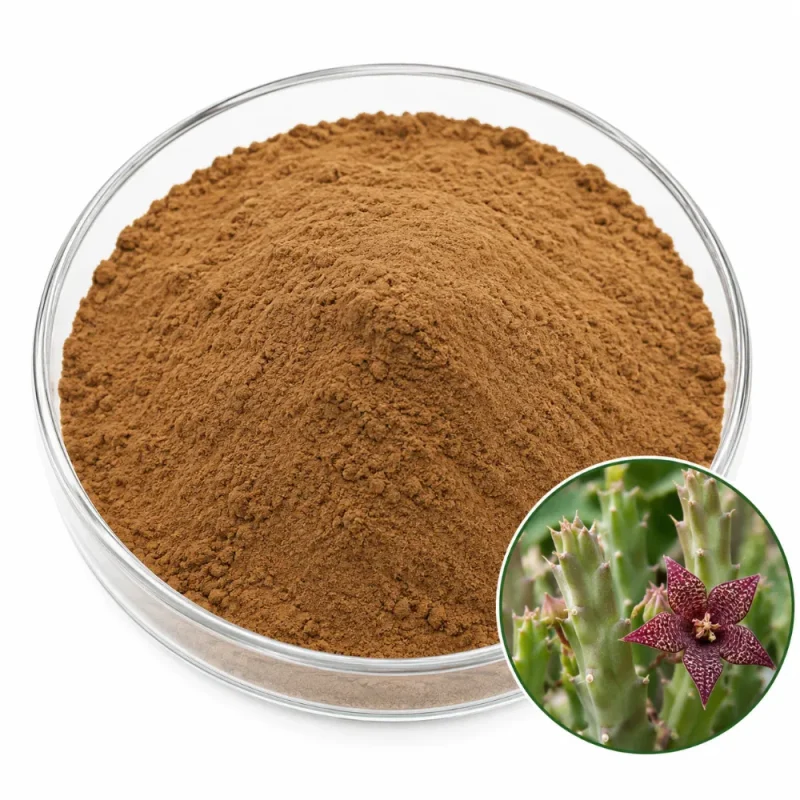
Caralluma fimbriata Extract 10–40% Pregnane Glycosides

The succulent stem of Caralluma fimbriata, a leafless, four-angled plant of dry Indian scrubland that is also eaten as a vegetable, is the only part used in this extract. Ethanol extraction takes up the pregnane glycosides, steroidal glycosides on a C21 skeleton, and the concentrate is dried to a light brown powder.

The primary grade is 40% pregnane glycosides by HPLC, with a 10% grade as the lower end. The powder is 80 mesh and slightly soluble in water. The 40% grade suits capsules that need a small fill weight, while the 10% grade suits blends in which the stem’s own matrix is wanted at higher inclusion.

Pregnane Glycoside Standardization & Grades

Pregnane glycosides are the characteristic compound family of the genus, a group of related sugar-bearing steroids that differ in the aglycone and in the sugar chain. Because the family has no single dominant member, the extract is standardized to the class sum and not to one named glycoside. The botanical entity is Caralluma fimbriata Wall., and the part used is the stem. The plant is leafless, so there is no leaf or flower material in a Caralluma fimbriata extract. The glycosides are drawn from the green, fleshy tissue of the stem itself, and the balance of the powder is sugars, flavone glycosides and plant acids that are carried over from that tissue.

GradeAssay & MethodWhere It Fits
10% Pregnane GlycosidesHPLCBlends with higher inclusion rates
40% Pregnane GlycosidesHPLCCapsules, small fill weight

Grade choice for Caralluma fimbriata extract follows dose and fill weight. The 40% grade carries four times the glycoside load of the 10% grade per gram, so a capsule reaches its target with less powder. The 10% grade is a bulkier solid that is easier to dose by volume in a sachet. Caralluma is also supplied as a 10:1 ratio extract with no marker figure, the Caralluma fimbriata Extract Powder. The standardized extract is the row to use when a glycoside figure has to appear in the specification.

Pregnane Glycoside Analysis & Purity Risks

HPLC separates the individual pregnane glycosides on a reversed-phase column and sums the identified peaks against a reference compound. The method reports the glycosides together, so a result depends on which peaks are integrated and which reference is used. A gravimetric steroid total or a UV reading would count other material and is not comparable with the HPLC figure.

For identity, the chromatographic fingerprint is read beside the total. The plant carries a recognizable set of pregnane glycosides together with flavone glycosides, and the relative pattern distinguishes the stem extract from extracts of related species.

Purity risks follow from the material class. Several Caralluma species and relatives of the Apocynaceae family are traded under similar names, and botanical databases treat C. fimbriata as a synonym of another succulent, so a named species, a stated stem part and a fingerprint protect identity better than a percentage. The stem is a fleshy tissue that holds a great deal of water. Material that is not fully dried can raise moisture and microbial counts, so the loss on drying of the extract matters.

Method detail matters for a class assay. Pregnane glycosides absorb weakly in the UV, so detection is set at a low wavelength where solvents and sugars also absorb. A gradient has to separate the glycoside cluster from the early-eluting sugars to keep the baseline under control. A reference compound for one glycoside is used to quantify the group, and the assignment of peaks to the class is part of the method definition. Two laboratories using different peak lists can report different totals for the same powder.

Typical Specifications

Specification ItemProduct Information
Latin NameCaralluma fimbriata
Plant PartBark & Stem
ProcessingEthanol Extraction
Compound ClassSaponins
Common NameCaralluma, Caralluma fimbriata
Ingredient TypeStandardized Extract
Marker Compound(s)Pregnane glycosides
Primary Grade40% Pregnane Glycosides (HPLC)
Available Grades10% · 40% Pregnane Glycosides (HPLC)
AppearanceLight Brown powder
Solubility / DispersibilitySlightly Soluble in Water
Quality Parameters
Moisture (LOD)≤5.0%
Total Ash≤5.0%
Particle Size80 mesh
Heavy MetalsLead ≤2 ppm · Arsenic ≤1 ppm · Cadmium ≤1 ppm · Mercury ≤0.1 ppm
MicrobiologyTPC ≤1,000 cfu/g · Yeast & Mold ≤100 cfu/g · E. coli Negative · Salmonella Negative/25 g
Shelf Life24 months in unopened original packaging, cool and dry storage

Applications by Grade

40% Grade for Small Capsules

The 40% grade of Caralluma fimbriata extract reaches a glycoside target in a small fill, which suits compact capsules. The extract is bitter and slightly hygroscopic, so encapsulate in a dry room and let the shell carry the taste instead of exposing loose powder. Seal filled capsules in a desiccated bottle.

10% Grade in Sachet Blends

At the lower grade, sachets hold the extract at a practical gram weight. The bitterness is strong, so pair it with a sweetener and a robust flavor base, and add a bulking carrier so the filler can weigh an accurate dose. A foil laminate with low moisture transmission keeps the bulky 10% grade free-flowing through shelf life.

40% Grade in Tablet Blends

The 40% grade compresses with a dry binder and a glidant, and a film coat covers the bitter taste. Check hardness and disintegration after storage, since glycoside-rich powders pick up moisture and soften the tablet. Dedicated tooling with a polished punch face limits sticking when the compression room is humid.

10% Grade for Drink Premixes

The 10% grade fits stick-pack drink powders, where its slight solubility leaves a mild haze. Choose citrus or spiced flavors to cover bitterness, and shake-test the premix for settling before release. Because the glycosides dissolve only partly, a stick pack should state that the drink is stirred, not left standing, before it is consumed.

10% Grade in Gummy Bases

Gummies take the lower grade with strong fruit flavors, because the bitterness is hard to hide in a chewable gel. Add the powder after the main cook and confirm that the gel set is not softened by its glycosides. Test a small cast first, since a bitter, fibrous solid can leave a grainy mouthfeel in a smooth gel.

Technical & Quality Considerations

Caralluma fimbriata extract is a light brown powder with a mild, plant-like odor and a bitter taste. It is slightly soluble in water, so a solution is hazy, with part of the glycoside dissolved and the rest held in suspension. Pregnane glycosides are generally stable in neutral media but hydrolyze under strong acid or prolonged heat, so acidic liquid formats need a stability check.

For scale-up, sieve the powder, premix it with a small share of the carrier and verify fill weight at each lot change. The material absorbs moisture, so keep drums sealed and run encapsulation and tableting in a controlled-humidity area. Bitterness is the main sensory limit, which is why taste-masking in the dosage form matters more than the choice of grade. Compare each lot with a retained sample for color and flow.

Dust control and handling follow from the fine, bitter powder. Charge Caralluma fimbriata extract through a closed system or under local extraction, and wipe balances down after each weighing. Residual dust carries the bitterness into adjacent products. Dedicated scoops, and a cleaning step that removes a sticky film from sieves and hoppers, keep one product from tainting the next. Where the powder is blended with sweeteners, check that the sweetener does not clump against the glycoside-rich particles.

Packaging & Commercial Supply

Essencefield supports product evaluation, formulation trials, commercial orders, and ongoing ingredient supply. Packaging, storage, and shipping arrangements are determined by product characteristics, order quantity, stability requirements, and destination-market needs.

Supply ItemGeneral Information
SampleAvailable upon request for formulation, testing, and supplier evaluation
Order Quantities100 g · 1 kg · 5 kg · 25 kg · 100 kg · 500 kg · Bulk
Sample Lead TimeTypically 5–7 days after sample confirmation
Production Lead TimeTypically 15–30 days after order and specification confirmation
PackagingSuitable protective inner packaging with bags, cartons, drums, or other appropriate outer packaging
StorageStore in tightly sealed, suitable protective packaging in a cool, dry environment. Protect from moisture, heat, and direct sunlight. Specific storage conditions follow the approved product specification.
DocumentationCOA · Product Specification · TDS · SDS · Applicable declarations (as applicable)

Final order quantities, lead times, packaging, documentation, and shipping arrangements are confirmed according to the selected product and commercial requirements.

Request Ingredient Specifications & Quote

Share your target specification, application, quantity, and documentation needs. We’ll help confirm suitable options, samples, and commercial supply details.