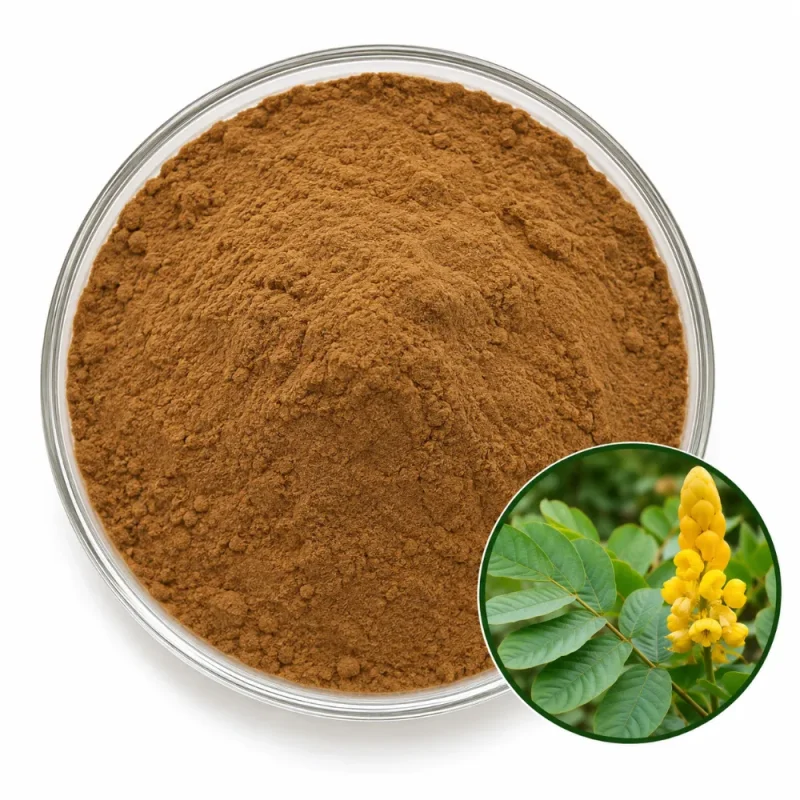
Cassia alata Extract 4–40% Total Anthraquinones

The leaf of Cassia alata, the candle bush, is the only part used in this extract, and pods, seed and bark are excluded. Ethanol extraction takes up the hydroxyanthracene derivatives of the leaf together with its flavonoid glycosides, and the concentrate is dried to a light brown powder.

Total anthraquinones are measured by UV, with a primary grade of 40% and a lower grade of 4%. The powder is 80 mesh and insoluble in water. The 40% grade fits capsules and tablets that need a small fill, while the 4% grade suits dry blends in which the leaf matrix carries most of the mass.

Total Anthraquinones Standardization & Grades

Total anthraquinones is a class figure that adds the anthraquinone-type compounds of the leaf, chiefly rhein, aloe-emodin, emodin and chrysophanol in free and glycoside-bound forms. The botanical entity is Cassia alata L. The Cassia alata extract is standardized to this class because the anthraquinones are the defining, measurable constituents of the leaf. The kaempferol-type flavonoids that accompany them are followed only as identity markers.

GradeAssay & MethodWhere It Fits
4% Total AnthraquinonesUVDry blends, higher inclusion rates
40% Total AnthraquinonesUVCapsules and tablets, small fill weight

Grade choice follows dose and fill weight. The 40% grade carries ten times the anthraquinone load of the 4% grade per gram, so a capsule reaches its target with far less powder. The 4% grade is a bulkier solid that behaves more like a milled leaf in a blend. Anthraquinone-type compounds are a regulated class in several regions, so the grade, the declared basis and the label wording of the finished product are decisions for regulatory review before launch. The standardized extract is the row to use when an anthraquinone figure has to appear in the specification.

Total Anthraquinones Analysis & Purity Risks

A UV assay for anthraquinones does not read the glycosides as they are. The sample is hydrolyzed, the aglycones are taken into an organic phase, and the color formed on alkalinization is read at a fixed wavelength against a reference. The result is therefore an equivalent that depends on the hydrolysis conditions and on the reference chosen, and it cannot be converted into an HPLC result for rhein or emodin.

For identity, an HPLC fingerprint of the leaf is read beside the total. Rhein and aloe-emodin are the characteristic anthraquinone peaks, and the kaempferol glycosides of the leaf give a flavonoid pattern that helps to separate this species from other senna-type leaves. The anthraquinone content of a Cassia alata extract depends on the leaf stage at harvest and on whether the aglycones or the glycosides dominate.

Purity risks follow from the botanical group. Cassia alata is a candle bush that plant databases now place in the senna genus. It is easily confused with true senna leaf, with Cassia fistula and with seed of Senna species that also carry anthraquinones. A named species, a stated leaf part and a fingerprint protect identity better than a percentage. Because several unrelated plants give a positive anthraquinone test, a UV total alone cannot show which one supplied it.

Leaf chemistry adds a practical complication to the assay. The ethanol liquor carries chlorophyll and its breakdown products, which absorb in the visible range and can disturb a color read, so a blank and a clarifying step are part of the method. Harvest stage matters as well, because young and mature leaves differ in how much of the anthraquinone is free and how much is bound, and drying temperature after harvest changes that ratio before extraction even starts.

Typical Specifications

Specification ItemProduct Information
Latin NameCassia alata
Plant PartLeaf & Herb
ProcessingEthanol Extraction
Compound ClassQuinones
Common NameCassia alata, Candle Bush
Ingredient TypeStandardized Extract
Marker Compound(s)Total anthraquinones (rhein, aloe-emodin, emodin, chrysophanol)
Primary Grade40% Total Anthraquinones (UV)
Available Grades4% · 40% Total Anthraquinones (UV)
AppearanceLight Brown powder
Solubility / DispersibilityInsoluble in Water
Quality Parameters
Moisture (LOD)≤5.0%
Total Ash≤5.0%
Particle Size80 mesh
Heavy MetalsLead ≤2 ppm · Arsenic ≤1 ppm · Cadmium ≤1 ppm · Mercury ≤0.1 ppm
MicrobiologyTPC ≤1,000 cfu/g · Yeast & Mold ≤100 cfu/g · E. coli Negative · Salmonella Negative/25 g
Shelf Life24 months in unopened original packaging, cool and dry storage

Applications by Grade

40% Grade for Compact Capsules

The 40% grade of Cassia alata extract reaches an anthraquinone target in a small fill, which suits compact capsules. The powder is dusty and orange-brown, so fill in a closed system and keep the dosing disc clean, because the colored dust stains shells and equipment.

4% Grade in Dry Blends

The 4% grade is bulky enough to carry in dry blends at a practical gram weight. Mix it in stages with a free-flowing carrier, since a leaf-derived solid of low density segregates when it is dumped into a large blender in one step.

40% Grade in Tablet Blends

Tablets of the 40% grade need a dry binder and a glidant, and a film coat limits color transfer and the slight bitter taste. Check hardness and disintegration after storage, because the anthraquinone-rich powder is mildly hygroscopic.

4% Grade in Sachet Premixes

Sachets of the lower grade dilute the extract with a bulking carrier so the filler can weigh an accurate dose. The extract is insoluble in water, so the label should advise stirring, and a fine grind avoids visible specks in the cup.

40% Grade for Contract Blending

Contract blenders use the 40% grade as a concentrated component in multi-ingredient powders. Because the colored dust contaminates adjacent runs, schedule it after dark-colored products and clean the line with a dry purge before a pale product follows.

4% Grade for Stick-Pack Powders

Stick packs of the 4% grade carry the extract at a gram weight the filler can meter. The leaf matrix is light and static-prone, so add a small share of a flow agent and run the packing line in a room with controlled humidity.

Technical & Quality Considerations

Cassia alata extract is a light brown to orange-brown powder with a mild herbal odor. It is insoluble in water, so any liquid format needs a suspension system, and part of the color migrates into the continuous phase. Anthraquinones are natural pH indicators. They are yellow to orange in acid and shift toward red in alkaline media, so a carbonate or a high level of alkaline lubricant can deepen the color of the finished product.

For scale-up, sieve the leaf-derived powder, premix it with a share of the carrier and weigh fills at every lot change. The aglycones are sensitive to light and slowly oxidize, so protect finished goods from direct light and store opened drums sealed. Where the product is blended with metal-containing minerals, check for chelation color changes during a short stability trial.

Handling follows from the staining dust. Use dedicated scoops, wipe down balances after each weighing and keep a clean-down record, because cross-contamination of pale products is the usual quality complaint with this type of material. Release each lot against a retained sample for shade and flow.

A leaf-derived extract also carries a residue of chlorophyll-type pigments, which give an olive cast to the light brown powder and fade at different rates from the anthraquinones. When a clear-coated tablet or a pale capsule is used, the combined effect is a slow shift in hue during storage, which a six-week accelerated trial at elevated temperature will show early. Sealed aluminum-laminate packs and a desiccant sachet slow this change, and they also protect the free aglycones from light-driven oxidation.

Packaging & Commercial Supply

Essencefield supports product evaluation, formulation trials, commercial orders, and ongoing ingredient supply. Packaging, storage, and shipping arrangements are determined by product characteristics, order quantity, stability requirements, and destination-market needs.

Supply ItemGeneral Information
SampleAvailable upon request for formulation, testing, and supplier evaluation
Order Quantities100 g · 1 kg · 5 kg · 25 kg · 100 kg · 500 kg · Bulk
Sample Lead TimeTypically 5–7 days after sample confirmation
Production Lead TimeTypically 15–30 days after order and specification confirmation
PackagingSuitable protective inner packaging with bags, cartons, drums, or other appropriate outer packaging
StorageStore in tightly sealed, suitable protective packaging in a cool, dry environment. Protect from moisture, heat, and direct sunlight. Specific storage conditions follow the approved product specification.
DocumentationCOA · Product Specification · TDS · SDS · Applicable declarations (as applicable)

Final order quantities, lead times, packaging, documentation, and shipping arrangements are confirmed according to the selected product and commercial requirements.

Request Ingredient Specifications & Quote

Share your target specification, application, quantity, and documentation needs. We’ll help confirm suitable options, samples, and commercial supply details.