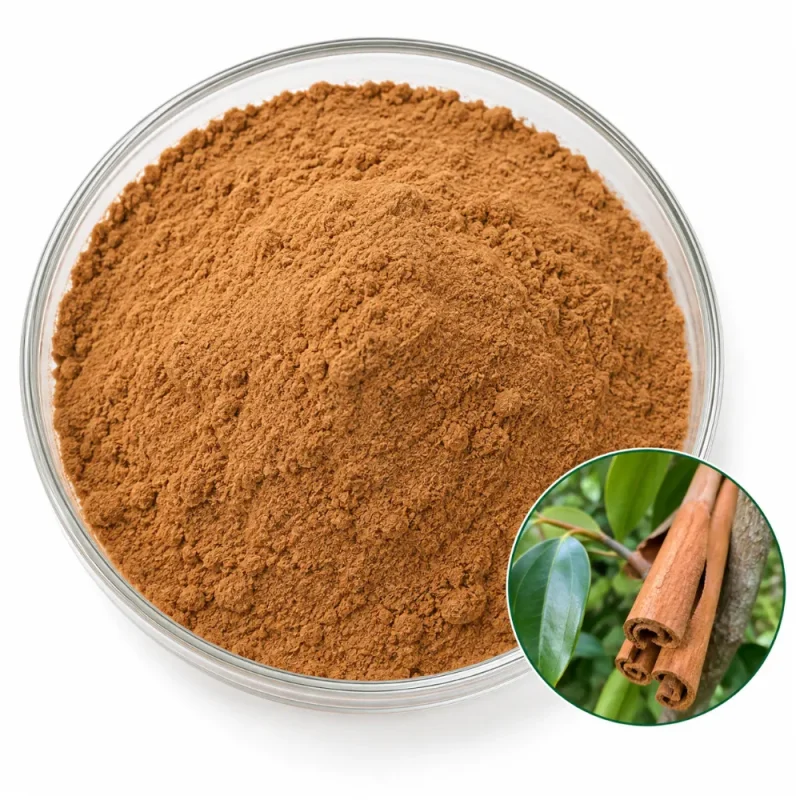
Ceylon Cinnamon Extract 5–15% Polyphenols

Ceylon cinnamon extract is prepared from the inner bark of Cinnamomum verum, the true cinnamon of Sri Lanka, and not from the thicker bark of the cassia species sold as common cinnamon. Ethanol extraction takes up the polyphenols of the bark, and the liquor is dried to a brown powder.

The grade range is 5–15% polyphenols by UV with the Folin-Ciocalteu method, and the primary grade is the 15% end. The powder is 80 mesh and water soluble. The 5% grade suits drink powders and tea-style mixes, while the 15% grade carries a higher polyphenol load for capsules and tablets.

Polyphenol Standardization & Grades

In cinnamon bark the polyphenols are mostly procyanidins, chains of catechin and epicatechin units, many of them of the A-type with a double linkage that is characteristic of the genus. The bark also holds phenolic acids and flavan-3-ols. The aromatic aldehyde cinnamaldehyde, which carries the odor, is a volatile oil constituent and is not part of the polyphenol figure. The botanical entity is Cinnamomum verum J.Presl, a tree of the Lauraceae, and the part used is the inner bark.

GradeAssay & MethodWhere It Fits
5% PolyphenolsUV, Folin-CiocalteuDrink powders and tea-style mixes
15% PolyphenolsUV, Folin-CiocalteuCapsules and tablets with small fill

The two grades differ by a factor of three. The 15% grade is a polyphenol concentrate that supplies a defined load from a small fill. The 5% grade is closer to the bark, with more of the sugars and mucilage, so Ceylon cinnamon extract at this level suits drink powders and tea-style mixes. True cinnamon and cassia are different products. The cassia species have a thicker, harder bark and a stronger, harsher flavor, and they are supplied as the Cinnamon Extract 10–30% Polyphenols. The names Ceylon cinnamon and true cinnamon refer to Cinnamomum verum only. Ceylon cinnamon extract at 15% is the more concentrated of the two grades, and Ceylon cinnamon extract at 5% is the fuller one. Sri Lanka is the traditional source of the bark, where the bark is rolled into thin quills.

Polyphenol Analysis & Purity Risks

The total polyphenol reading comes from UV with Folin-Ciocalteu reagent. The result counts every compound that reduces the reagent, including phenolic acids, procyanidins and some non-phenolic reducing substances. It is not an HPLC result for any single compound, and it cannot be converted into one.

The reference phenol and the reaction conditions belong with the figure. Gallic acid is the usual standard, and the percentage is expressed as gallic acid equivalents. A procedure with a different standard or a different reaction time gives a different percentage for the same extract, so a figure is comparable only with one measured the same way.

Sample preparation affects the number. The powder is dissolved in a polar diluent and filtered, the reagent is added with a base, and the color develops at a controlled temperature for a fixed time. A blank corrects for the color of the extract. Because the bark contains little else that reduces the reagent, the Folin reading is a reasonable class measure for this material.

Purity risks follow from the botany. Cinnamon and cassia are often sold under the same word, and the cassia species contain far more coumarin than Ceylon cinnamon, which is why they are treated differently in food regulation. Ceylon cinnamon is also the thin, multi-layered inner bark rolled into quills, while cassia bark is thick and single-layered. A stated species and the inner bark as the plant part are the first identity checks.

Typical Specifications

Specification ItemProduct Information
Latin NameCinnamomum verum
Plant PartBark & Stem
ProcessingEthanol Extraction
Compound ClassPolyphenols
Common NameCeylon Cinnamon, True Cinnamon
Ingredient TypeStandardized Extract
Marker Compound(s)Total polyphenols (chiefly A-type and B-type procyanidins and phenolic acids)
Primary Grade15% Polyphenols (UV, Folin-Ciocalteu)
Available Grades5% · 15% Polyphenols (UV, Folin-Ciocalteu)
AppearanceBrown powder
Solubility / DispersibilityWater Soluble
Quality Parameters
Moisture (LOD)≤5.0%
Total Ash≤5.0%
Particle Size80 mesh
Heavy MetalsLead ≤2 ppm · Arsenic ≤1 ppm · Cadmium ≤1 ppm · Mercury ≤0.1 ppm
MicrobiologyTPC ≤1,000 cfu/g · Yeast & Mold ≤100 cfu/g · E. coli Negative · Salmonella Negative/25 g
Shelf Life24 months in unopened original packaging, cool and dry storage

Applications by Grade

15% Grade for Compact Capsules

The 15% grade delivers a polyphenol load from a small fill, which suits capsules and tablets. The brown powder is water soluble, astringent and hygroscopic, so fill in a dry room and keep a desiccant in the closure of the bottle.

15% Grade in Tablet Blends

Tablets of the 15% grade need a dry binder and a moisture-tolerant filler, because polyphenol powders take up water and soften compacts. Keep the blend away from iron-bearing equipment, which darkens tannin-like compounds on contact.

5% Grade in Drink Powders

The 5% grade dissolves in water to a clear brown drink with a mild, sweet cinnamon note. It suits instant mixes with apple, citrus or chai-style spices, and the astringency of the bark is gentle at this level.

5% Grade in Tea-Style Mixes

Tea-style mixes use the 5% grade with ginger, cardamom and dried fruit. The extract is water soluble, so it clears quickly in a hot cup, and it adds color and a soft spice note without the pieces of ground bark.

5% Grade in Gummy Premixes

Gummy premixes accept the 5% grade for color and a light cinnamon note. Add the powder after the main cook, keep the pH near neutral to mildly acidic, and test the set, since tannin-like compounds can stiffen a pectin gel.

15% Grade in Stick Packs

Stick packs carry the 15% grade at a small fill with a flow agent and a sweet carrier. Seal the packs in moisture-barrier film, because the powder clumps at the seal, and check the dissolved drink for haze.

Technical & Quality Considerations

The extract is a brown powder with a soft, sweet cinnamon odor and a mild, astringent taste. Procyanidins bind proteins, so milk and gelatin-based systems can turn cloudy or form a precipitate. The polyphenols darken in alkaline bases and on contact with iron or copper, and neutral to mildly acidic systems keep color more stable.

Sieve before blending to break up soft lumps, and fold the powder into a portion of the carrier so that it disperses without clumping. The 15% grade packs more densely, and a fine flow aid helps it pass through hoppers and feeders.

The flavor of Ceylon cinnamon extract is subtle because most of the volatile oil is lost in extraction and drying, so the cinnamon note comes mainly from the bark solids. A taste trial with the final sweetener and flavor system sets the usable dose. Keep the drum sealed and away from light, compare each lot with a retained sample for color, odor and the polyphenol reading, and clean the line after a run, because the brown powder stains mixers and hoppers. A cool, dry store keeps the powder free-flowing, and a sample tested again near the end of shelf life shows whether the packaging holds the reading and the color.

Ceylon cinnamon extract is gentler in flavor than cassia, so the usable dose in a sweet base is higher, and a taste panel at several doses shows where the astringency starts to dominate the cinnamon note.

Packaging & Commercial Supply

Essencefield supports product evaluation, formulation trials, commercial orders, and ongoing ingredient supply. Packaging, storage, and shipping arrangements are determined by product characteristics, order quantity, stability requirements, and destination-market needs.

Supply ItemGeneral Information
SampleAvailable upon request for formulation, testing, and supplier evaluation
Order Quantities100 g · 1 kg · 5 kg · 25 kg · 100 kg · 500 kg · Bulk
Sample Lead TimeTypically 5–7 days after sample confirmation
Production Lead TimeTypically 15–30 days after order and specification confirmation
PackagingSuitable protective inner packaging with bags, cartons, drums, or other appropriate outer packaging
StorageStore in tightly sealed, suitable protective packaging in a cool, dry environment. Protect from moisture, heat, and direct sunlight. Specific storage conditions follow the approved product specification.
DocumentationCOA · Product Specification · TDS · SDS · Applicable declarations (as applicable)

Final order quantities, lead times, packaging, documentation, and shipping arrangements are confirmed according to the selected product and commercial requirements.

Request Ingredient Specifications & Quote

Share your target specification, application, quantity, and documentation needs. We’ll help confirm suitable options, samples, and commercial supply details.