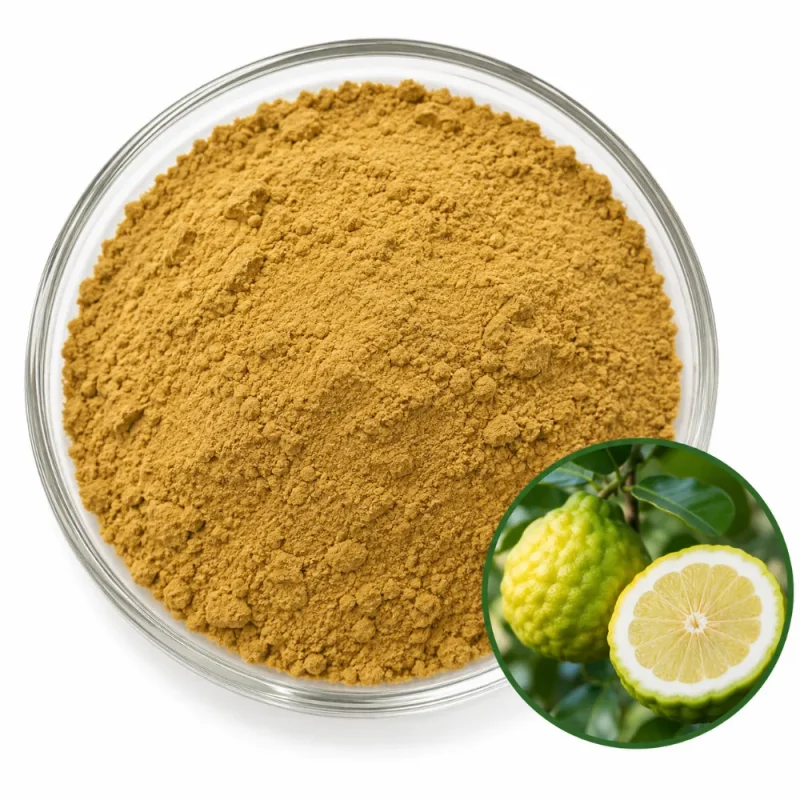
Citrus Bergamot Extract 25–40% Total Flavonoids / defined BPF grade

Citrus bergamot extract takes the fruit of Citrus bergamia, the bergamot orange of the Calabrian coast, as its only starting material, and the leaf and flower are excluded. Ethanol extraction takes up the flavanone and flavone glycosides of the fruit, and the concentrate is dried to a light yellow powder.

Total flavonoids are measured by UV, with a primary grade of 40% and a lower grade of 25%. The powder is 80 mesh and slightly soluble in water. The 40% grade fits capsules and tablets that need a small fill, while the 25% grade fits blends in which a bulkier fruit matrix is wanted.

Total Flavonoids Standardization & Grades

The total flavonoid figure is a class value and not one compound. In bergamot it is dominated by flavanone glycosides, chiefly neoeriocitrin, neohesperidin and naringin, together with the less common hydroxy-methylglutaryl flavanones brutieridin and melitidin that are characteristic of this fruit. A UV assay adds them into one number. The botanical entity is Citrus × bergamia (Risso) Risso & Poit., and the citrus bergamot extract is standardized to this class because it is the defining phenolic fraction of the fruit.

GradeAssay & MethodWhere It Fits
25% Total FlavonoidsUVBlends with higher inclusion rates
40% Total FlavonoidsUVCapsules and tablets, small fill weight

Grade choice follows dose and fill weight. The 40% grade carries a little over one and a half times the flavonoid load of the 25% grade per gram, so a capsule reaches its target with less powder, while the 25% grade is bulkier and gives a looser, easier-to-blend solid. Bergamot is also supplied as a 10:1 ratio extract with no marker figure, the Citrus Bergamia Extract Powder, and the furanocoumarin bergapten is available as a single reference compound, Bergapten. The name also refers to a defined polyphenolic fraction grade, which is not published as a separate figure here.

Total Flavonoids Analysis & Purity Risks

UV spectrophotometry reads the absorbance of a flavonoid complex against a reference compound, so the number is an equivalent and not a molecule count. Because the reference moves the number, a figure can be compared only with another figure on the same basis. A UV total cannot be turned into an HPLC result for neohesperidin or naringin, since the two methods measure different things.

For identity, an HPLC fingerprint of the fruit is read beside the total. Neoeriocitrin, naringin and neohesperidin form the main flavanone peaks, and brutieridin and melitidin, which are largely specific to bergamot among the common citrus fruits, support the species identity. The relative height of these peaks separates bergamot from sweet orange, lemon and grapefruit extracts.

Purity risks follow from the botanical group and the chemistry. Citrus flavonoids are commercial products from several species, and a total flavonoid figure alone cannot show which fruit supplied it. Bergamot peel oil is also rich in furanocoumarins such as bergapten, which are photoactive, so the stated part and the removal of oil-bearing peel residue matter for a juice-based or pulp-based extract. A reference test for bergapten is a standard purity check for this species.

Sample preparation needs dilution into a hydroalcoholic medium and filtration through a fine membrane, because pectin and fiber carried over from the fruit can block a filter. A blank without the reagent corrects for the pale yellow background of the citrus bergamot powder.

Raw material choice shapes the result before extraction. Bergamot is grown almost exclusively in a narrow coastal belt of southern Italy, and the fruit is processed for peel oil first, so the material left for flavonoid extraction is mainly juice, pulp and albedo. Each of these fractions has its own flavonoid balance: juice and albedo carry most of the glycosides, while the flavedo that holds the oil carries more of the lipophilic furanocoumarins. A citrus bergamot extract made from a mixed press residue can therefore differ from one made from juice alone.

Typical Specifications

Specification ItemProduct Information
Latin NameCitrus bergamia
Plant PartFruit & Berry
ProcessingEthanol Extraction
Compound ClassFlavonoids, Polyphenols
Common NameBergamot, Bergamot Orange
Ingredient TypeStandardized Extract
Marker Compound(s)Total flavonoids (flavanone glycosides of bergamot)
Primary Grade40% Total Flavonoids (UV)
Available Grades25% · 40% Total Flavonoids (UV)
AppearanceLight Yellow powder
Solubility / DispersibilitySlightly Soluble in Water
Quality Parameters
Moisture (LOD)≤5.0%
Total Ash≤5.0%
Particle Size80 mesh
Heavy MetalsLead ≤2 ppm · Arsenic ≤1 ppm · Cadmium ≤1 ppm · Mercury ≤0.1 ppm
MicrobiologyTPC ≤1,000 cfu/g · Yeast & Mold ≤100 cfu/g · E. coli Negative · Salmonella Negative/25 g
Shelf Life24 months in unopened original packaging, cool and dry storage

Applications by Grade

40% Grade for Compact Capsules

The 40% grade of citrus bergamot extract reaches a flavonoid target in a small fill, which suits compact capsules. The flavanone powder is hygroscopic, so fill in a dry room and seal the capsules in a desiccated bottle.

25% Grade in Powder Blends

The 25% grade is bulky enough to carry in powder blends at a practical gram weight. Add it in stages to a free-flowing carrier, since the fine citrus powder cakes if it meets humid air during transfer, and keep transfer containers closed.

40% Grade in Tablet Blends

Tablets of the 40% grade need a dry binder and a glidant, and a film coat covers the faint bitterness of the flavanones. Check hardness and disintegration after storage, because the fruit matrix takes up moisture.

25% Grade in Stick-Pack Drink Powders

Stick packs of the 25% grade give a pale yellow, slightly bitter citrus cup. Orange, grapefruit or bergamot-style flavors blend naturally with it, and a fine grind improves dispersion in cold water, though a stir is still needed before drinking.

40% Grade in Sachet Dilutions

Sachets of the 40% grade call for stepwise dilution with a bulking carrier so the filler can weigh an accurate dose. The yellow powder tints pale carriers, which makes mixing uniformity easy to check by eye.

25% Grade for Contract Blending

Contract blenders use the 25% grade in multi-ingredient powders where the citrus matrix is wanted. Schedule it after dark products and purge the line, since the yellow dust carries into pale runs on the same line.

Technical & Quality Considerations

The citrus bergamot powder is light yellow with a mild, bitter-citrus odor. It is slightly soluble in water, so a solution turns hazy pale yellow, with part of the glycosides dissolved and the rest in suspension. Neoeriocitrin and neohesperidin dissolve better than naringin, and warm water helps dissolution but slows clarification as the solution cools.

Flavanone glycosides are reasonably stable at neutral to acidic pH, but they hydrolyze at strongly acidic pH over long storage and chelate iron to form darker complexes. Stainless contact surfaces and low-iron fillers avoid color drift. Citrus flavonoids may also crystallize out from supersaturated solutions, so clear beverages at high inclusion can form a fine haze or sediment.

Bergamot powder goes through a screen and a premix with part of the carrier before the first fills are weighed against target. Drums stay sealed with a desiccant, cool and out of direct light. In long runs, use a closed charging system and wipe balances after each weighing to limit yellow dust on adjacent equipment.

Flavor is the last formulation constraint. Citrus bergamot extract tastes bitter and slightly astringent, because naringin and neohesperidin are classic bitter flavanones, and the bergamot character is lost with the peel oil, so the citrus bergamot powder tastes of fruit pulp and not of Earl Grey tea. Sweeteners with a lingering profile and acid flavors cover the bitterness better than a sugar-only base. In capsules the taste is irrelevant, and in tablets a thin film coat is enough.

Packaging & Commercial Supply

Essencefield supports product evaluation, formulation trials, commercial orders, and ongoing ingredient supply. Packaging, storage, and shipping arrangements are determined by product characteristics, order quantity, stability requirements, and destination-market needs.

Supply ItemGeneral Information
SampleAvailable upon request for formulation, testing, and supplier evaluation
Order Quantities100 g · 1 kg · 5 kg · 25 kg · 100 kg · 500 kg · Bulk
Sample Lead TimeTypically 5–7 days after sample confirmation
Production Lead TimeTypically 15–30 days after order and specification confirmation
PackagingSuitable protective inner packaging with bags, cartons, drums, or other appropriate outer packaging
StorageStore in tightly sealed, suitable protective packaging in a cool, dry environment. Protect from moisture, heat, and direct sunlight. Specific storage conditions follow the approved product specification.
DocumentationCOA · Product Specification · TDS · SDS · Applicable declarations (as applicable)

Final order quantities, lead times, packaging, documentation, and shipping arrangements are confirmed according to the selected product and commercial requirements.

Request Ingredient Specifications & Quote

Share your target specification, application, quantity, and documentation needs. We’ll help confirm suitable options, samples, and commercial supply details.