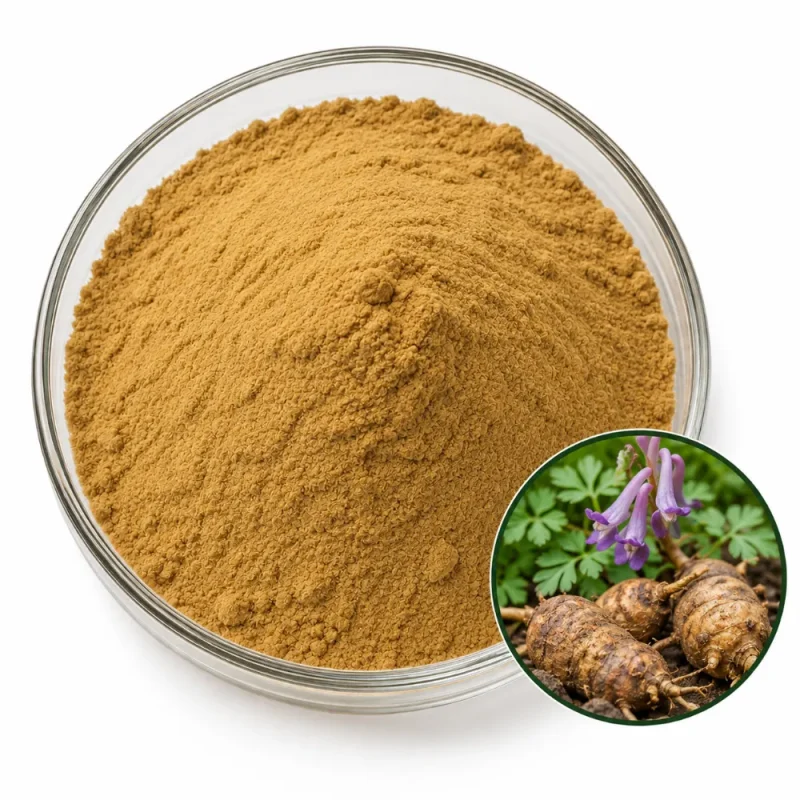
Corydalis Yanhusuo Extract 10–50% Total Alkaloids

The dried tuber of Corydalis yanhusuo, known in the Chinese trade as yan hu suo, is the only part used in this extract, and the leaf, stem and flower are excluded. Ethanol extraction takes up the isoquinoline alkaloids of the tuber, and the concentrate is dried to a light brown powder.

The primary grade is 50% total alkaloids, with a 10% grade as the lower end, and the grade has no named assay method. The powder is 80 mesh and slightly soluble in water. The 50% grade fits capsules and tablets that need a small fill, while the 10% grade fits dry blends in which the tuber matrix is wanted.

Alkaloid Standardization & Grades

The alkaloids of yan hu suo are isoquinoline alkaloids of the protoberberine and protopine groups. Tetrahydropalmatine is the best known, with corydaline, tetrahydroberberine, protopine, columbamine and dehydrocorydaline as companions. The botanical entity is Corydalis yanhusuo W.T.Wang ex Z.Y.Su & C.Y.Wu, and the extract is standardized to the total alkaloid fraction because the alkaloids are the defining class of the tuber.

GradeAssay & MethodWhere It Fits
10% Total AlkaloidsClass figure, no named methodDry blends, higher inclusion
50% Total AlkaloidsClass figure, no named methodCapsules and tablets, small fill

Grade choice follows dose and fill weight. The 50% grade carries five times the alkaloid load of the 10% grade per gram, so a capsule reaches its target with far less powder, while the 10% grade is bulkier and behaves more like a milled tuber in a blend. Corydalis is also supplied as a 10:1 ratio extract with no marker figure, the Corydalis Tuber Extract Powder, and as milled tuber, the Corydalis Tuber Powder. Some tetrahydroprotoberberine alkaloids are restricted in some regions, so the grade and the label wording are matters for regulatory review. The standardized extract is the row to use when an alkaloid figure has to appear in the specification.

Alkaloid Analysis & Purity Risks

A total alkaloid figure can be obtained by acid-base extraction with gravimetric or titrimetric determination, or by summing alkaloid peaks in an HPLC run. The grade carries no named method, so the figure is read as the alkaloid fraction determined by the laboratory procedure that accompanies the lot. Because a class figure depends on what is counted, it cannot be converted into a tetrahydropalmatine figure or compared with a number from a different procedure.

For identity, the HPLC fingerprint shows the isoquinoline pattern of the tuber. Tetrahydropalmatine, corydaline, protopine and columbamine are the characteristic peaks, and tetrahydropalmatine serves as the secondary identity marker. It is followed in the fingerprint of the Corydalis yanhusuo extract. The balance between tertiary and quaternary alkaloids shifts with the processing of the tuber.

Purity risks follow from the botanical group. Several Corydalis species are traded as yan hu suo, among them Corydalis decumbens and Corydalis bungeana, and their alkaloid profiles differ. The stated species and the tuber part are part of the identity. Because a class figure cannot show which species supplied it, the fingerprint matters as much as the percentage.

Sample preparation uses an acidic or basic extraction followed by filtration, and the alkaloid salts are kept in solution at suitable pH. Quaternary alkaloids such as dehydrocorydaline differ in solubility from tertiary ones, so the extraction conditions must be fixed in the procedure.

Raw material handling also matters. Tubers are harvested in early summer, boiled or steamed, and dried, and some processing uses vinegar to increase alkaloid extractability. These steps change the alkaloid balance of the starting tuber, so the processing of the raw material is part of the lot history.

Typical Specifications

Specification ItemProduct Information
Latin NameCorydalis yanhusuo
Plant PartRoot & Rhizome
ProcessingEthanol Extraction
Compound ClassAlkaloids
Common NameCorydalis, Yan Hu Suo
Ingredient TypeStandardized Extract
Marker Compound(s)Total alkaloids (isoquinoline alkaloids of the tuber)
Primary Grade50% Total Alkaloids
Available Grades10% · 50% Total Alkaloids
AppearanceLight Brown powder
Solubility / DispersibilitySlightly Soluble in Water
Quality Parameters
Moisture (LOD)≤5.0%
Total Ash≤5.0%
Particle Size80 mesh
Heavy MetalsLead ≤2 ppm · Arsenic ≤1 ppm · Cadmium ≤1 ppm · Mercury ≤0.1 ppm
MicrobiologyTPC ≤1,000 cfu/g · Yeast & Mold ≤100 cfu/g · E. coli Negative · Salmonella Negative/25 g
Shelf Life24 months in unopened original packaging, cool and dry storage

Applications by Grade

50% Grade for Compact Capsules

The 50% grade of Corydalis yanhusuo extract reaches an alkaloid target in a small fill, which suits compact capsules. The powder is bitter and hygroscopic, so fill in a dry room and let the shell carry the taste.

10% Grade in Dry Blends

The 10% grade is bulky enough to carry in dry blends at a practical gram weight. Add it in stages to a free-flowing carrier, because the low-density powder segregates when it is dumped into a large blender at once.

50% Grade in Tablet Blends

Tablets of the 50% grade need a dry binder and a glidant, and a film coat covers the intense bitterness of the alkaloids. Check hardness and disintegration after storage, as the alkaloid salts take up moisture. A bottle with a desiccant keeps tablets intact through shelf life.

10% Grade in Sachet Premixes

Sachets of the 10% grade use a bulking carrier to bring the tuber extract to a weight the filler can meter accurately. The bitter taste is strong, so cocoa, coffee or spiced flavors are needed to cover it. Trial the premix with a taste panel before launch, because bitterness at low inclusion is easy to underestimate.

50% Grade in Stepwise Dilutions

Where a dose is small, the 50% grade is diluted in stages with a bulking carrier before it reaches the filler. Verify uniformity on a test batch, since a concentrated alkaloid at low inclusion segregates easily, and sample the blend from several depths rather than from the top only.

10% Grade for Contract Blending

Contract blenders use the 10% grade in multi-ingredient powders where a tuber matrix is wanted. Bitterness carries across adjacent runs, so dedicated scoops and a purge of the line protect the products that follow. A written clean-down step keeps a mild product from picking up the bitterness of the previous run.

Technical & Quality Considerations

Corydalis yanhusuo extract is a light brown powder with a faint, earthy odor and a persistent bitter taste, and the Corydalis yanhusuo extract shows the same character in both grades. It is slightly soluble in water, so a solution turns hazy yellow-brown, with part of the alkaloid salts dissolved and the rest in suspension. Isoquinoline alkaloids are weak bases, so solubility rises as pH falls, and an acidic beverage dissolves more of the fraction than a neutral one.

Tertiary protoberberines such as tetrahydropalmatine oxidize slowly in air and light to the corresponding quaternary, more intensely yellow dehydro forms, so the shade of the powder can shift from light brown toward yellow-brown during long storage. Light-protective packaging and sealed liners slow this change. The alkaloid salts are also hygroscopic and cake in humid air.

The tuber extract is sieved and premixed with part of the carrier at scale, and early fills are weighed against target. A sealed drum with a desiccant, kept cool and shaded, protects the powder. Closed charging and local extraction limit the bitter, staining dust that otherwise settles on adjacent equipment.

Compatibility with other ingredients needs a short check. Alkaloid salts can interact with tannin-rich botanicals, forming insoluble complexes that lower the dissolved alkaloid in a drink, and with strongly alkaline minerals, which precipitate the free base. Blends that pair the extract with magnesium oxide or calcium carbonate are therefore better trialed at the target pH before launch.

Packaging & Commercial Supply

Essencefield supports product evaluation, formulation trials, commercial orders, and ongoing ingredient supply. Packaging, storage, and shipping arrangements are determined by product characteristics, order quantity, stability requirements, and destination-market needs.

Supply ItemGeneral Information
SampleAvailable upon request for formulation, testing, and supplier evaluation
Order Quantities100 g · 1 kg · 5 kg · 25 kg · 100 kg · 500 kg · Bulk
Sample Lead TimeTypically 5–7 days after sample confirmation
Production Lead TimeTypically 15–30 days after order and specification confirmation
PackagingSuitable protective inner packaging with bags, cartons, drums, or other appropriate outer packaging
StorageStore in tightly sealed, suitable protective packaging in a cool, dry environment. Protect from moisture, heat, and direct sunlight. Specific storage conditions follow the approved product specification.
DocumentationCOA · Product Specification · TDS · SDS · Applicable declarations (as applicable)

Final order quantities, lead times, packaging, documentation, and shipping arrangements are confirmed according to the selected product and commercial requirements.

Request Ingredient Specifications & Quote

Share your target specification, application, quantity, and documentation needs. We’ll help confirm suitable options, samples, and commercial supply details.