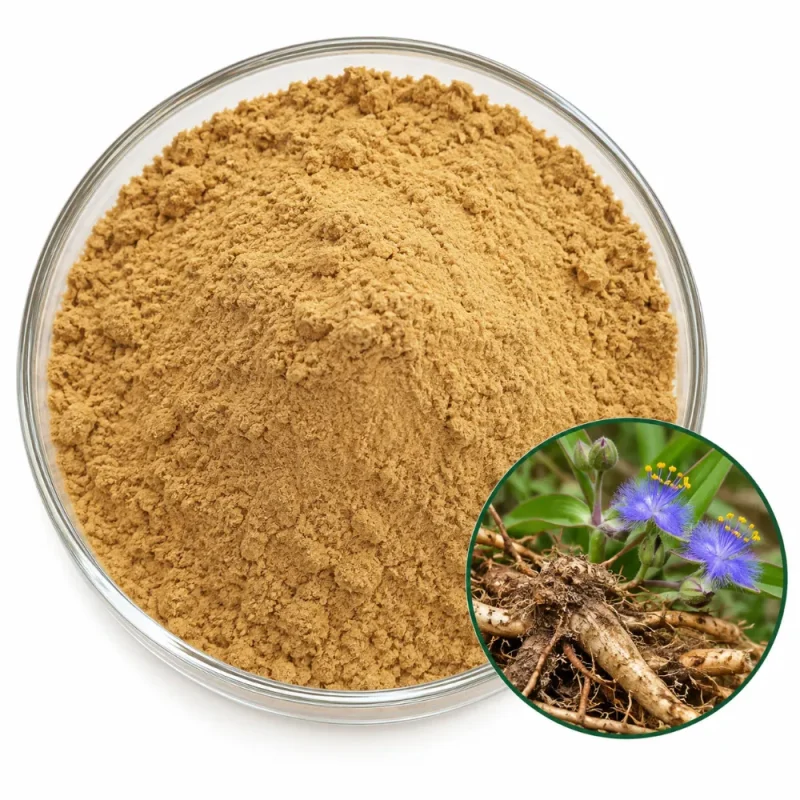
Cyanotis arachnoidea Extract 10–90% Ecdysteroids

The tuberous root of Cyanotis arachnoidea, a spiderwort-family herb of southwestern China, is the only part used in this extract, and the leaf and stem are excluded. Ethanol extraction takes up the polar steroid hormones of the plant kingdom known as ecdysteroids, and the concentrate is dried to a light brown powder.

Ecdysteroids are measured by HPLC, with a primary grade of 90% and a lower grade of 10%. The powder is 80 mesh and slightly soluble in water. The 90% grade fits capsules and tablets that need a very small fill, while the 10% grade fits blends and drink powders in which the root matrix is wanted at higher inclusion.

Ecdysteroid Standardization & Grades

Ecdysteroids are polyhydroxylated steroids that are the molting hormones of insects and occur in some plants as phytoecdysteroids. In Cyanotis arachnoidea root the dominant member is 20-hydroxyecdysone, also called ecdysterone, with polypodine B, ecdysone and related analogs in smaller amounts. The botanical entity is Cyanotis arachnoidea C.B.Clarke, and the extract is standardized to the ecdysteroid group because 20-hydroxyecdysone leads the profile and HPLC resolves it from the other steroids of the root.

GradeAssay & MethodWhere It Fits
10% EcdysteroidsHPLCBlends and drink powders, higher inclusion
90% EcdysteroidsHPLCCapsules and tablets, very small fill

Grade choice follows dose and fill weight. The 90% grade carries nine times the ecdysteroid load of the 10% grade per gram, so a capsule reaches its target with a fraction of the powder, while the 10% grade is a bulky, sugar-rich solid that behaves more like a milled botanical. The pure compound is available as 20-Hydroxyecdysone (Ecdysterone) 98%. The standardized extract is the row to use when an ecdysteroid figure has to appear in the specification of the Cyanotis arachnoidea extract.

Ecdysteroid Analysis & Purity Risks

HPLC separates 20-hydroxyecdysone from its analogs on a reversed-phase column and quantifies the peaks against reference standards, with UV detection near 245 nm where the enone chromophore of the steroid ring absorbs. The result is an ecdysteroid sum. A UV reading of the whole extract would count other material that absorbs near the same wavelength, and neither a UV nor a gravimetric figure can be converted into the HPLC sum.

For identity, the fingerprint of the root is read beside the sum. 20-Hydroxyecdysone, polypodine B and ecdysone appear in a pattern that is characteristic of the species, and the ratio of 20-hydroxyecdysone to the analogs shows whether the material is whole-root extract or an enriched fraction.

Purity risks follow from the botanical group. Ecdysteroids occur in many plants, among them Cyanotis vaga, Ajuga turkestanica, spinach and Rhaponticum, and the traded material of each has a different ecdysteroid balance. The stated species and the stated root part are therefore part of the identity. A very high percentage grade is a refined fraction and not a milled root, and the 98% single compound is a separate product type with its own page.

Sample preparation uses a polar solvent such as aqueous methanol to dissolve the ecdysteroids, followed by filtration. The polyhydroxylated steroids are polar and elute early on a reversed-phase column, so the gradient is tuned to separate them from sugars and amino acids carried over from the root.

Raw material handling also matters. Roots are harvested at maturity, washed and dried, and the ecdysteroid level rises with root age. Soil residue is removed carefully, because it adds ash and adds non-target compounds to the feed.

Typical Specifications

Specification ItemProduct Information
Latin NameCyanotis arachnoidea
Plant PartRoot & Rhizome
ProcessingEthanol Extraction
Compound ClassTerpenoids
Common NameCyanotis, Ecdysteroid Plant
Ingredient TypeStandardized Extract
Marker Compound(s)Ecdysteroids (20-hydroxyecdysone and related analogs)
Primary Grade90% Ecdysteroids (HPLC)
Available Grades10% · 90% Ecdysteroids (HPLC)
AppearanceLight Brown powder
Solubility / DispersibilitySlightly Soluble in Water
Quality Parameters
Moisture (LOD)≤5.0%
Total Ash≤5.0%
Particle Size80 mesh
Heavy MetalsLead ≤2 ppm · Arsenic ≤1 ppm · Cadmium ≤1 ppm · Mercury ≤0.1 ppm
MicrobiologyTPC ≤1,000 cfu/g · Yeast & Mold ≤100 cfu/g · E. coli Negative · Salmonella Negative/25 g
Shelf Life24 months in unopened original packaging, cool and dry storage

Applications by Grade

90% Grade for Very Small Capsules

The 90% grade of Cyanotis arachnoidea extract reaches an ecdysteroid target in a very small fill, which suits compact capsules. The fine powder is static-prone, so a flow agent and an anti-static dosing path keep the fill weight steady.

10% Grade in Sports-Nutrition Powders

Sports-nutrition powders carry the 10% grade at a practical gram weight. The root extract is slightly soluble and bitter, so cocoa, coffee or citrus flavors help, and the label should advise shaking to disperse the particles. A small amount of lecithin in the premix helps the powder wet and sink.

90% Grade in Tablet Blends

Tablets of the 90% grade need a dry binder and a disintegrant, because the dense steroid powder compacts into hard tablets that dissolve slowly. A film coat covers the bitter taste, and hardness should be checked after storage.

10% Grade in Stick-Pack Drink Powders

Stick packs of the 10% grade give a light brown, slightly hazy cup. The grade carries natural root sugars that attract water, so foil laminate with low moisture transmission keeps the powder free-flowing. Test the pouch after a month at warm, humid conditions, since a small leak is enough to cake the contents.

90% Grade in Stepwise Dilutions

Where a dose is small, the 90% grade is diluted in stages with a bulking carrier before it reaches the filler. Verify uniformity on a test batch, because a concentrated steroid at low inclusion segregates easily.

10% Grade for Contract Blending

Contract blenders place the 10% grade in multi-ingredient powders where a root matrix is wanted. Sample the blend from several depths, since a bulky light powder stratifies during transport. Keep a retained sample of each lot, because the root matrix of the 10% grade varies slightly in shade from one harvest to the next.

Technical & Quality Considerations

Cyanotis arachnoidea extract is a light brown powder with a faint, earthy odor and a bitter taste. It is slightly soluble in water, so a solution turns hazy pale brown. 20-Hydroxyecdysone itself dissolves better in water than most steroids because of its many hydroxyl groups, while the lower grades also carry root sugars and proteins that dissolve and attract moisture.

Ecdysteroids are stable to moderate heat and to mildly acidic pH, but they degrade under strong acid or base and in prolonged heat. The lower grade absorbs water readily and cakes in humid air because of its sugar content, whereas the 90% grade is far less hygroscopic. Light has a modest effect on the steroid itself, though it darkens the root matrix of the lower grade.

Scale-up of Cyanotis arachnoidea extract starts with sieving and a premix with part of the carrier, then a weight check on the first fills. Drums are stored sealed and cool, and the lower grade gets a desiccant liner. Closed charging and local extraction limit dust, and balances should be wiped after each weighing.

Particle behavior differs strongly between the grades. The 90% grade is a fine, crystalline-feeling powder with poor flow and a strong tendency to cling to surfaces, so it is usually pre-blended with a free-flowing carrier before it reaches a filler. The 10% grade carries root sugars and fiber, flows more slowly when damp and can form a hard cake in a sealed drum. Cyanotis arachnoidea extract of either grade benefits from a sieving step directly before use.

Formulation with other ingredients needs a trial. Amino-acid and protein powders add moisture, and acidic ingredients can degrade the steroid at high temperature, so an accelerated stability study at the target blend is a sensible early step.

Packaging & Commercial Supply

Essencefield supports product evaluation, formulation trials, commercial orders, and ongoing ingredient supply. Packaging, storage, and shipping arrangements are determined by product characteristics, order quantity, stability requirements, and destination-market needs.

Supply ItemGeneral Information
SampleAvailable upon request for formulation, testing, and supplier evaluation
Order Quantities100 g · 1 kg · 5 kg · 25 kg · 100 kg · 500 kg · Bulk
Sample Lead TimeTypically 5–7 days after sample confirmation
Production Lead TimeTypically 15–30 days after order and specification confirmation
PackagingSuitable protective inner packaging with bags, cartons, drums, or other appropriate outer packaging
StorageStore in tightly sealed, suitable protective packaging in a cool, dry environment. Protect from moisture, heat, and direct sunlight. Specific storage conditions follow the approved product specification.
DocumentationCOA · Product Specification · TDS · SDS · Applicable declarations (as applicable)

Final order quantities, lead times, packaging, documentation, and shipping arrangements are confirmed according to the selected product and commercial requirements.

Request Ingredient Specifications & Quote

Share your target specification, application, quantity, and documentation needs. We’ll help confirm suitable options, samples, and commercial supply details.