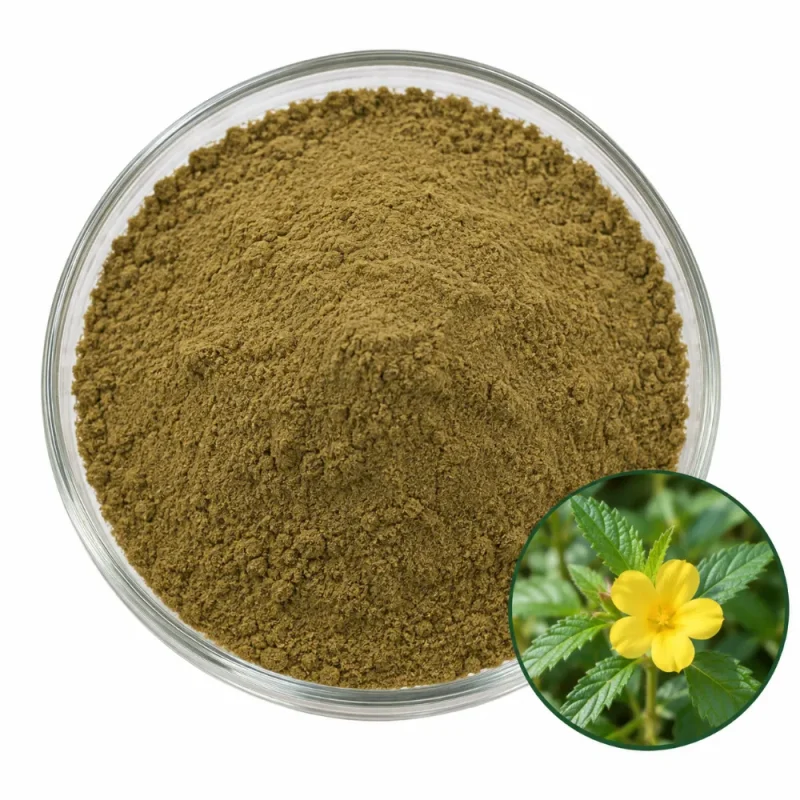
Damiana Extract ≥2.5% Total Flavonoids

Damiana extract takes the dried leaf of Turnera diffusa, a small aromatic shrub of the warm Americas, as its only starting material, and the stem, flower and the unrelated shrubs sold under the same name are excluded. Ethanol extraction takes up the flavonoids and phenolic compounds of the leaf, and the concentrate is dried to a light brown powder.

The single grade is 2.5% total flavonoids by UV. The powder is 80 mesh and slightly soluble in water. It fits capsules, tablets and herbal blends in which a leaf-derived flavonoid fraction is the design target.

Total Flavonoids Standardization & Grades

A total flavonoid figure stands for a class, not a single molecule. In damiana leaf it covers flavone and flavonol aglycones and glycosides, including apigenin-type and acacetin-type compounds, together with the arbutin and phenolic acids that accompany them in the polar fraction. A UV assay adds the flavonoids into one number. The botanical entity is Turnera diffusa Willd. ex Schult., and the extract is standardized to this class because the flavonoids are the stable, measurable phenolic fraction of the leaf, whereas its aroma is carried by a volatile oil that is largely lost in drying.

The grade is a single point at 2.5%, so there is no grade table. The figure is a minimum, and a lot above it is still within the grade. Damiana can also be bought as a 10:1 ratio extract without a marker figure, the Damiana Extract Powder. The data also records a defined apigenin marker option, which is not published here. The standardized extract is the row to use when a flavonoid figure has to appear in the specification of the damiana extract.

Total Flavonoids Analysis & Purity Risks

The UV method measures a flavonoid complex against a reference compound, giving an equivalent instead of a count of molecules. A figure is comparable only with another on the same basis, since the choice of reference moves the number. A UV total cannot be turned into an HPLC result for apigenin, since the two methods measure different things.

An HPLC fingerprint of the leaf is read beside the total as an identity check. The flavone cluster, the arbutin peak and the phenolic acids give a pattern that is characteristic of Turnera diffusa, and the ratio between them helps to separate it from the substitutes sold under the same trade name.

Purity risks follow from the botanical group. Several plants are traded as damiana, among them Turnera aphrodisiaca and Aplopappus discoideus, a different shrub, and their chemistry differs. The stated species and the leaf part protect identity better than one percentage does. Turnera species are also reported to contain cyanogenic glycosides in small amounts, so the stated part and the removal of stems and woody fragments matter for a leaf extract.

Sample preparation is simple, but the extract absorbs in the visible range through its leaf pigments, so a sample blank without the reagent is run beside the reagent sample. Samples are filtered through a fine membrane, because suspended leaf tissue scatters light.

Raw material handling also matters. The leaf is stripped from the stem, dried at moderate temperature and milled, and long storage in warm air lowers both aroma and flavonoid content. A well-dried leaf is green-brown and aromatic, whereas a stale lot is pale and dull.

Typical Specifications

Specification ItemProduct Information
Latin NameTurnera diffusa
Plant PartLeaf & Herb
ProcessingEthanol Extraction
Compound ClassFlavonoids, Polyphenols
Common NameDamiana
Ingredient TypeStandardized Extract
Marker Compound(s)Total flavonoids
Primary Grade≥2.5% Total Flavonoids (UV)
AppearanceLight Brown powder
Solubility / DispersibilitySlightly Soluble in Water
Quality Parameters
Moisture (LOD)≤5.0%
Total Ash≤5.0%
Particle Size80 mesh
Heavy MetalsLead ≤2 ppm · Arsenic ≤1 ppm · Cadmium ≤1 ppm · Mercury ≤0.1 ppm
MicrobiologyTPC ≤1,000 cfu/g · Yeast & Mold ≤100 cfu/g · E. coli Negative · Salmonella Negative/25 g
Shelf Life24 months in unopened original packaging, cool and dry storage

Applications by Grade

2.5% Grade for Standard Capsules

Damiana extract at 2.5% total flavonoids fills two-piece capsules at a larger weight than concentrated grades. The leaf matrix is light and slightly fibrous, so use a flow agent, fill in a dry room and seal the capsules in a desiccated bottle.

2.5% Grade in Tablet Blends

Tablets need a dry binder and a lubricant, and a film coat covers the bitter, herbal taste of the leaf. Check hardness and disintegration after storage, because the fibrous leaf matrix swells slowly and can soften the tablet.

2.5% Grade in Herbal Powder Blends

Herbal powder blends carry the extract alongside other leaf and flower extracts. Add it in stages to a free-flowing carrier, since a low-density leaf powder segregates when it is dumped into a large blender at once.

2.5% Grade in Stick-Pack Drink Powders

Stick-pack drink powders pair the extract with citrus, mint or ginger flavors that match its aromatic, bitter character. The cup is hazy and amber, and a fine grind improves dispersion in cold water. Add the powder to the glass before the liquid so that it wets evenly and does not form a floating layer.

2.5% Grade in Sachet Premixes

Sachets dilute the extract with a bulking carrier so the filler can weigh an accurate dose. A foil laminate holds the aroma and protects the flavonoids from light, which otherwise bleaches the tone of the powder.

2.5% Grade for Contract Blending

Contract blenders place the extract in multi-ingredient powders where a leaf matrix is wanted. Leaf aroma lingers on mixer paddles and hoppers, so a dry purge between runs protects milder products that follow. Keep a note of the product order in the batch record.

Technical & Quality Considerations

Damiana extract is a light brown powder with a spicy, aromatic, slightly floral odor and a bitter taste. It is slightly soluble in water, so a solution turns hazy yellow-brown, with part of the polar fraction dissolved and the flavonoid aglycones largely in suspension. Cool dispersion keeps the aroma cleaner than hot water.

Flavonoid glycosides are reasonably stable at neutral to mildly acidic pH, but they chelate iron and darken, so stainless contact surfaces and low-iron fillers avoid color drift. The arbutin of the leaf hydrolyzes slowly in acid to hydroquinone, so acidic beverages stored for long periods need a short stability trial.

Scale-up of damiana extract begins with a sieving step, because dried leaf fragments form soft lumps that a screen breaks cleanly. Premix the powder with a small share of the carrier, then check the first fills against target weight. Drums stay sealed, cool and out of direct light, with a desiccant liner in humid regions, and the strong aroma calls for separate scoops and local extraction at the charging point.

Taste and color deserve a short trial in any liquid format. A cup that carries more than a small serving of damiana extract tastes distinctly bitter, and a sweetener alone does not cover it. Acid, citrus oils and mint soften the effect.

Storage behavior of the leaf matrix is a further point. Damiana extract carries some leaf waxes and resinous material that soften slightly in warm storage, so the powder can clump if drums are stacked near heat. A shipping and storage range of cool, dry conditions keeps the powder free-flowing, and a quick check of flow after transit confirms that the lot has not been exposed to heat during shipment.

Packaging & Commercial Supply

Essencefield supports product evaluation, formulation trials, commercial orders, and ongoing ingredient supply. Packaging, storage, and shipping arrangements are determined by product characteristics, order quantity, stability requirements, and destination-market needs.

Supply ItemGeneral Information
SampleAvailable upon request for formulation, testing, and supplier evaluation
Order Quantities100 g · 1 kg · 5 kg · 25 kg · 100 kg · 500 kg · Bulk
Sample Lead TimeTypically 5–7 days after sample confirmation
Production Lead TimeTypically 15–30 days after order and specification confirmation
PackagingSuitable protective inner packaging with bags, cartons, drums, or other appropriate outer packaging
StorageStore in tightly sealed, suitable protective packaging in a cool, dry environment. Protect from moisture, heat, and direct sunlight. Specific storage conditions follow the approved product specification.
DocumentationCOA · Product Specification · TDS · SDS · Applicable declarations (as applicable)

Final order quantities, lead times, packaging, documentation, and shipping arrangements are confirmed according to the selected product and commercial requirements.

Request Ingredient Specifications & Quote

Share your target specification, application, quantity, and documentation needs. We’ll help confirm suitable options, samples, and commercial supply details.