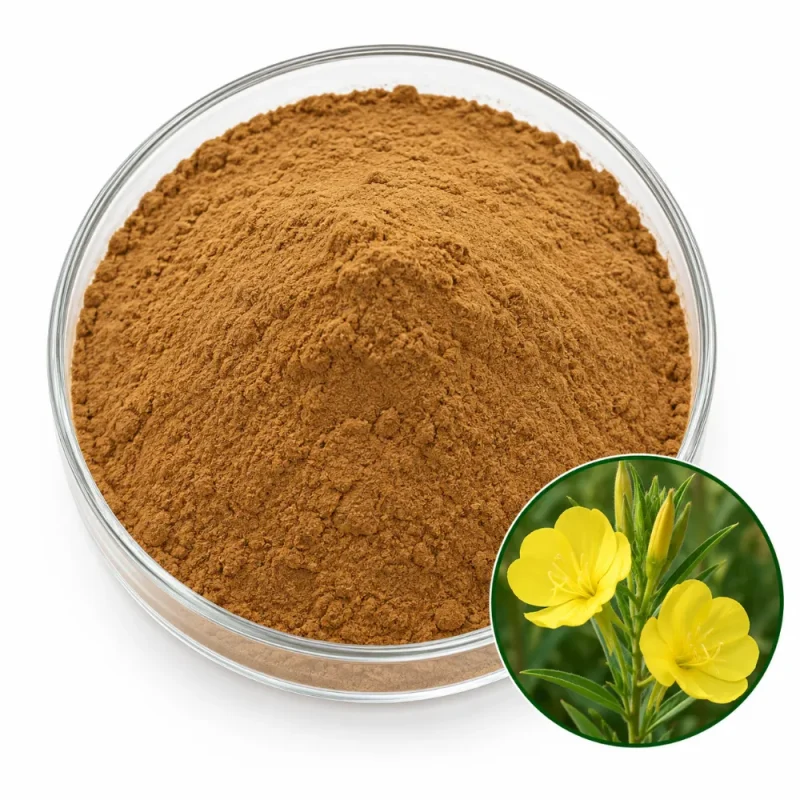
Evening Primrose Flower Extract Powder

Evening primrose flower extract starts from the flowers of Oenothera biennis, a tall biennial whose yellow blossoms open at dusk, with the seed, stem and leaf excluded. Water extraction concentrates the soluble flower fraction, and the liquor is dried into a light brown powder that disperses in water.

The extract is supplied at a 10:1 ratio with no marker percentage and is milled to 80 mesh. It is not the seed oil that evening primrose is best known for, and the flower extract carries none of the oil or its fatty acids.

Oenothera biennis Flower Source & Identity

The botanical entity is Oenothera biennis L., common evening primrose, a biennial of the Onagraceae with a rosette of leaves in year one and a tall flowering stem in year two. The part used is the flower. Seed, stem, leaf and root are not part of this ingredient.

The identity point buyers meet most often is the oil. Evening primrose seed oil, rich in gamma-linolenic acid, is the usual commercial product, and a supplier page that lists evening primrose extract without naming the part may mean oil or a seed press residue. The flower itself carries flavonoid glycosides, tannins such as oenothein B, and phenolic acids, named only as constituent families.

What 10:1 Means for Evening Primrose

A flower extract of a plant known for its seed oil needs the part to be spelled out, because the oil does not travel into a water extract. The 10:1 ratio describes how concentrated the Oenothera biennis flower extract is against the starting blossom and does not define flavonoid or tannin content. A defined flavonoid or tannin value has to come from a marker-based product. One who names species, flower and ratio can use this extract directly. No powder or standardized grade of the flower is listed beside it.

Typical Specifications

Specification ItemProduct Information
Latin NameOenothera biennis
Plant PartFlower
ProcessingWater Extraction
Common NameEvening Primrose Flower
Ingredient TypeRatio Extract
Extract Ratio10:1
AppearanceLight brown powder
Solubility / DispersibilityWater Dispersible
Quality Parameters
Moisture (LOD)≤5.0%
Total Ash≤5.0%
Particle Size80 mesh
Heavy MetalsLead ≤2 ppm · Arsenic ≤1 ppm · Cadmium ≤1 ppm · Mercury ≤0.1 ppm
MicrobiologyTPC ≤1,000 cfu/g · Yeast & Mold ≤100 cfu/g · E. coli Negative · Salmonella Negative/25 g
Shelf Life24 months in unopened original packaging, cool and dry storage

Application Areas

Flower Extract Capsules

Evening primrose flower extract is encapsulated as a dispersible light brown powder. Without the fatty seed oil, the powder is dry and free-running, unlike seed products. Fill weights are confirmed early in the run, then the finished capsule is tested for disintegration.

Tannin-Aware Tablet Blends

Evening primrose tablets use microcrystalline cellulose as filler and a disintegrant for breakup. Oenothein-type tannins add astringency and can discolor on iron, so stainless tooling is used. A film coat hides the brown tint and the dry, tannic taste.

Floral Tea-Style Mixes

Instant tea-style powders use the extract as a light, floral, mildly astringent base. Lemon, apricot and honey flavors blend well. The cup is hazy tan, and a carrier in the dry blend keeps dose uniform from one sachet to the next.

Powder Stick Premixes

Drink sticks combine the extract with berry or citrus flavors, which balance its astringency. It disperses to a hazy light brown liquid. Barrier laminate matters because flower extracts take up humidity during storage. Sticks are filled in a dry room, since flower extracts lump quickly in humid air.

Gummy Base Additions

Gummies carry the extract in peach, apricot and passion fruit flavors that echo its floral note. Add it late in the cooked base. Tannins can tighten the bite of the finished gummy, so texture is judged after the gel has set.

Formulation Notes

Evening primrose flower extract is a light brown powder with a faint, sweet, hay-like floral aroma and a dry, astringent, mildly bitter taste. In water it gives a hazy tan liquid, and petal fragments settle slowly. Tannins give a puckering finish that limits dose in clear, lightly flavored drinks.

Flower extracts attract humidity, so the powder is weighed in a dry room and the liner is closed after every draw. Store it away from heat and direct light, and compare shade with a retained sample for each new lot. Since the plant is better known for its oil, check that the certificate names the flower as the part for every shipment.

Evening primrose flower extract is checked against the retained sample for shade before each blend.

Packaging & Commercial Supply

Essencefield supports product evaluation, formulation trials, commercial orders, and ongoing ingredient supply. Packaging, storage, and shipping arrangements are determined by product characteristics, order quantity, stability requirements, and destination-market needs.

Supply ItemGeneral Information
SampleAvailable upon request for formulation, testing, and supplier evaluation
Order Quantities100 g · 1 kg · 5 kg · 25 kg · 100 kg · 500 kg · Bulk
Sample Lead TimeTypically 5–7 days after sample confirmation
Production Lead TimeTypically 15–30 days after order and specification confirmation
PackagingSuitable protective inner packaging with bags, cartons, drums, or other appropriate outer packaging
StorageStore in tightly sealed, suitable protective packaging in a cool, dry environment. Protect from moisture, heat, and direct sunlight. Specific storage conditions follow the approved product specification.
DocumentationCOA · Product Specification · TDS · SDS · Applicable declarations (as applicable)

Final order quantities, lead times, packaging, documentation, and shipping arrangements are confirmed according to the selected product and commercial requirements.

Request Ingredient Specifications & Quote

Share your target specification, application, quantity, and documentation needs. We’ll help confirm suitable options, samples, and commercial supply details.