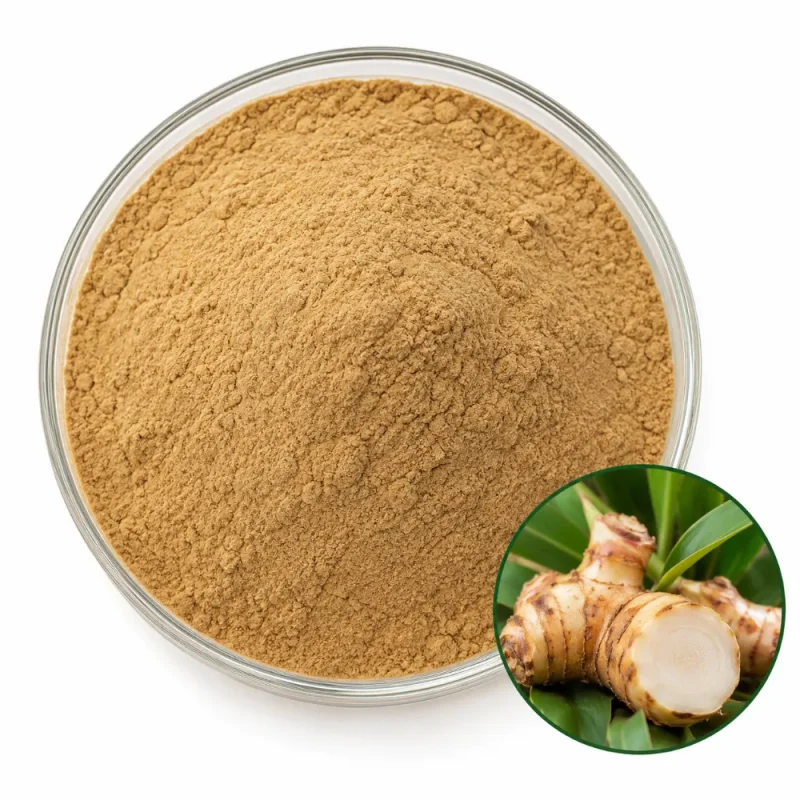
Galangal Extract 3% Polyphenols

Galangal extract takes the rhizome of Alpinia galanga, the greater galangal of Southeast Asian cooking, as its starting material, and the leaf, flower and the smaller lesser galangal (Alpinia officinarum) are not part of the starting material. Ethanol extraction takes up the polar phenolics of the rhizome, and the concentrate is dried to a light brown powder.

The single grade is 3% polyphenols by UV with the Folin-Ciocalteu method. The powder is 80 mesh and water soluble. It fits capsules, tablets and herbal drink mixes in which a mild, spice-forward rhizome fraction is the design target.

Polyphenol Standardization & Grades

Polyphenols here is a class figure, not a single compound. In greater galangal the pungent character comes from phenylpropanoid esters such as 1′-acetoxychavicol acetate, which are moderately lipophilic, while the polyphenol figure reports the polar phenolics that the extract carries: flavonoid glycosides, phenolic acids and diarylheptanoids. The botanical entity is Alpinia galanga (L.) Willd., and the extract is standardized to polyphenols because no single compound of the rhizome dominates enough to serve as a marker, and the class figure is the steadier release parameter.

The grade is a single point at 3%, so there is no grade table. A figure of 3% is modest in absolute terms, which means the powder keeps most of the rhizome’s carbohydrate matrix and a clear spice character. Galangal is also supplied as milled rhizome, the Galangal Root Powder, which has no marker figure and keeps the full pungent profile. The standardized extract is the row to use when a polyphenol figure has to appear in the specification of the galangal extract.

Polyphenol Analysis & Purity Risks

The Folin-Ciocalteu method is a color reaction in which the reagent is reduced by phenolic hydroxyl groups, and the blue product is read by UV-visible spectrophotometry against a reference phenol, most often gallic acid. The result is therefore an equivalent of that reference. The method is non-specific: ascorbic acid, some sugars and amino acids also reduce the reagent, so a figure is comparable only with another figure on the same basis and cannot be converted into an HPLC result for a named flavonoid.

For identity, an HPLC fingerprint of the rhizome is read beside the polyphenol figure. Galangin and kaempferide, the typical flavonoids of the genus, and the diarylheptanoids form a recognizable pattern, and the fingerprint helps to separate greater galangal from the lesser galangal, whose flavonol profile differs in proportion. The pungent esters sit mainly in the less polar fraction and are followed by a separate GC or HPLC run when needed.

Purity risks follow from the botanical group. Greater and lesser galangal are traded under overlapping names, and Alpinia galanga is also confused with galangal-like rhizomes of other ginger-family plants and with ginger and turmeric. The stated species, the stated rhizome part and a fingerprint protect identity better than one percentage does. A polyphenol figure cannot show pungency, so a buyer who wants the sharp, camphoraceous character should judge it by the sensory profile of the powder as well.

Sample preparation needs dilution into the working range of the curve and a reagent blank. Because the reaction is sensitive to time and temperature, samples are read in a fixed window after the alkali is added.

Raw material handling also matters. The rhizome is dug, cleaned, sliced and dried, and the volatile and ester constituents decline during slow drying and long storage. The flavonoid fraction is steadier, which is one reason the polyphenol figure is a more reliable release parameter for this spice than any pungency measure.

Typical Specifications

Specification ItemProduct Information
Latin NameAlpinia galanga
Plant PartRoot & Rhizome
ProcessingEthanol Extraction
Compound ClassPolyphenols
Common NameGalangal, Greater Galangal
Ingredient TypeStandardized Extract
Marker Compound(s)Total polyphenols
Primary Grade3% Polyphenols (UV, Folin-Ciocalteu)
AppearanceLight Brown powder
Solubility / DispersibilityWater Soluble
Quality Parameters
Moisture (LOD)≤5.0%
Total Ash≤5.0%
Particle Size80 mesh
Heavy MetalsLead ≤2 ppm · Arsenic ≤1 ppm · Cadmium ≤1 ppm · Mercury ≤0.1 ppm
MicrobiologyTPC ≤1,000 cfu/g · Yeast & Mold ≤100 cfu/g · E. coli Negative · Salmonella Negative/25 g
Shelf Life24 months in unopened original packaging, cool and dry storage

Applications by Grade

3% Grade for Standard Capsules

Galangal extract at 3% polyphenols fills two-piece capsules at a larger weight than concentrated grades. The powder is hygroscopic and slightly resinous, so fill in a dry room, use a flow agent and seal the capsules in a desiccated bottle.

3% Grade in Tablet Blends

Tablets need a dry binder and a lubricant, and a coating hides the warm, peppery taste of the rhizome. Hygroscopic, resinous powders can be sticky, so check flow and compression early and test hardness after storage.

3% Grade in Instant Herbal Drink Mixes

Instant drink mixes pair the extract with lemongrass, ginger and citrus flavors in a style close to Southeast Asian herbal drinks. The powder dissolves with a faint haze, and heat intensifies the pine-like note, so test at serving temperature.

3% Grade in Spice Blends

Dry spice blends carry the extract where galangal’s pine-like heat is wanted, in rubs and curry bases. The powder disperses quickly into hot liquids, and cooking trials set the dose against the sharpness of the finished dish.

3% Grade in Polyphenol Premixes

Premix developers include the extract with other plant powders where a measurable polyphenol level is wanted. Premixing with a flow aid keeps the hygroscopic powder moving, and uniformity is checked because the marker is a small share of the total.

3% Grade in Sachet Dilutions

A bulking carrier dilutes the extract in sachets, so the filler can weigh an accurate dose. A foil laminate with low moisture transmission keeps the powder free-flowing, because the rhizome sugars draw water in humid air.

Technical & Quality Considerations

Galangal extract is a light brown powder with a warm, resinous, peppery odor and a pungent, slightly bitter taste. It is water soluble, giving a clear to lightly cloudy brown solution. The solution darkens with heat as the phenolics oxidize, and the pungent esters, which are less polar, partly separate as a thin film or haze on standing.

Flavonoid glycosides and phenolic acids are reasonably stable at neutral to mildly acidic pH, but they chelate iron and darken, so stainless contact surfaces and low-iron fillers avoid color drift. The pungent phenylpropanoid esters hydrolyze at high pH and in prolonged heat, so alkaline buffers and long hot-fill steps soften the spice character, even though the polyphenol figure stays nearly unchanged.

Scale-up of galangal extract starts with sieving and a premix with part of the carrier, then a weight check on the first fills. The powder takes up moisture readily and cakes in humid air, so use a dry room, sealed drums and desiccant liners, and store cool and out of direct light.

Aroma and taste deserve a trial in any liquid format. A cup with more than a modest serving tastes strongly pungent, and honey, lemon and ginger blend well with the character. A taste panel on the final recipe is worth more than a calculation.

Packaging & Commercial Supply

Essencefield supports product evaluation, formulation trials, commercial orders, and ongoing ingredient supply. Packaging, storage, and shipping arrangements are determined by product characteristics, order quantity, stability requirements, and destination-market needs.

Supply ItemGeneral Information
SampleAvailable upon request for formulation, testing, and supplier evaluation
Order Quantities100 g · 1 kg · 5 kg · 25 kg · 100 kg · 500 kg · Bulk
Sample Lead TimeTypically 5–7 days after sample confirmation
Production Lead TimeTypically 15–30 days after order and specification confirmation
PackagingSuitable protective inner packaging with bags, cartons, drums, or other appropriate outer packaging
StorageStore in tightly sealed, suitable protective packaging in a cool, dry environment. Protect from moisture, heat, and direct sunlight. Specific storage conditions follow the approved product specification.
DocumentationCOA · Product Specification · TDS · SDS · Applicable declarations (as applicable)

Final order quantities, lead times, packaging, documentation, and shipping arrangements are confirmed according to the selected product and commercial requirements.

Request Ingredient Specifications & Quote

Share your target specification, application, quantity, and documentation needs. We’ll help confirm suitable options, samples, and commercial supply details.