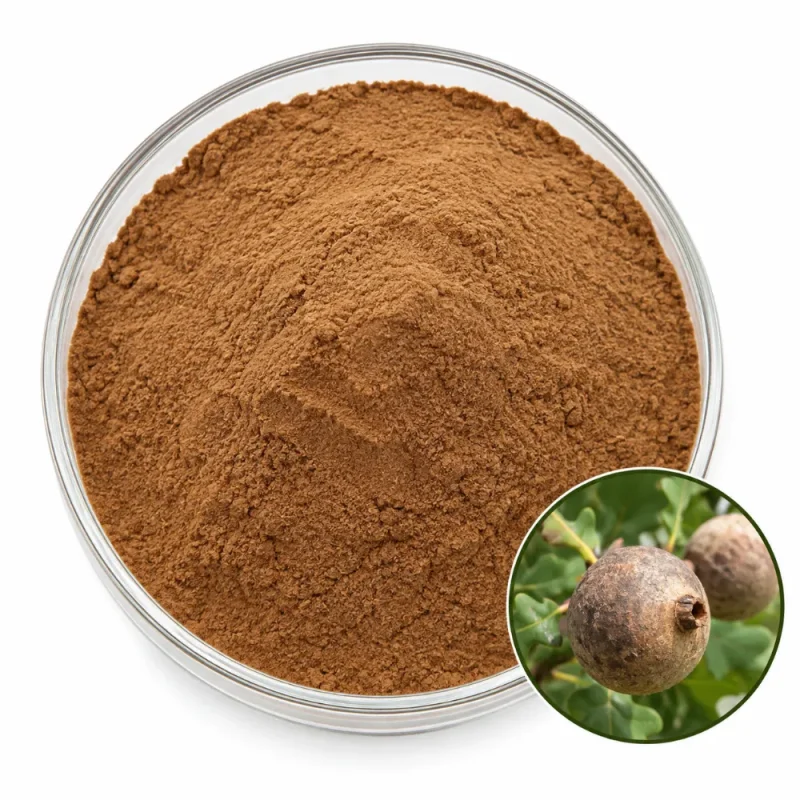
Gallnut Extract 70–90% Tannins

Gallnut extract is prepared from the gall of Quercus infectoria, the oak gall of the eastern Mediterranean, a hard, round growth that forms on young twigs when a gall wasp lays its eggs, and the leaf, acorn and bark are not part of the starting material. Ethanol extraction takes up the hydrolyzable tannins of the gall, and the concentrate is dried to a light brown powder.

Total tannins are measured by UV, with a primary grade of 90% and a lower grade of 70%. The powder is 80 mesh and water soluble. The 90% grade fits capsules and tablets that need a small fill, while the 70% grade fits technical blends and powders in which the gall matrix is wanted.

Tannin Standardization & Grades

Gallnut tannin is a gallotannin, a family of glucose molecules esterified with several gallic acid units, and it is the chemistry behind the commercial product known as tannic acid. The gall of Quercus infectoria is among the richest natural sources of it. The botanical entity is Quercus infectoria G.Olivier, and the extract is standardized to tannins because they are the defining and by far the largest fraction of the gall, in contrast to the small amounts of free gallic acid and ellagic acid that accompany them.

GradeAssay & MethodWhere It Fits
70% TanninsUVTechnical blends, higher inclusion
90% TanninsUVCapsules and tablets, small fill weight

Grade choice follows dose and fill weight. The 90% grade carries nearly one and a third times the tannin load of the 70% grade per gram, so a capsule reaches its target with less powder, while the 70% grade is bulkier, carries more sugars and free phenolic acids and dissolves more slowly. Gallnut is offered additionally as a 10:1 ratio extract that carries no marker figure, the Gallnut Extract Powder. The standardized extract is the row to use when a tannin figure has to appear in the specification of the gallnut extract.

Tannin Analysis & Purity Risks

A UV assay for tannins uses a color reaction in which the reagent is reduced by phenolic hydroxyl groups, and the blue product is read by spectrophotometry against a reference such as gallic acid or tannic acid. The result is an equivalent. Pharmacopoeial tannin methods add a hide-powder step that separates true tannins, which bind protein, from other phenolics that do not, and the two approaches can give noticeably different numbers on the same powder.

For identity, an HPLC fingerprint is read beside the UV total. Gallic acid appears as the free-acid peak, and the gallotannin series appears as a cluster of later-eluting peaks with increasing numbers of galloyl units. The proportion of free gallic acid shows how much of the tannin has hydrolyzed, which is a useful freshness signal.

Purity risks follow from the botanical group. Aleppo gall from Quercus infectoria and Chinese gall from Rhus chinensis are different growths on different trees, and both are sold as gallnut. Their tannins are both gallotannins, but their gallic acid content, color and trade grades differ. The stated species and the stated gall part therefore protect identity better than one percentage does. Gall is also a hard, dense material that can carry insect residue and soil, which is why cleaning before extraction matters.

Sample preparation uses an aqueous or aqueous-alcohol extraction at room temperature, followed by dilution into the working range of the curve. Tannins oxidize and hydrolyze in solution, so samples are analyzed promptly and kept slightly acidic.

Raw material handling also matters. Galls are collected before the wasp emerges, because exit holes indicate lower tannin content, and are dried and stored dry. Damp storage allows enzymatic hydrolysis and mold, and a poorly stored lot gives a darker extract with more free gallic acid.

Typical Specifications

Specification ItemProduct Information
Latin NameQuercus infectoria
Plant PartOther
ProcessingEthanol Extraction
Compound ClassPolyphenols
Common NameGallnut, Oak Gall, Aleppo Gall
Ingredient TypeStandardized Extract
Marker Compound(s)Tannins (gallotannins of the gall)
Primary Grade90% Tannins (UV)
Available Grades70% · 90% Tannins (UV)
AppearanceLight Brown powder
Solubility / DispersibilityWater Soluble
Quality Parameters
Moisture (LOD)≤5.0%
Total Ash≤5.0%
Particle Size80 mesh
Heavy MetalsLead ≤2 ppm · Arsenic ≤1 ppm · Cadmium ≤1 ppm · Mercury ≤0.1 ppm
MicrobiologyTPC ≤1,000 cfu/g · Yeast & Mold ≤100 cfu/g · E. coli Negative · Salmonella Negative/25 g
Shelf Life24 months in unopened original packaging, cool and dry storage

Applications by Grade

90% Grade for Compact Capsules

The 90% grade of gallnut extract reaches a tannin target in a small fill, which suits compact capsules. The powder is hygroscopic and intensely astringent, so fill in a dry room and keep the capsules in a desiccated bottle.

70% Grade in Technical Powder Blends

The 70% grade is bulky enough to blend at a practical gram weight in powder premixes. Tannins bind proteins and metals, so test the blend with its other ingredients, since a tannin-rich powder can precipitate protein and color iron-containing minerals.

90% Grade in Tablet Blends

Tablets of the 90% grade need a dry binder and a glidant, because tannin-rich powders compact into dark, hard tablets that dissolve slowly. A film coat covers the dry, puckering taste, and hardness should be checked after storage.

70% Grade in Sachet Premixes

Sachets of the 70% grade dilute the extract with a bulking carrier so the filler can weigh an accurate dose. Because tannin-rich extracts cake when they take up water, a foil laminate with low moisture transmission is used to keep the powder free-flowing.

70% Grade in Stick-Pack Drink Powders

Stick packs of the 70% grade give a brown, astringent cup that needs sweetener, acid or milk to round it. The extract dissolves readily in cool water, and a short stir is enough to reach a uniform serving.

90% Grade in Stepwise Dilutions

When the dose is small, the 90% grade is diluted stepwise with a bulking carrier before it reaches the filler, and the blend is sampled once. A concentrated tannin powder at low inclusion segregates easily, so verify uniformity on a test batch.

Technical & Quality Considerations

Gallnut extract is a light brown to tan powder with a faint, slightly sweet, woody odor and a strongly astringent, puckering taste. It is water soluble, giving a clear to slightly hazy brown solution that darkens on standing as the tannin oxidizes. The solution is acidic, because gallotannin and the free gallic acid it contains lower the pH of the medium.

Gallotannins are reactive. They bind proteins, forming haze or precipitate in drinks that contain milk or plant proteins, and they give blue-black complexes with iron salts, which is the basis of traditional iron-gall ink. Contact with iron-containing minerals or stainless steel that is not passivated can therefore discolor the powder. Strong acid, alkali and heat hydrolyze the ester bonds, releasing gallic acid and glucose, so processing conditions change the balance of the tannin and its breakdown products.

Scale-up starts with sieving the hygroscopic powder and premixing it with part of the carrier, then a weight check on the first fills. Drums are stored sealed and cool with desiccant liners, and a closed charging system limits the fine, astringent dust. Operators should use masks, since inhaled tannin dust irritates the airway.

Formulation compatibility is the main constraint. Protein, gelatin, iron and some alkaloids interact with tannins, so a pilot batch at the target pH shows early whether the combination is sound.

Packaging & Commercial Supply

Essencefield supports product evaluation, formulation trials, commercial orders, and ongoing ingredient supply. Packaging, storage, and shipping arrangements are determined by product characteristics, order quantity, stability requirements, and destination-market needs.

Supply ItemGeneral Information
SampleAvailable upon request for formulation, testing, and supplier evaluation
Order Quantities100 g · 1 kg · 5 kg · 25 kg · 100 kg · 500 kg · Bulk
Sample Lead TimeTypically 5–7 days after sample confirmation
Production Lead TimeTypically 15–30 days after order and specification confirmation
PackagingSuitable protective inner packaging with bags, cartons, drums, or other appropriate outer packaging
StorageStore in tightly sealed, suitable protective packaging in a cool, dry environment. Protect from moisture, heat, and direct sunlight. Specific storage conditions follow the approved product specification.
DocumentationCOA · Product Specification · TDS · SDS · Applicable declarations (as applicable)

Final order quantities, lead times, packaging, documentation, and shipping arrangements are confirmed according to the selected product and commercial requirements.

Request Ingredient Specifications & Quote

Share your target specification, application, quantity, and documentation needs. We’ll help confirm suitable options, samples, and commercial supply details.